Cost of Transcription Services Explained
tl;dr: Transcription costs range from $0.10 per minute for AI to over $1.50 per minute for humans. The final price depends on audio quality, turnaround time, and the number of speakers. AI is cheap and fast for clear audio, while human transcribers are best for complex files needing high accuracy.
So, you've got audio and you need it turned into text. But the million-dollar question—or hopefully, the much-less-than-a-million-dollar question—is: what’s it going to cost?
The short answer is you can expect to pay anywhere from $0.10 per audio minute for a quick AI-powered transcript to around $1.50 per minute for a human expert to handle it. But the final price tag really comes down to a few key things, like how clear your audio is, how fast you need it back, and the specific style of transcript you're after.
This guide will walk you through the benchmarks and variables, so you know exactly what to expect.
Your Quick Guide to Transcription Costs
Before we dig into the nitty-gritty, let's look at a simple side-by-side comparison. It's the best way to see how AI and human transcription services stack up on price and understand where your money goes.
The infographic below gives you a nice visual summary of these cost benchmarks.
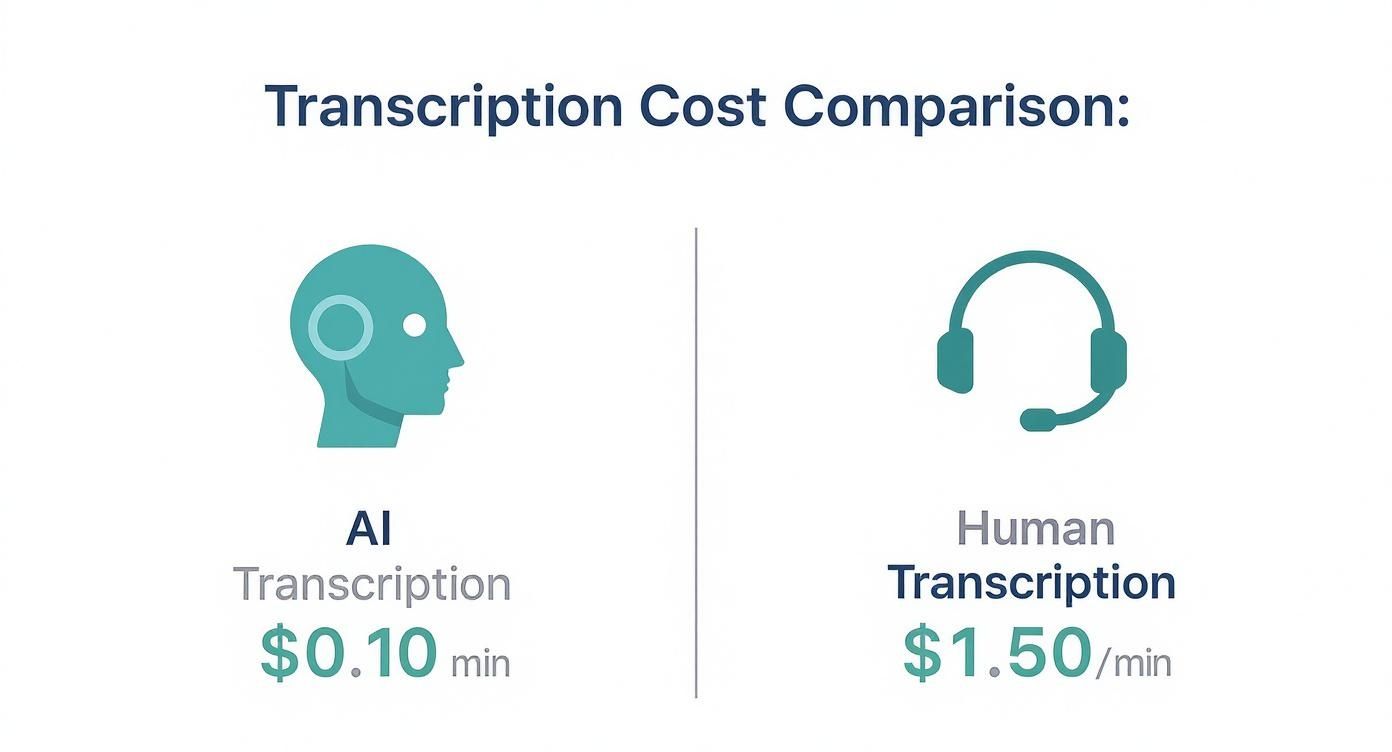
As you can see, automated transcripts can be incredibly affordable, starting as low as $0.10 per minute. On the other end, dedicated human services are closer to that $1.50 mark, which reflects the extra care, precision, and human brainpower you get.
To make it even clearer, here’s a table that breaks down the typical costs.
Transcription Cost Comparison AI vs Human
This table summarizes the most common pricing models and what you can generally expect to pay for both automated and manual transcription.
| Service Type | Common Pricing Model | Typical Cost Range (Per Audio Minute) | Best For |
|---|---|---|---|
| AI Transcription | Subscription or pay-as-you-go | $0.05–$0.20 | High-volume projects with clear audio |
| Human Transcription | Per-minute or per-hour rate | $1.00–$3.00 | Complex audio, high-stakes accuracy |
The takeaway here is pretty straightforward: automated and human services are built for different jobs, and their pricing reflects that. Your choice really depends on what you value most—blazing-fast speed and volume, or absolute, guaranteed accuracy.
So, When Do You Choose One Over the Other?
Think about it this way: AI transcription is like a factory assembly line. It’s incredibly fast and cost-effective, churning out transcripts in minutes, but you might find a few rough edges that need polishing. A human transcriber, on the other hand, is like a craftsman who meticulously refines every detail, ensuring the final product is perfect.
Here’s how that plays out in the real world:
- Got hours of clear audio? If you have a massive batch of recordings from a quiet conference room, an AI platform is your best friend. The per-minute rates are unbeatable.
- Need it to be perfect? For legal depositions, medical records, or a published interview, every single word matters. This is where you invest in human precision, even if it costs more upfront.
- Want the best of both? A popular strategy is to run your audio through an AI for a quick first draft, then have a human editor polish it up. This hybrid approach can save you a good chunk of change while still delivering high accuracy.
- Need a predictable budget? Many AI services offer flat-rate monthly plans for unlimited minutes, which is fantastic for businesses that need to keep costs under control.
What Drives the Price Up or Down?
Several factors can make that per-minute rate swing one way or the other. It’s not just a simple choice between AI versus human.
Things like background noise, multiple people talking over each other, or thick accents all add complexity, which adds to the cost. The same goes for rush jobs or needing a "verbatim" transcript that includes every single "um," "ah," and stutter.
Here are the biggest cost drivers:
- Audio Clarity: Clean, crisp recordings will always cost less to transcribe.
- Turnaround Time: Need it back yesterday? A same-day service can easily come with a 50% surcharge.
- Transcript Style: A "clean read" (edited for readability) is almost always cheaper than a strict verbatim transcript.
- Speaker Count: The more voices you have, the more work it takes to accurately label who said what.
What's Next?
Keeping these benchmarks in mind is the best way to avoid sticker shock when you start getting quotes. And if you're looking for more tips, you might be interested in our full collection of best practices in transcription over in the WhisperAI Guides.
The next sections will dive deeper into each of these variables and show you how to find the perfect balance between cost and quality for your project.
The Two Worlds of Transcription: AI vs. Human
The single biggest factor that dictates transcription cost is simple: who—or what—is doing the transcribing. Your choice boils down to two distinct paths: a machine-driven AI or a skilled human professional. Each has its strengths, and understanding them is key to making a smart investment.
AI-powered transcription uses sophisticated machine learning models to convert your audio into text, often in just a few minutes, and at a fraction of the cost of human services.
AI Transcription: Fast, Affordable, and Scalable
Think of AI transcription as the workhorse. It’s built for speed and volume, making it a fantastic tool for getting a solid first draft quickly and affordably.
- Speed: AI is incredibly fast. Most platforms can process an hour of audio in just a few minutes, delivering a finished transcript faster than you can brew a pot of coffee.
- Cost: You can expect to pay between $0.05 to $0.20 per audio minute. It’s incredibly budget-friendly, especially for large volumes of content.
- Accuracy: For clean audio with a single, clear speaker, accuracy can hover around 90%–95%.
- Best For: High-volume projects, internal meeting notes, academic research, or first-pass drafts where perfection isn't the immediate goal.
For example, a marketer who just finished recording a webinar can get a usable draft of the entire session in less than ten minutes. Well-trained AI models from services like LunaBloom AI are also surprisingly good at identifying different speakers and handling multiple languages.
Human Transcription: Precision, Nuance, and Context
When accuracy is non-negotiable, you bring in a human expert. They provide a level of nuance, context, and understanding that machines just can’t match yet.
- Precision: Human transcribers routinely achieve 99%+ accuracy, which is the gold standard for legal, medical, or academic fields where every word counts.
- Cost: That expertise comes at a premium, typically ranging from $1.00 to $3.00 per audio minute.
- Turnaround: Standard delivery is usually within 24 to 72 hours, though most services offer rush options for a higher fee.
- Best For: Complex audio with background noise, heavy accents, multiple overlapping speakers, or specialized industry terminology.
A human transcriber catches the subtle context, emotion, and industry-specific jargon that an AI might misinterpret. You’re paying for fewer errors, which saves you hours of cleanup on the back end.
Humans bring a layer of contextual understanding that AI, for all its power, cannot fully replicate.
Comparing AI and Human Transcription at a Glance
| Feature | AI Transcription | Human Transcription |
|---|---|---|
| Typical Cost per Minute | $0.05–$0.20 | $1.00–$3.00 |
| Accuracy | 90%–95% | 99%+ |
| Turnaround Time | Minutes | Hours to Days |
| Ideal Projects | Clear, high-volume audio | Complex, high-stakes audio |
The market reflects this split. As of 2024, the global AI transcription market is already valued at $4.5 billion and is projected to hit $19.2 billion by 2034. That’s a 15.6% CAGR, fueled by businesses that need scalable transcription, speaker identification, and multilingual support.
But remember, the sticker price isn't the whole story. You also have to think about things like data security, software integrations, and the final output format you need. Ultimately, understanding these trade-offs helps you decide when a cheap and fast AI draft is good enough, and when you absolutely need an expert's touch.
Real-World Scenarios
Let's look at how this plays out in practice:
- An early-stage startup is conducting one-on-one user interviews with clear audio. Using an AI service at $0.10 per minute, they transcribe 60 minutes of interviews for just $6 and get the text back in under ten minutes.
- A legal team needs a transcript of a courtroom deposition with background noise and overlapping speakers. They opt for a human transcriptionist at $2.00 per minute to guarantee 99% accuracy. The cost for a one-hour file is $120.
- A podcast producer runs their episode through an AI service for $0.15 per minute. They then spend about an hour cleaning up the draft. This hybrid approach cuts their total transcription costs by 40% compared to going straight to a human service.
This hybrid model is becoming incredibly popular. It often results in 98% accuracy (after human editing) at roughly half the cost of a fully human-transcribed file. Knowing how the cost shifts based on your needs is key to making a smart decision.
Key Trade-offs to Consider
When you're making a choice, it usually comes down to a few core questions:
- Budget vs. Accuracy: AI can save you up to 90% on upfront costs, but you'll likely need to budget time for cleanup.
- Turnaround Time: AI delivers in minutes. Humans need hours or even days. How urgent is your deadline?
- Audio Complexity: Recordings filled with jargon, heavy accents, or poor audio quality almost always require human expertise.
- Data Compliance: For sensitive content, many human services offer NDA coverage and more robust, secure handling protocols.
In one survey, 68% of project managers said that cost predictability was their number one concern when choosing between AI and human options. By weighing these factors, you can find the right balance for your project and your budget.
Next, we’ll dig even deeper into the specific factors that can drive these costs up or down.
What Really Drives Your Transcription Bill?
Ever get two completely different quotes for the same audio file and wonder what's going on? The final price of a transcript is rarely a simple, flat rate. Once you've decided between AI and a human service, a handful of key factors can send your costs climbing.
Knowing what these variables are is the secret to setting a realistic budget and avoiding any nasty surprises. Think of it like hiring a contractor to paint your house—the base price is just a starting point. The real cost depends on the prep work, how fast you need it done, and whether the job requires a specialist.
Audio Quality: The Cleanliness Factor
This is the big one. After your choice of AI vs. human, nothing impacts your price more than audio quality. Crisp, clear audio from a good mic in a quiet room? That's the dream, and it's the cheapest to transcribe. Poor audio, on the other hand, is the fastest way to blow your budget.
Why does it matter so much? Because bad audio is a time-sink. Anyone trying to decipher it—human or machine—has to strain to separate words from background noise, which makes the whole process slower and more error-prone.
Common audio problems that will cost you more include:
- Background Noise: Coffee shop chatter, street traffic, or a humming AC unit can easily swallow words.
- Muffled Speakers: Voices that are too far from the mic or just generally unclear demand a lot more focus.
- Heavy Accents: Strong accents can be tricky for both AI and human transcribers who aren't familiar with them.
- Bad Mics: Recording in a big, echoey room with a built-in laptop mic is a recipe for a tough (and expensive) transcription job.
Most services will tack on a surcharge for messy audio, often anywhere from $0.25 to $1.00 extra per minute. That fee covers the extra time a human needs to keep rewinding and correcting. Even with AI, bad audio crushes accuracy, forcing you to spend more time cleaning it up yourself. To see just how much these things matter for automated tools, check out our deep dive on what affects AI transcription accuracy in our detailed article.
Turnaround Time: The Speed Premium
How fast do you need that transcript? Your answer to this question has a direct line to your wallet. For human services, a standard turnaround is usually somewhere between 24 and 72 hours. If you can wait, you'll pay the base rate.
But if you’re up against a tight deadline, you’ll pay a premium for a rush job. This is because the provider has to push your file to the front of the queue, often pulling transcribers in to work outside of normal hours.
A rush order is basically buying a VIP pass to skip the line. That convenience comes at a price—expect to pay anywhere from 25% to 100% more for expedited delivery.
For example, a standard $1.50 per-minute rate can quickly jump to $2.25 per minute for a 12-hour turnaround, or even $3.00 per minute if you need it back the same day. If your project isn't time-sensitive, just opting for standard delivery is one of the easiest ways to keep costs down.
How Common Factors Impact Your Transcription Bill
To put it all together, here’s a quick breakdown of the most common cost drivers and what kind of price hike you can generally expect for each.
| Cost Factor | Description | Typical Price Increase | Why It Costs More |
|---|---|---|---|
| Poor Audio Quality | Background noise, muffled speakers, echo, or poor mics. | +$0.25 to +$1.00 / minute | It takes significantly longer to decipher unclear words, requiring repeated listening. |
| Rush Turnaround | Needing the transcript back in under 24 hours. | +25% to +100% | The service must prioritize your job, often requiring overtime or reassigning staff. |
| Multiple Speakers | Audio with 3 or more distinct speakers. | +$0.25 / minute (or more) | Identifying and labeling each speaker adds a layer of complexity and time. |
| Full Verbatim | Capturing every "um," "uh," stutter, and false start. | +$0.25 to +$0.50 / minute | This meticulous style demands more intense focus and typing from the transcriber. |
| Specialized Terms | Content with dense legal, medical, or technical jargon. | +$0.25 to +$1.00 / minute | It requires a transcriber with subject-matter expertise to ensure accuracy. |
As you can see, these extras can add up fast. A file that seems simple on the surface could easily end up costing double the initial estimate if it's full of jargon, has multiple speakers, and needs to be done by tomorrow.
Number of Speakers: The More Voices, The More Work
Transcribing one person speaking is simple. Transcribing a six-person focus group with everyone talking over each other? That's a different beast entirely. The number of speakers in your audio is a huge factor in the final cost.
Every new voice adds another layer of work. The transcriber has to:
- Identify each unique speaker.
- Tell them apart, especially if they sound similar.
- Label who is speaking correctly throughout the file.
- Untangle cross-talk, where people are speaking at the same time.
Because of that extra effort, nearly all services charge more for multi-speaker files. A common approach is to have one price for 1-2 speakers, then add a surcharge for three or more. That extra fee often starts around $0.25 per audio minute.
Verbatim vs. Clean Read: The Style Surcharge
Not all transcripts are created equal. The style you need directly affects the price. The two most common options are verbatim and clean read.
Verbatim Transcription: This is the "everything but the kitchen sink" style. It captures every single word exactly as spoken, including all the filler words ("um," "uh," "you know"), stutters, and false starts. It even includes non-verbal sounds like laughter. This is the most time-consuming and expensive option, usually reserved for legal cases or deep research.
Clean Read (or Intelligent Verbatim): This is the go-to for most people. The transcriber lightly edits the text for clarity, removing all the filler words and stutters that make sentences clunky. You get a clean, readable document that captures the core message without the fluff.
Since verbatim work requires much more intensive listening and typing, it usually costs $0.25 to $0.50 more per minute than a clean read. For most business, content, or academic needs, a clean read is all you need—and it's much friendlier to your budget.
Specialized Terminology: The Expertise Fee
Finally, what are people talking about in your audio? If it's packed with complex, industry-specific language—think legal depositions, medical reports, or technical deep-dives—it needs a transcriber who knows the lingo.
A generalist would stumble over that kind of jargon, filling your transcript with mistakes. Services that handle specialized content employ professionals who actually have a background in those fields. That expertise costs more. You should expect to pay a premium for content in areas like:
- Legal
- Medical
- Technical or Engineering
- Financial
- Academic Research
This "expertise fee" can add anywhere from $0.25 to over $1.00 per minute to the bill. It's a necessary investment, though, because it's the only way to guarantee your transcript will be accurate enough to be useful.
Navigating Industry-Specific Transcription Prices
Not all transcription work is created equal, and neither is the price tag. Transcribing a casual two-person podcast is a completely different beast than a multi-speaker legal deposition packed with objections and technical jargon.
Think of it like hiring a contractor. You could get a general handyman for a simple job, but you’d call a licensed master electrician for a full-scale rewiring project. Specialized fields demand specialized transcribers, and that expertise naturally costs more. Getting a handle on these industry differences is the key to setting a realistic budget and choosing a service that actually fits your needs.
Legal Transcription Costs
In the legal world, precision isn't just a goal—it's a requirement. Every single word in a court hearing, deposition, or client interview carries enormous weight. There is absolutely zero room for error, and this high-stakes environment is a major driver of transcription costs.
Legal transcription is far more than just typing what’s said. It requires:
- Certified Professionals: Most legal work requires certified transcribers who are fluent in legal terminology and strict formatting protocols.
- Strict Verbatim Style: Transcripts often need to be strict verbatim, which means capturing every "um," stutter, and awkward pause. These moments can be legally significant.
- Complex Formatting: Legal documents follow rigid rules for line numbering, timestamps, and speaker identification.
Because of this intense level of detail, expect legal transcription to run anywhere from $2.00 to $5.00 or more per audio minute. The premium price reflects the transcriber's specialized training, the meticulous work involved, and the legal liability on the line. For a deeper dive, check out our comprehensive guide to legal transcription.
Medical Transcription Prices
Just like the legal field, medicine is built on a foundation of accuracy and confidentiality. A single mistake in a patient’s medical record can have life-altering consequences, making medical transcription another premium-priced service.
The biggest cost drivers here aren't just the complex terminology but also the strict compliance mandates. HIPAA (Health Insurance Portability and Accountability Act) compliance is non-negotiable. Providers must have rock-solid, secure systems to protect sensitive patient information.
Medical transcribers have to be fluent in a vast and complex vocabulary, from pharmacology to surgical procedures. This expertise is critical for preventing errors and ensuring every document is clinically accurate. The need is so great that the global medical transcription market was valued at around USD 6.58 billion in 2025, with hospitals leading the charge. You can explore the full research on the medical transcription market to understand the factors behind this growth.
Given the necessary expertise and security protocols, medical transcription rates typically land between $1.50 and $4.00 per audio minute.
Academic and Research Transcription
Transcription for academic purposes serves a different function, but accuracy is still paramount. Researchers rely on faithful transcripts of interviews, lectures, and focus groups to analyze their qualitative data. While it might not be a life-or-death situation, the integrity of their entire study is on the line.
Costs in this area can vary quite a bit. A simple one-on-one interview with crystal-clear audio might cost around $1.25 to $2.00 per minute for a human transcriber. However, prices quickly climb when you introduce common academic scenarios:
- Multiple Speakers: A focus group with people talking over each other is exponentially harder to transcribe accurately.
- Technical Jargon: Every field has its own dense, subject-specific language.
- Poor Audio Quality: Interviews recorded in noisy cafes or public spaces are a transcriber’s nightmare.
The demand is so high that some institutions have even built their own automated transcription services to handle the massive volume of research audio.
Media and Entertainment Transcription
Podcasters, YouTubers, and filmmakers need transcripts for a completely different set of reasons: accessibility (like captions), SEO, and turning audio into blog posts or social media content. Here, the focus is usually on readability and speed, not a word-for-word, strict verbatim record.
This is where AI transcription really comes into its own. An automated service can quickly generate a clean, time-stamped transcript for video captions (an SRT file) or a blog-ready version of a podcast episode. For this reason, media transcription is often the most budget-friendly, with prices ranging from $0.10 per minute for AI up to $1.50 per minute for a human-polished clean read. It all comes down to whether a good-enough AI draft will do the trick or if you need a human to make it perfect for your audience.
How to Lower Your Transcription Costs
Getting accurate transcripts doesn’t have to drain your budget. While plenty of factors can drive up the cost of transcription services, a few smart moves can slash your bill without touching the quality. The trick is to be proactive and make choices that cut down the work for your transcription provider.
With just a little planning, you can get way more bang for your buck. These practical tips will help you make savvy, cost-effective decisions on your next project.
Start with High-Quality Audio
This is the big one. The single most effective way to lower your costs is to provide the cleanest audio you possibly can. Bad audio is the #1 reason for extra charges because it forces both humans and AI to work overtime just to figure out what’s being said.
Think of it this way: transcribing clear audio is like reading a perfectly typed page. Messy audio is like trying to decipher a doctor's handwriting. One takes a lot more time and effort.
To sidestep those extra fees, focus on these simple steps before you ever hit record:
- Use a decent microphone. Anything external is almost always better than your laptop's built-in mic.
- Find a quiet spot. Ditch the coffee shop, open-plan office, or any room with background noise and echo.
- Speak clearly and get close to the mic. This makes sure your voice is the star of the show.
Taking these steps can help you dodge surcharges that often run from $0.25 to $1.00 per minute, saving a huge chunk on your final bill.
Embrace the Hybrid Approach
You don't have to go all-in on AI or humans. A hugely popular and effective strategy is the hybrid approach: let an AI do the first pass, then have a human editor clean it up.
It’s a simple two-step process:
- Run your audio through a low-cost AI transcription service for an instant, machine-generated draft.
- Hire a human proofreader to review that AI transcript, fixing any mistakes in spelling, grammar, or speaker labels.
This method is almost always cheaper than a full human transcription from scratch. You get the speed and low cost of AI paired with the accuracy and nuance of a human expert, often for 40-60% less than a traditional service.
Choose Your Features Wisely
Not every project needs the full, deluxe treatment. You can keep costs down just by being selective about the features you actually need.
For instance, do you really need a strict verbatim transcript that catches every single "um," "ah," and stutter? For most business meetings or interviews, a clean read transcript is more than enough—and it costs less. That one decision can save you $0.25 to $0.50 per minute.
The same goes for turnaround time. Unless you’re on a fire-drill deadline, stick with standard delivery. Rush jobs can easily double the price. If you can wait 24-48 hours, you'll pay the standard rate and avoid those painful rush fees.
"The cheapest transcript is the one you plan for. By optimizing audio quality and choosing only the features you truly need, you can cut your costs dramatically before you even submit the file."
Batch Your Projects for Volume Discounts
If you have a steady stream of files to transcribe, don't just send them in one at a time. Many services offer volume discounts for bigger projects or repeat customers.
Instead of submitting five separate 10-minute files, ask your provider if they offer a better rate for bundling them into a single 50-minute batch. Businesses and creators with ongoing needs can often lock in subscription plans or bulk-minute packages that bring the per-minute cost way down. This turns a variable expense into a predictable one, making budgeting a whole lot easier.
How to Choose the Right Transcription Service
The cheapest option isn't always the right one, and the most expensive is often overkill. Once you understand the factors driving transcription costs, you can connect the dots and find the perfect fit. This is all about hitting the sweet spot between your budget, accuracy needs, and security requirements.
Making the right choice really boils down to a simple evaluation. Before you sign up, just run your project through these four key questions.
Evaluate Your Core Needs
Start by defining what really matters for this specific project. Your answers will immediately tell you whether you should be looking at AI or human-powered services.
- Your Budget: Are you working with a tight budget where every dollar counts? If so, a solid AI service is your best starting point. But if precision is worth paying for, a human service is the better investment.
- Required Accuracy: Is a 90% accurate draft good enough, or do you need a flawless 99%+ transcript? Internal notes can handle a few mistakes; legal or medical documents cannot.
- Your Deadline: Do you need this transcript back in minutes, or can you wait a day or two? AI delivers nearly instant results, while human services need a bit more time.
- Content Sensitivity: Are you transcribing a public podcast or a confidential board meeting? The level of security you need will steer your decision.
Thinking through these points helps you look past the simple per-minute rate and focus on what actually delivers value for you.
When to Choose AI Transcription
For a ton of common tasks, a simple AI service is more than enough—and it's by far the smartest financial choice.
An AI-powered tool is your go-to when speed, volume, and cost are top of mind. It’s perfect for tasks where a good, usable draft is the main goal.
Consider using AI transcription for:
- Internal Meeting Notes: Quickly pull out action items and key discussion points.
- First Drafts of Content: Get a fast text version of a webinar to repurpose into a blog post.
- Student Lecture Notes: Transcribe hours of lectures to make them searchable for studying.
- Personal Voice Memos: Turn your spoken thoughts into organized text you can actually use.
In these cases, a few minor errors are a completely acceptable trade-off for huge savings in time and money.
When to Invest in Human Transcription
Then there are the times when investing in a premium human service is the only responsible move. If your project involves high stakes, tricky audio, or sensitive information, human expertise is non-negotiable.
The U.S. transcription market was valued at around USD 30.42 billion in 2024, and human services are a huge part of that. This is driven by the need for high-accuracy, confidential transcription in fields like healthcare and law, where compliance is critical and nuance is everything.
You should always opt for human transcription when dealing with:
- Legal Depositions or Court Hearings: Where every single word can impact a case's outcome.
- Medical Dictation and Patient Records: Accuracy is non-negotiable for patient safety.
- Market Research Focus Groups: With multiple people talking over each other and subtle feedback.
- High-Production Media: For final video captions or published interviews where quality reflects directly on your brand.
Security and Integration for Businesses
For businesses, the decision goes way beyond just accuracy and cost. You also have to think about security protocols and how a service fits into your workflow. As you compare options, it's crucial to review a service's pricing structure to see if they offer the enterprise-level features you need.
A few key business considerations include:
- Confidentiality: Does the provider offer non-disclosure agreements (NDAs)?
- Security Protocols: Look for robust data protection, like 256-bit encryption and SOC 2 compliance.
- Integration Capabilities: Can the service connect with the tools your team already uses?
Choosing the right partner means finding a provider that protects your data while fitting seamlessly into how your team works. By weighing all these factors, you can confidently pick a service that delivers both quality and peace of mind.
Frequently Asked Questions
Got a few lingering questions about how transcription pricing works? We’ve put together some quick, straightforward answers to the most common queries we hear. This should clear up any final details so you can make a decision you feel good about.
How Is the Cost of Transcription Services Calculated?
Most services build their pricing around a per-audio-minute or per-audio-hour rate. It’s pretty simple: they just multiply that base rate by the length of your recording to get a starting number.
But that’s not always the final price. If your file requires extra effort, you’ll likely see additional fees tacked on. These surcharges are common for things like poor audio quality, files with lots of different speakers, rush delivery, or content that’s dense with medical or legal terms.
Is AI Transcription Good Enough to Replace Humans?
That really comes down to what you need it for. If you've got a clean, single-speaker recording—say, a solo podcast or a university lecture—today’s AI can deliver over 95% accuracy. For straightforward jobs like that, it's often more than good enough. It’s fast, incredibly affordable, and efficient.
On the other hand, for audio with a ton of background noise, heavy accents, people talking over each other, or specialized jargon, humans still have a clear edge in accuracy. A smart, cost-effective strategy many people use is a hybrid approach: get a cheap first draft from an AI, then have a human editor give it a final polish.
What Is Verbatim vs. Clean Read Transcription?
These are two different transcription styles that dictate how the final text looks and reads. They can also impact the cost.
Verbatim Transcription: This is the "warts and all" version. It captures every single sound exactly as it was spoken—we’re talking filler words ('um,' 'uh'), false starts, stutters, and even things like laughter or a cough. It’s a highly detailed style that costs more and is typically reserved for legal cases or deep academic research.
Clean Read Transcription: Sometimes called "intelligent verbatim," this style is lightly edited to be as readable as possible. The transcriber strips out all the stutters and filler words, giving you a polished, clean document that’s easy to skim. This is the go-to standard for most business, media, and content creation needs.
How Does Audio Quality Affect Transcription Price?
Bad audio is one of the single biggest culprits behind a surprisingly high transcription bill. When a recording is fuzzy, muffled, or full of background noise, the transcriber has to work a lot harder to figure out what’s being said. That's true for both humans and AI.
That extra effort and concentration take time. To make up for it, nearly every human transcription service will add a surcharge for difficult audio, often anywhere from $0.25 to $1.00 per minute. And even if you use an AI, poor audio means lower accuracy, which just means more time spent on your end making manual corrections.
Ready to turn your audio into accurate, searchable text in minutes? WhisperAI offers business-grade transcription with near-human accuracy across 100+ languages. Get started with our secure, AI-powered platform today. Learn more at https://whisperai.com.