Difference between Transcription and Translation: A Clear Guide
Learn the difference between transcription and translation with clear definitions, examples, and practical tips to master the basics.
tl;dr: Transcription turns spoken words into text in the same language (like a meeting recording into a Word doc). Translation takes written text from one language and converts it into another language (like an English website into Spanish). One creates a written record; the other bridges a language gap.
It's easy to get transcription and translation mixed up, but the difference is actually quite simple. Think of it this way: transcription is all about listening to audio and writing down what's said, word for word, in the same language. Translation, on the other hand, is about taking a piece of writing and converting its meaning into a completely different language.
One process captures sound and turns it into text. The other bridges a communication gap between two distinct cultures. Understanding this is key, whether you're making a video accessible or taking your business global.
What Is Transcription?
At its heart, transcription is the process of converting an audio or video file into written text. The main goal is to create an accurate, word-for-word document of everything spoken.
Imagine a journalist recording an interview. To write their story, they first need a written version of that conversation—that's transcription. It’s all about capturing the spoken word in its original language, just in a different, more usable format.
What Is Translation?
Translation, on the other hand, is all about meaning. It takes a written document in a source language (like English) and accurately conveys its message in a target language (like Spanish or Japanese).
A good translation does more than just swap words. It captures the nuance, tone, and cultural context to ensure the message resonates with a new audience exactly as intended. It's about breaking down language barriers so a great idea can travel anywhere.
Working Together: A Common Workflow
While they are distinct skills, transcription and translation often go hand-in-hand, especially in the world of global business.
Think about a multinational company's quarterly earnings call. The first step is to transcribe the English audio from the call into an English text document. That transcript is then handed off to a team of translators, who convert the English text into multiple languages—French, German, and Mandarin—for international investors.
This two-step workflow is essential for clear and consistent global communication. You can find more strategies like this in our other professional communication guides.
Transcription vs Translation At a Glance
To put it all together, here’s a quick table breaking down the core differences between the two.
| Attribute | Transcription | Translation |
|---|---|---|
| Primary Goal | Create an accurate, written record of spoken audio or video. | Convey the original meaning of a text in a different language. |
| Input Format | Audio or video files (MP3, WAV, MP4). | Written text (DOCX, PDF, HTML). |
| Output Format | A text document in the same language as the audio. | A text document in a different language. |
| Core Skill | Exceptional listening, attention to detail, and typing speed. | Deep fluency in at least two languages, plus cultural and subject matter expertise. |
This table really highlights the fundamental divide. Transcription is a monolingual task focused on accuracy, while translation is a multilingual art that balances accuracy with cultural meaning.
What Is Transcription, Really?
At its heart, transcription is the simple act of converting spoken words into written text. Think of it as taking an audio recording or a video file and creating an accurate, readable document from it—all in the original language. A court reporter typing every word in a trial is a classic example of transcription in action.
But it's more than just fast typing. A skilled transcriber needs a sharp ear to catch subtle details, navigate different accents, and understand the context to make sure the meaning stays intact. It's a delicate balance of speed and precision, all to create a faithful written record of what was said.
Different Flavors of Transcription
Not every transcript is the same. The right style really depends on what you plan to do with the final document. There are two main approaches people take, and each serves a very different need.
- Verbatim Transcription: This is the "warts and all" version. It captures everything—every "um," "uh," and "like," along with stutters, false starts, and even background noises. This level of detail is critical for legal depositions or research studies where how something is said is just as important as what is said.
- Clean Read Transcription: Also called an edited transcript, this is the go-to style for most businesses, marketers, and content creators. The transcriber removes all the filler words, fixes minor grammatical slips, and polishes the text so it’s smooth and easy to read. The original message is preserved, but it’s optimized for clarity.
The choice isn't about which style is better, but which one fits the job. Verbatim gives you raw, unfiltered speech, while a clean read delivers a polished, professional text.
Human vs. AI: The Modern Transcription Team
For decades, human transcribers were the gold standard, and for good reason. A human expert can easily handle poor audio quality, tell speakers apart in a noisy conversation, and make sense of thick accents or industry-specific jargon. They bring a level of understanding that machines are still trying to replicate.
That said, AI-powered tools have gotten impressively good and are driving massive growth in the industry. The global transcription market was valued at around USD 21.01 billion and is expected to climb to USD 35.8 billion by 2032, thanks to high demand from legal, healthcare, and media fields.
This boom is happening because technology makes transcription faster and more affordable for everyone. Our guide on AI audio transcription dives deeper into how these tools are shifting the landscape.
It's also worth noting that transcription isn't limited to audio. Technologies like Optical Character Recognition (OCR) do something similar by pulling text out of images and making it editable. In both cases, the goal is the same: turning information you can't easily use into data that's searchable and ready to go.
Diving into the World of Translation
While transcription is all about capturing what is said, translation is about communicating meaning from one language to another. It's so much more than just swapping words; it’s a delicate craft that has to navigate both language and cultural barriers. A great translator makes sure the original message's intent, tone, and emotional punch land perfectly.
Just imagine trying to translate a clever marketing slogan. A direct, word-for-word switch would almost certainly sound clunky, miss the joke, or just feel completely out of place. The translator’s real job is to recreate that slogan so it delivers the same gut feeling to a brand new audience.
It's About More Than Just Words
The best translations come from a deep well of cultural knowledge. A pro has to know the idioms, local customs, and social etiquette to sidestep cringeworthy blunders. This brings us to a crucial concept: localization.
Localization is all about adapting your content so it feels like it was made for a specific region. This often means:
- Switching currencies and units of measurement.
- Using colors and images that resonate culturally.
- Tweaking humor or references to fit local tastes.
When content is truly localized, it doesn't feel translated at all. It feels like it was created with that specific audience in mind from day one.
A direct translation might tell someone what you're selling, but a localized translation makes them feel like buying it. It connects with them on a personal, cultural level.
The Human Touch in Translation
This is exactly why human expertise is still so important in translation. A professional translator brings a mix of skills that algorithms are still trying to figure out. It’s not just about being fluent in two languages; it's also about having deep knowledge in specific fields like law, medicine, or tech.
And the need for these skills is booming. The global market for translation services was valued at around £31.7 billion and is expected to climb to over £38 billion by 2033. This surge is fueled by companies going global and needing top-notch, culturally aware content. You can read more about the translation industry's future on alphatrad.com.
For businesses with teams spread across the globe, getting these details right is everything. You can learn more about the tools that help in our guide on real-time translation for global teams. At the end of the day, good translation is a creative process that demands linguistic skill, cultural empathy, and a solid grasp of what the original message was trying to achieve.
Key Skills And Technical Differences
When you get down to it, the best way to understand the difference between transcription and translation is to look at the skills and tools each one demands. They’re really two separate worlds, each requiring a unique kind of expert and a completely different set of technologies.
A transcriber lives in an auditory world. Their most important skill is exceptional listening. Think about trying to pick out individual voices in a crowded room, understand a heavy accent, or make out words over loud background noise—that's their day-to-day. This is combined with a serious attention to detail to make sure every single word is captured just as it was spoken.
A translator, on the other hand, works with language and culture. Being fluent in at least two languages is just the beginning. The real work involves a deep understanding of cultural nuances, local slang, and specific industry jargon. It's not about swapping words; it’s about making sure the true meaning gets across.
Core Competencies For Each Role
The following infographic gives a great snapshot of what a professional translator needs to bring to the table to successfully bridge language and cultural gaps.
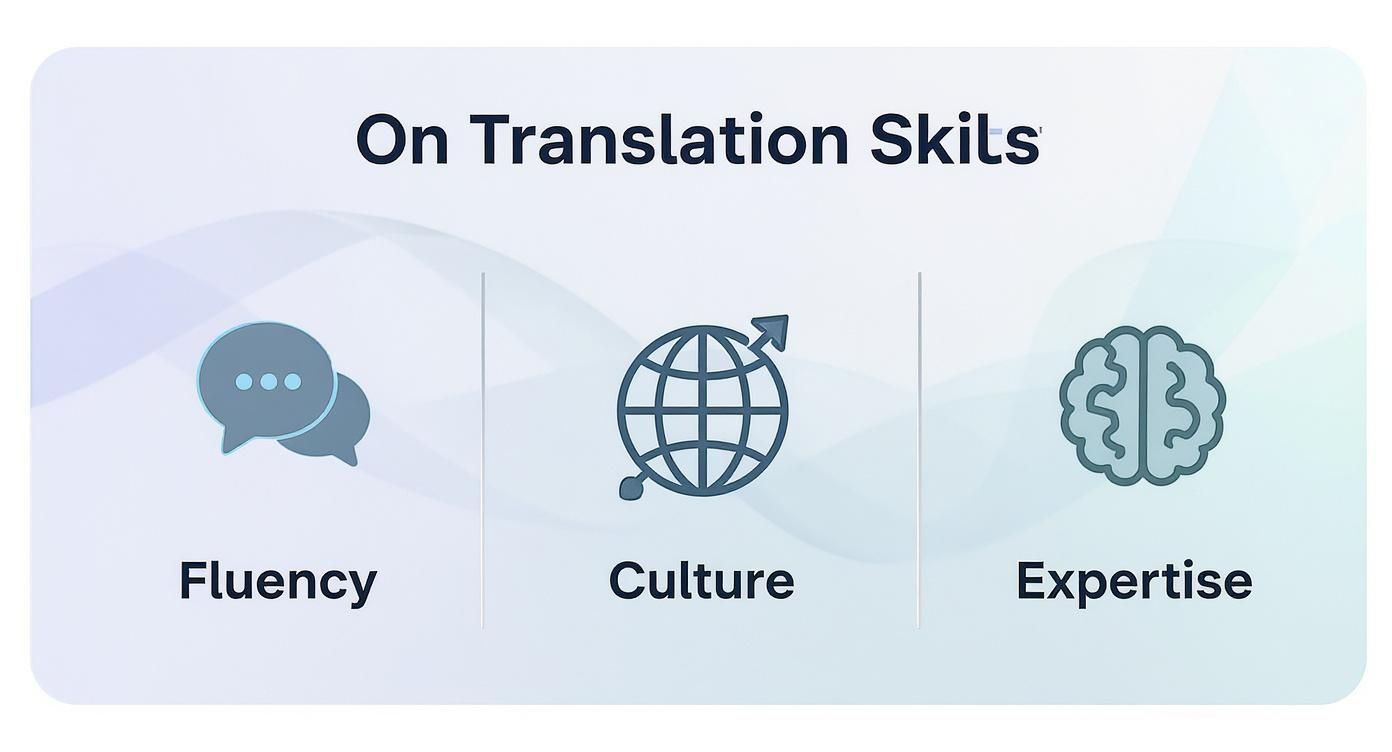
As you can see, a translator’s job is a mix of language fluency, cultural awareness, and subject-matter expertise. These skills are essential for adapting a message's intent, not just its literal text.
Technical And Workflow Comparison
Looking at the day-to-day processes for transcription and translation really drives home how different they are. The entire workflow, from the files they start with to what they deliver at the end, is completely distinct.
This table breaks down the practical side of things.
| Criteria | Transcription | Translation |
|---|---|---|
| Input Format | Audio or video files (e.g., MP3, WAV, MP4). | Written documents (e.g., DOCX, PDF, HTML). |
| Output Format | A text document in the same language as the input. | A text document in a different language from the input. |
| Common Challenges | Poor audio quality, multiple speakers talking at once, strong accents, and technical jargon. | Idiomatic phrases, cultural references, complex sentence structures, and ambiguous wording. |
| Quality Metrics | Word Accuracy Rate (WAR), clarity, and proper formatting for readability. | Fidelity to the original meaning, cultural appropriateness, and grammatical correctness in the target language. |
This comparison highlights a clear divide. For transcription, quality is often about raw data and can be measured with metrics like Word Error Rate. You can dig deeper into how this works in guides on AI transcription accuracy. Translation quality, however, is much more subjective and often needs a human reviewer to check for cultural fit and nuance.
Transcription preserves the spoken word; translation preserves the intended meaning. This is the core technical difference that defines every aspect of the work, from the skills needed to the final product delivered.
Interestingly, while transcription is all about turning spoken words into text, a related technology does the exact opposite: generating audio from text. Both fields deal with the relationship between sound and text, but they come at it from opposite ends, which just goes to show how specialized each discipline truly is.
When to Use Transcription vs. Translation
Knowing the technical difference is great, but the real question is: which one does your project actually need? It all boils down to your end goal. Are you trying to create a written record of what was said, or are you trying to share that message with a whole new audience?
As businesses go global and content explodes online, making this choice is becoming a daily task for many. The global language services market, which includes both, was valued at a huge USD 60.68 billion and is expected to climb to USD 96.21 billion by 2032. This isn't just a niche industry; it shows how critical both clear documentation and cross-cultural communication have become. You can discover more insights about these market trends on redokun.com.
So, let's get practical and look at the real-world situations where each service shines.
Scenarios Demanding Transcription
You need transcription when your main objective is to capture spoken words and turn them into text—all in the original language. Think of it as creating a perfect paper trail of a conversation.
Here are a few classic examples:
- Documenting Meetings and Interviews: A transcript of a big company meeting or an important interview gives you a searchable, accurate record. It's perfect for pulling exact quotes later, verifying decisions, or catching up colleagues who missed it.
- Improving Accessibility: Creating captions for a video is a form of transcription. It opens up your content to viewers who are deaf or hard-of-hearing and gives your SEO a nice boost by letting search engines "read" your video's content.
- Legal and Academic Records: For lawyers, a verbatim transcript of a court proceeding isn't just helpful; it's a critical legal document. In the same way, academic researchers rely on precise transcripts of interviews to analyze their data without losing any nuance.
If your starting point is audio or video and you need a text file in the same language, you're looking for transcription. The entire focus is on accuracy and faithfulness to the original spoken word.
Scenarios Requiring Translation
It's time to call in a translator when you need to cross a language barrier. The goal here is to make sure your core message is understood by people from a completely different linguistic and cultural background. It’s less about word-for-word and more about conveying the original spirit and meaning.
You’ll need translation for projects like these:
- Launching a Global Marketing Campaign: A catchy slogan in English might fall flat or even be offensive in another language. A good translator adapts your marketing copy, including cultural references and calls-to-action, so it connects with the local audience.
- Localizing Software or an App: Taking your app international means translating every button, menu, and help article. This is what creates a natural, easy-to-use experience for people around the world.
- Creating Multilingual Product Manuals: When selling products internationally, user guides and safety warnings must be perfectly translated. This is non-negotiable for customer happiness, legal reasons, and basic safety.
In every one of these situations, you're starting with written text and aiming to produce an equivalent version in a new language.
How to Choose the Right Service for Your Project
Choosing between transcription and translation really comes down to one thing: what are you trying to accomplish? Once you’ve nailed down the end goal for your content, the right path usually becomes pretty clear.
Before you dive into searching for vendors, take a minute to ask yourself two simple questions. The answers will point you straight to the service you actually need.
Start With These Two Questions
- Is your starting point audio or text? If you're holding an audio or video file—say, a podcast recording or a Zoom meeting—you need to turn spoken words into written text. That’s transcription. If you already have a document, like a user manual or a marketing email, you’re starting with text.
- Do you need a written record, or do you need to reach a new audience? If the goal is just to get an accurate, searchable text version of your content in its original language, you’re creating a record. This is a job for transcription. If you need to make that same message understood by people who speak a different language, your goal is communication. That’s where translation comes in.
Here’s the simplest way I think about it: Transcription creates a document, while translation bridges a communication gap. If a project needs both, you always start with transcription first, then move on to translation.
Key Business Factors to Consider
Once you know which service you need, a few other practical considerations come into play, especially when you’re making decisions for your business. These factors will help you decide whether a human-powered service or an AI tool is the better fit.
- Accuracy Needs: How perfect does it have to be? Legal depositions and medical records require near-flawless accuracy, which usually means leaning on specialized human services. For things like internal business meetings or brainstorming content, a high-quality AI tool is often more than good enough.
- Turnaround Time: Need it now? AI services can turn around transcripts or initial translations in just a few minutes, which is perfect for fast-moving projects. Human services will always take longer, but you’re paying for a deeper level of nuance and cultural understanding.
- Data Security: If you’re handling sensitive information, you need to find a provider with rock-solid security protocols. Look for things like GDPR compliance, end-to-end encryption, and a clear data privacy policy.
- Scalability: When you're dealing with a massive amount of content, AI solutions are hard to beat on both speed and cost. If you’re processing hundreds of hours of audio, it’s worth exploring a list of the best AI transcription apps to see which platforms are built to handle that kind of volume.
Frequently Asked Questions
Even after grasping the basics of transcription and translation, a few questions always seem to pop up. Let's dig into those common head-scratchers to clear things up for good.
Can Transcription And Translation Be Used Together?
Not only can they be used together, but they often are. Think of it as a one-two punch for taking content global.
For instance, take a popular English-language video podcast. The first step is to transcribe the audio, creating an accurate written record of what was said. That transcript then becomes the source material for a professional linguist, who will translate it into Spanish, German, or Japanese. The final translations can then be used as subtitles, blog posts, or marketing materials. It’s a powerful workflow.
This two-step process ensures the final output is true to the original recording and makes sense culturally for new audiences.
Which Service Costs More?
This is a classic "it depends" situation because they're priced completely differently.
Transcription services usually charge by the minute of audio or video. You'll see costs go up if the audio quality is poor, if multiple people are speaking at once, or if you need it done yesterday.
On the other hand, translation is almost always priced per word. The cost can swing quite a bit based on the language pair—a common language like Spanish will generally cost less than a rare one. The price also climbs if the text is highly technical or requires a subject matter expert, like a doctor or an engineer.
How Is Interpretation Different From Translation?
The core difference here is the medium and the time pressure.
Translation is all about the written word. A translator has the time to carefully consider word choice, consult dictionaries, and meticulously edit their work to get it just right.
Interpretation, however, is live and on the fly. It’s about converting spoken language in real-time, like an interpreter in a booth at a UN conference (simultaneous) or someone who translates after each sentence in a business meeting (consecutive). There's no backspace key in interpretation.
Ready to turn your audio into accurate, searchable text? WhisperAI offers professional-grade transcription and translation powered by advanced AI, delivering speed and precision for all your business needs. Learn more and get started today!