HIPAA Compliant Transcription Services Explained
A complete guide to HIPAA compliant transcription services. Learn how to choose a secure partner and protect patient health information (PHI).
tl;dr: HIPAA compliant transcription services are more than just software—they are secure, legally-bound partners that protect patient data. They must use specific safeguards like encryption, have strict internal policies, and most importantly, sign a Business Associate Agreement (BAA). Choosing a certified partner is non-negotiable for any healthcare provider to avoid massive fines, prevent data breaches, and maintain patient trust. This guide breaks down what makes a service genuinely compliant, helping you choose the right one.
At a glance: HIPAA compliant transcription services aren't just about typing out what’s said; they're secure, legal partners bound by law to protect patient data. These services use specific technical safeguards like encryption, enforce administrative policies like workforce training, and maintain physical security for their servers.
Most importantly, they must sign a Business Associate Agreement (BAA), making them legally liable for protecting your patients' information. For any healthcare provider, choosing a certified partner is non-negotiable to avoid massive fines, prevent data breaches, and keep patient trust intact. This guide breaks down what makes a service genuinely compliant, helping you turn a regulatory headache into a secure, efficient part of your workflow.

Why HIPAA Compliance in Transcription Is Non-Negotiable
Picking a transcription service for your practice isn't like grabbing a new tool for meeting notes. It involves handling Protected Health Information (PHI)—some of the most sensitive, personal data that exists. This is where HIPAA compliant transcription services become more than just software; they act as a secure extension of your clinic.
Think of it this way: a standard transcription tool is like sending a postcard. Anyone who gets their hands on it can read the message. A HIPAA compliant service, on the other hand, is like an armored truck with a GPS tracker and a required signature upon delivery. It creates a secure, legally-binding channel to turn spoken patient encounters into accurate, protected medical records.
The Foundation of Trust and Security
The whole point of these specialized services is to protect patient privacy while making your clinical documentation faster and more accurate. Without strict adherence to the Health Insurance Portability and Accountability Act (HIPAA), a simple audio file of a patient visit turns into a huge liability.
A data breach can lead to fines that easily reach into the millions, but the damage doesn't stop there. The loss of patient trust can be catastrophic and, frankly, irreversible for a practice.
This guide will walk you through exactly what makes a transcription service truly compliant. We’ll get into the weeds on the critical components that protect both your data and your practice:
- Business Associate Agreements (BAAs): The non-negotiable legal contract that makes your vendor a true partner in compliance.
- Essential Security Safeguards: The combination of technical, physical, and administrative rules that protect PHI from the moment it's recorded to when it's stored.
- Evaluating Potential Partners: Actionable steps to cut through the marketing noise and verify a vendor's security claims.
By the end, you won't just know the rules; you'll have a clear framework for choosing HIPAA compliant transcription services that actually strengthen your operations and protect your patients. It’s all about turning a regulatory hurdle into a strategic advantage.
Understanding HIPAA in Medical Transcription
To really get why HIPAA-compliant transcription services are so critical, you have to think beyond just turning audio into text. Imagine you're handing over your patients' most private medical narratives to an outside partner. You wouldn't give sensitive legal files to a standard mail carrier; you’d hire a certified, bonded courier you can trust.
That’s exactly the role a compliant transcription service plays. It’s a secure, legally obligated partner for handling patient data, making sure every single word is shielded from unauthorized eyes. The entire system is built to safeguard what HIPAA calls Protected Health Information (PHI).
What Is Protected Health Information (PHI)?
PHI isn't just a diagnosis or a lab result. It's any piece of information that can be used to identify a patient in connection with their healthcare. This includes the obvious stuff, but also data points you might not immediately think of.
Common examples of PHI include:
- Personal Identifiers: Names, addresses, birth dates, and Social Security numbers.
- Contact Information: Phone numbers and email addresses.
- Medical Records: Medical record numbers, account numbers, and health plan beneficiary numbers.
- Biometric Data: Fingerprints, retinal scans, and voiceprints.
Any audio file from a patient visit, once transcribed, becomes a document absolutely loaded with PHI. This is precisely why using a generic, non-compliant tool instantly puts your practice at serious risk.
The Business Associate Agreement: The Cornerstone of Compliance
So, how do you legally and safely extend your practice's duty to protect PHI to an outside company? The answer is a critical legal document: the Business Associate Agreement (BAA).
A BAA is a signed contract between a healthcare provider (that’s you, the "covered entity") and a service provider like a transcription company (the "business associate"). This agreement isn't just a piece of paper; it legally binds your vendor to uphold the exact same HIPAA standards you do.
By signing a BAA, your transcription service is formally acknowledging its responsibility to protect your patients' PHI. They become a true partner in compliance, sharing the legal liability if a data breach happens on their watch. Without a BAA, your practice is left holding the bag for any data mishandling by your vendor.
This shared responsibility is everything. When you're looking into medical transcription software, a quality vendor will be completely transparent about their security protocols and the tech they use. For a deeper look at the nuts and bolts, you might find our complete guide to medical transcription helpful.
The need for these secure services isn't just a small concern—it's a massive, booming market. Globally, medical transcription services were valued at roughly $82.1 billion in 2024, with North America leading the charge thanks to strict rules like HIPAA. This market is expected to grow at a 5.4% annual clip, potentially hitting $145.9 billion by 2035, according to Transparency Market Research. This growth just underscores how much healthcare relies on specialized, secure services to manage clinical notes effectively.
The Three Pillars of HIPAA Security Safeguards
To ensure patient data is genuinely protected, the HIPAA Security Rule established a framework built on three distinct but interconnected pillars: Administrative, Physical, and Technical Safeguards. Think of it like building a secure fortress. You need strong walls (Physical), smart guards who know the rules (Administrative), and a high-tech alarm system (Technical).
A top-tier HIPAA compliant transcription service must implement and maintain all three to be considered truly secure. Missing even one pillar leaves a huge vulnerability that could expose Protected Health Information (PHI) and put your practice at risk. Let's break down what each of these really means for medical transcription.
This diagram shows how HIPAA, Protected Health Information (PHI), and the essential Business Associate Agreement (BAA) all fit together.
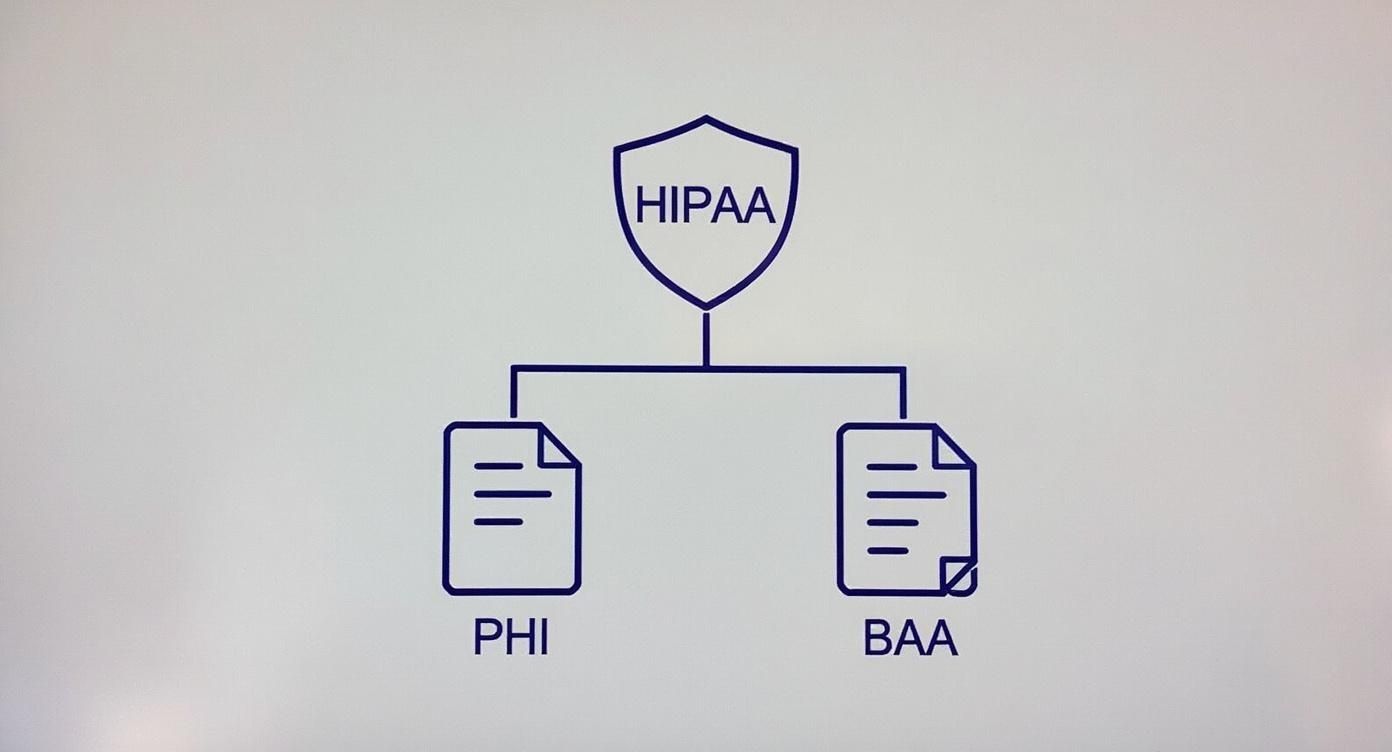
It clarifies how a BAA legally binds a transcription service to the core duties of protecting PHI under HIPAA regulations.
Administrative Safeguards: People and Policies
Administrative Safeguards are the "people" part of the equation. These are the policies, procedures, and day-to-day actions a transcription service uses to manage the security of PHI. It’s all about creating a culture of security, not just relying on software to do the job.
These safeguards ensure that everyone who might interact with patient data understands their role in protecting it. This is your human firewall.
Key components of Administrative Safeguards include:
- Security Management Process: The service must conduct regular risk analyses to spot potential threats to PHI and then implement security measures to shut those risks down.
- Workforce Training and Management: Employees need ongoing training on security policies. This covers everything from how to handle PHI securely in their daily work to what to do if a breach is suspected.
- Information Access Management: This is the principle of least privilege. It ensures employees can only access the absolute minimum amount of PHI needed to do their jobs. A transcriptionist shouldn't see a patient's entire medical history if they only need to transcribe a single consultation note.
- Contingency Plan: A reliable service absolutely must have a disaster recovery plan. What happens if there's a fire, power outage, or major system failure? They need a solid plan to protect and restore data.
Physical Safeguards: Securing the Hardware
While we spend a lot of time thinking about digital threats, Physical Safeguards are just as critical. These are the measures taken to protect the physical servers, computers, and other hardware where PHI is stored. If someone can walk out the door with a server, the world's best encryption won't matter much.
For a HIPAA compliant transcription service, this usually means securing the data centers where audio files and transcribed documents live. It’s all about controlling who can physically get near the data.
Think of it like a bank vault. The money inside might be in locked boxes (encryption), but the vault itself needs thick steel doors, security guards, and cameras to stop someone from just walking in and taking a box.
This includes measures like:
- Facility Access Controls: Limiting physical access to data centers to only authorized personnel, often enforced with key cards, biometric scanners, and on-site security guards.
- Workstation Use and Security: Policies that dictate how workstations are protected. This can include things like privacy screens to prevent "shoulder surfing" and automatic logoffs after a period of inactivity.
- Device and Media Controls: Clear procedures for handling hardware and electronic media containing PHI, including how they are securely disposed of or wiped for reuse.
Technical Safeguards: The Digital Locks and Alarms
Finally, we have Technical Safeguards. These are the technology and policies used to protect and control access to electronic PHI. This is the layer most people think of when they hear "cybersecurity," covering everything from encryption to user authentication. These digital controls are vital for protecting data both when it's being sent over the internet (in transit) and when it's stored on a server (at rest).
The industry is quickly moving to cloud-based solutions because they can implement these technical safeguards at a massive scale. In fact, by 2025, remote, cloud-based HIPAA-compliant transcription services are expected to be the industry standard. This shift is fueled by the need to fight data breaches—roughly 30% of healthcare data breaches between 2010 and 2020 involved unauthorized access.
Specific technical safeguards include:
- Access Control: This ensures only authorized individuals can access electronic PHI. It’s enforced through unique user IDs, strong passwords, and often two-factor authentication.
- Audit Controls: A compliant service must have mechanisms to record and examine all activity in systems containing PHI. This creates an audit trail showing exactly who accessed what data, and when.
- Integrity Controls: These are measures to ensure PHI is not improperly altered or destroyed. Think of it as a digital seal that proves the data hasn't been tampered with.
- Transmission Security: This requires the service to guard against unauthorized access to PHI that is being sent over a network. End-to-end encryption is the gold standard here.
When vetting a potential vendor, it's helpful to see how their features map directly to these three pillars.
HIPAA Security Safeguards Checklist for Transcription Vendors
Here's a practical checklist you can use to evaluate whether a transcription service is taking security seriously across all three required areas.
| Pillar | Key Action | Example in Transcription |
|---|---|---|
| Administrative | Conducts regular risk assessments and trains staff. | The vendor can show you their training materials and provide a summary of their most recent risk analysis. |
| Administrative | Enforces "minimum necessary" access policies. | A transcriptionist can only access the audio file for their assigned job, not browse all patient records. |
| Physical | Uses secure, access-controlled data centers. | Their servers are housed in a facility with 24/7 security, biometric scanners, and video surveillance. |
| Physical | Secures workstations and devices. | Employee laptops have screen locks, and there's a formal process for wiping old hard drives before disposal. |
| Technical | Implements unique user logins and strong passwords. | Every user has their own account, and access is protected by multi-factor authentication (MFA). |
| Technical | Encrypts all data, both in transit and at rest. | Audio files are encrypted during upload, while stored on the server, and during the download of the transcript. |
| Technical | Maintains detailed audit logs of all PHI access. | The system can produce a report showing which user viewed, edited, or downloaded a specific patient's transcript. |
This table helps translate the dense HIPAA rules into concrete features and policies to look for. By understanding these three pillars, you're in a much better position to evaluate whether a transcription service truly has a comprehensive security program.
To see how these principles are put into practice, you can explore the details of our own commitment to security at WhisperAI.
How to Choose the Right HIPAA-Compliant Partner
Choosing a HIPAA-compliant transcription partner is a huge decision. It goes way beyond just looking for a "HIPAA Compliant" badge on a website. You're not just buying software; you're entrusting a vendor with your patients' most sensitive data, and that carries serious weight.
Think of it like bringing a new specialist into your practice. You wouldn't just glance at their resume. You'd verify their credentials, check their references, and make sure they meet your high standards. You need to apply that exact same level of scrutiny when vetting a transcription service. Let's walk through the essential checklist to help you separate the real partners from the risky ones.
Start with the BAA: A Non-Negotiable Contract
The very first question for any potential vendor should be simple: "Will you sign a Business Associate Agreement (BAA)?"
If the answer is anything but an immediate and confident "yes," walk away. It's that simple. A vendor who hesitates, doesn't know what a BAA is, or wants to charge extra for one is a major red flag. They're not serious about healthcare.
A BAA is the legally binding contract that holds the transcription service accountable for protecting PHI under HIPAA. Without it, your organization is on the hook for any breach that happens on their end.
A vendor's willingness to sign a BAA is the first and most critical gate in your evaluation process. It's the baseline requirement that separates professional, secure services from risky, non-compliant tools.
Dig Into Their Security Protocols
Once they’ve confirmed they’ll sign a BAA, it’s time to get into the weeds of their security. Don't let them get away with vague promises of "bank-grade security." You need concrete answers about how they protect your data every step of the way.
Here’s a quick checklist of technical questions to ask:
- What type of encryption do you use? Be specific. Ask about encryption for data in transit (while it's being uploaded) and at rest (while it's stored on their servers). The industry standard is AES-256 bit encryption, and you shouldn't settle for less.
- What are your data retention and destruction policies? You need to know exactly how long they keep your data and what their process is for securely deleting it. A professional service will have this clearly documented.
- Can we access audit logs? Audit logs are your paper trail. They show who accessed what data and when, which is critical for accountability. A compliant partner must be able to provide these logs.
Evaluate Their Internal Policies and People
Great technology isn't enough. The people and policies behind the scenes are just as crucial. A company's internal security culture speaks volumes about its real commitment to compliance.
Ask them about their administrative safeguards:
- What kind of HIPAA training do your employees receive? Their staff should get regular, documented training on how to handle PHI and spot security threats.
- What is your data breach response plan? Things can go wrong. A secure organization will have a clear, step-by-step plan for how they'll handle a breach and, most importantly, how they will notify you.
This kind of detailed vetting is more important than ever. The U.S. medical transcription market is projected to hit $3.3 billion by 2025 as more providers turn to transcription to combat EHR burnout and manage the telehealth explosion. As this market booms, you can discover more insights about these spending trends on Dittotranscripts.com. All this growth means you have to be extra careful to pick a partner who truly takes compliance seriously.
Asking these tough questions helps you see past the marketing fluff. When you find a vendor who gives clear, confident answers, you've found a partner you can trust. As you consider different solutions, see how they fit your broader operational needs by exploring WhisperAI’s offerings for business teams. A true partner will be transparent about their security and ready to prove it.
Real-World Scenarios Where Compliance Matters
It's one thing to read about HIPAA rules in a guide, but it’s another to see them in action. The journey of a spoken conversation turning into a secure medical record really shows why a generic transcription tool is a huge liability. Let's walk through a few common situations to see how specific HIPAA safeguards make all the difference.
These examples prove that compliance isn’t just a box to check—it’s woven into the fabric of modern, secure healthcare.
Scenario 1: The Telehealth Therapy Session
A therapist holds a video call with a patient to discuss sensitive mental health topics, including anxiety and depression. After the session, the therapist uses an AI transcription service to document the conversation for the patient’s file. The audio contains deeply personal stories, a diagnosis, and a treatment plan.
- The Risk: A non-compliant service might just dump that audio file onto an unsecured server. A curious employee could listen in, or a hacker could easily intercept it, exposing intensely private information.
- The HIPAA Compliant Solution: The moment the audio leaves the therapist's computer, it's encrypted (transmission security). When it arrives at the service's secure servers, it stays encrypted (data at rest). Access is locked down with role-based controls, and a detailed audit log tracks every single interaction with the file.
This layered approach ensures that even the most sensitive mental health conversations are shielded from prying eyes. The Business Associate Agreement (BAA) also creates a legal obligation for the transcription service to uphold these protections, sharing the responsibility for keeping the patient's story safe.
Scenario 2: The Specialist Consultation
An oncologist and a radiologist have a recorded call to go over a patient's complex cancer case. They review imaging results, debate different treatment paths, and use the patient's name and other identifiers. The final transcript is a critical part of the patient's official medical record and essential for coordinating care.
- The Risk: Without the right security, this incredibly detailed PHI is vulnerable. A data breach could lead to medical identity theft or simply reveal a serious diagnosis against the patient's wishes.
- The HIPAA Compliant Solution: The transcription platform requires both the oncologist and radiologist to log in with unique user IDs and two-factor authentication just to access the recording and transcript. Once finalized, the document is sent directly into the hospital's Electronic Health Record (EHR) system through a secure, encrypted connection, preserving its integrity from end to end.
To get ready for this kind of real-world scrutiny, it helps to understand what regulators look for. This 8-point HIPAA compliance audit checklist gives a great breakdown of what an official audit covers.
Scenario 3: The Routine Primary Care Visit
A family doctor dictates a quick summary after a patient's annual physical. The recording includes the patient's name, date of birth, notes on their blood pressure medication, and a referral. It seems routine, but it's still packed with PHI.
- The Risk: Even "simple" data is a target. Using a standard transcription app on a personal phone could leave the audio file sitting in a consumer-grade cloud account, totally unprotected and miles away from any compliance framework.
- The HIPAA Compliant Solution: A professional-grade service provides a secure mobile app that isolates the recording in a protected environment on the phone. The data is never commingled with personal photos or files. Once it's securely uploaded to the compliant cloud server, the file is automatically wiped from the local device, preventing a data leak if the phone is ever lost or stolen.
How AI Transcription Meets HIPAA Requirements
Modern AI transcription platforms are designed with compliance at their very core. It's not about bolting on security features as an afterthought; it's about engineering a system where protecting patient data (PHI) is part of the fundamental architecture. Let’s break down exactly how the features you’ll find in a top-tier service connect directly to specific HIPAA rules.
This direct line from a HIPAA requirement to a product feature isn't just reassuring—it offers transparent, provable evidence of a genuine commitment to security and patient privacy.
Mapping Technical Safeguards to AI Features
The HIPAA Security Rule's technical safeguards are all about using technology to protect electronic PHI. A secure AI platform tackles this with a multi-layered defense system.
The most important feature is end-to-end encryption. Using military-grade standards like AES-256 bit encryption, your data is scrambled the moment it leaves your device, remains unreadable while stored, and is only decrypted when an authorized user accesses it. This ensures data integrity at every single stage of the process.
Access control is another key technical safeguard. Secure platforms implement a few non-negotiable features:
- Unique User IDs: Every person gets their own login. This eliminates shared accounts, which make it impossible to track who did what.
- Role-Based Access Controls (RBAC): This is just a fancy way of saying people can only see the data they absolutely need for their job. An administrator has different permissions than a medical assistant, which minimizes unnecessary exposure of PHI.
- Immutable Audit Trails: The system automatically logs every single action taken on a file—who viewed it, when they accessed it, and what they did. This creates a permanent, unchangeable record that ensures total accountability.
These aren't just nice-to-have options; they are the digital locks, alarms, and security cameras required to provide truly HIPAA compliant transcription services.
Fulfilling Administrative and Legal Duties
Beyond the tech, a compliant AI service has to nail HIPAA’s administrative requirements. The big one here is the Business Associate Agreement (BAA). A trustworthy platform like WhisperAI will readily sign a BAA, which creates a legal contract outlining shared responsibility for protecting PHI. It’s a formal acknowledgment of their duty to safeguard your data.
On top of that, these services run inside secure data centers that meet strict physical security standards, covering the physical safeguard requirements of HIPAA. To see how this technology can transform your workflows, check out our guide on AI audio transcription.
A truly secure platform shows its commitment not with vague promises but with a clear, verifiable architecture. By directly aligning its features with HIPAA’s rules—from encryption and access controls to audit logs and a signed BAA—an AI service provides the concrete proof needed to earn your trust and protect your patients' data.
Frequently Asked Questions
When you're trying to navigate the world of HIPAA compliant transcription services, a lot of questions come up. We get it. Below, we’ve tackled some of the most common ones we hear from healthcare providers and their teams.
Can I Use a General Transcription Tool for Patient Notes?
It's a tempting shortcut, but using a general-purpose transcription tool for patient notes is almost always a major compliance violation. These consumer-grade services simply aren't built for healthcare. They usually lack critical security features like end-to-end encryption, and more importantly, they won't sign a Business Associate Agreement (BAA).
Without a BAA in place, there’s no legal contract holding the vendor accountable for protecting your patients' sensitive data (PHI). This means your practice is left holding the bag for any data breaches that happen on their platform, opening you up to massive financial penalties and serious damage to your reputation.
A vendor's willingness to sign a BAA is the first and most important test. If they won’t sign one, they are not a viable option for handling patient data. Period.
What Is a Business Associate Agreement (BAA)?
Think of a Business Associate Agreement as a legally binding contract between a healthcare provider (that’s you, the "covered entity") and a service provider like a transcription company (the "business associate"). This document is what formally extends your HIPAA obligations to your vendor.
A BAA requires the business associate to implement the same kind of administrative, physical, and technical safeguards you do to protect PHI. It also spells out exactly what they have to do if a data breach occurs, including how and when they must notify you. It essentially makes them a partner in compliance, sharing the legal responsibility for keeping data safe.
What Happens If Our Transcription Service Has a Data Breach?
If your HIPAA compliant transcription service has a security incident, a clear, pre-defined process kicks into gear—one that's laid out in your BAA. The vendor is legally required to notify you of the breach without unreasonable delay.
From that point on, the responsibility is shared:
- The Vendor: Their job is to immediately investigate the breach, contain the damage, and give you all the details about what happened and which patients' PHI was affected.
- Your Practice: You are ultimately responsible for notifying the affected patients and, in most situations, the Department of Health and Human Services (HHS).
This is why having a solid incident response plan is so critical. You can review our privacy policy to see how we handle data security and notifications as part of our own commitment to transparency.
Ready to streamline your clinical documentation with a secure, AI-powered solution? WhisperAI offers enterprise-grade security, near-human accuracy, and the peace of mind that comes with a true compliance partner. Transform your transcription workflow today at WhisperAI.