Proofreading in Transcription: Your Guide to 99% Accuracy
Master proofreading in transcription with our expert guide. Learn actionable techniques to catch errors, boost accuracy, and perfect your transcripts.
tl;dr: Raw AI transcripts are a great start, but they're not the final product. True accuracy comes from a human proofreader who catches the subtle errors AI misses—like homophones (their/there), wrong speaker labels, and niche jargon. This guide walks you through a simple three-pass system: a quick cleanup, a deep listening pass with the audio, and a final polish for formatting. This human-in-the-loop process is what turns a decent AI draft into a reliable, professional transcript.
Think of a raw transcript from an AI like WhisperAI as a fantastic first draft. It gets you about 90% of the way there in a fraction of the time, but it’s not the finished product. Proofreading is that essential final step where a human expert steps in to clean up errors, fix speaker labels, and make sure the text is truly accurate. While AI is incredibly fast, it just can't catch the subtleties of human speech—like accents, industry jargon, or the specific context of a conversation. That manual check is what makes a transcript genuinely reliable.
Why a Raw AI Transcript Is a Risky First Draft
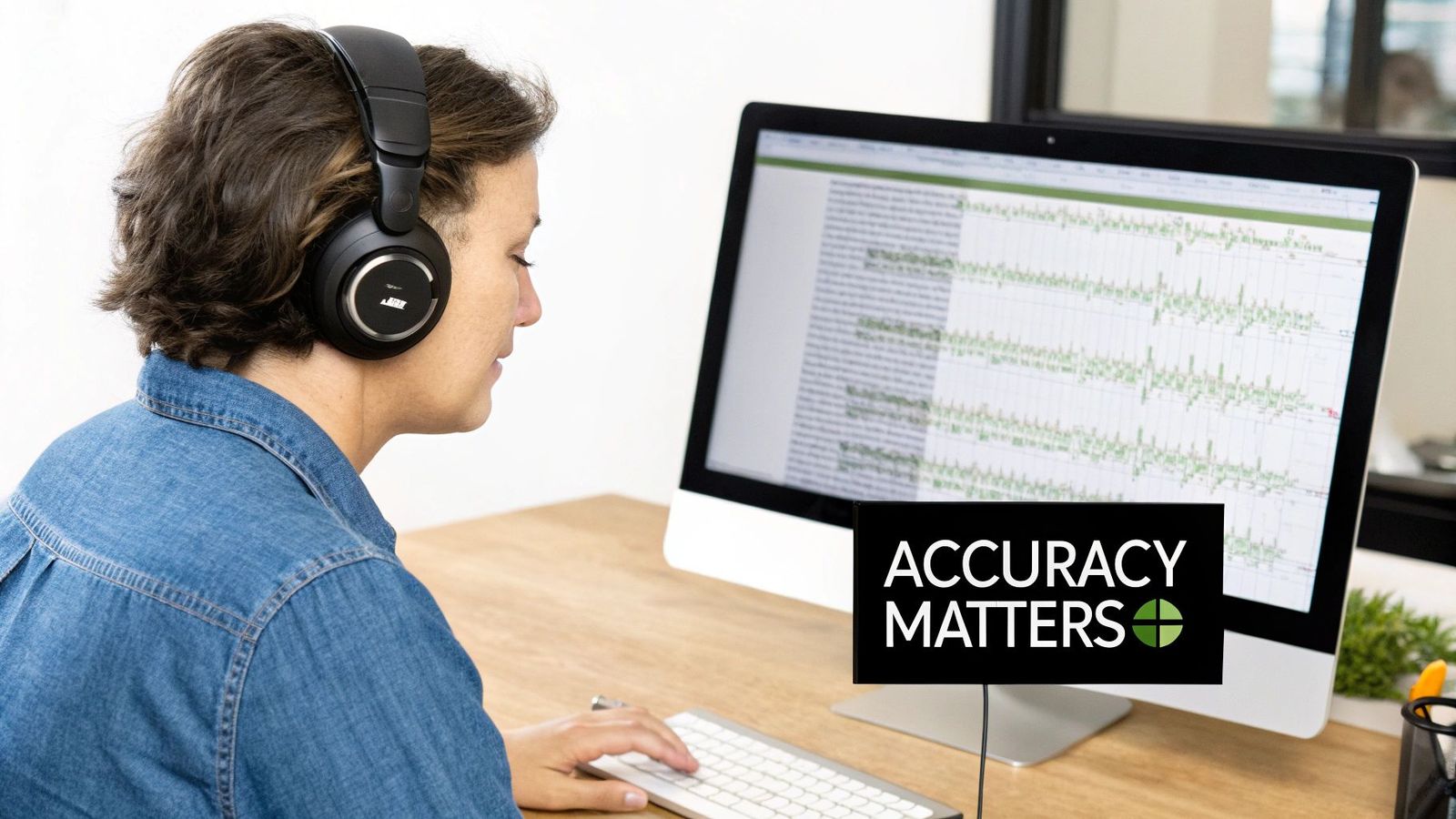
Let's be real—relying solely on an automated transcript is like sending a critical email to your boss without reading it over. You might get the general point across, but small mistakes can create huge misunderstandings. Effective proofreading in transcription is the safety net that catches these blunders.
This process transforms a functional but flawed document into a trustworthy and polished record. It’s not just about fixing typos; it’s about making sure the original meaning is perfectly preserved.
The Real-World Impact of Small Errors
In fields where precision is everything, a single transcription error can have massive consequences. Imagine a legal deposition where the AI transcribes "I can't deny it" as "I can deny it." The entire meaning flips, and it could dramatically change the outcome of a case.
Here are a few scenarios where pinpoint accuracy is non-negotiable:
- Medical Field: Mistaking "hypotension" (low blood pressure) for "hypertension" (high blood pressure) in a doctor's notes could lead to the wrong treatment.
- Media and Journalism: Misquoting someone in an interview can seriously damage a publication's credibility and force embarrassing public retractions.
- Corporate Meetings: Inaccurately documenting action items from a board meeting can throw entire teams off track and lead to costly strategic missteps.
Beyond Simple Typos: The Common AI Traps
When you only use automation, you run into the same predictable problems again and again—the kind of mistakes only a human can spot and fix. For instance, AI often gets tripped up by overlapping conversations, which results in jumbled sentences or attributing words to the wrong speaker.
It also struggles with homophones. A human instantly knows the difference between "their," "there," and "they're" based on context, but an AI can easily get it wrong.
To see the difference clearly, here's a quick comparison:
AI Transcript vs Human-Proofread Transcript
This table gives a quick look at the critical differences between a machine-generated transcript and one that has been professionally proofread.
| Feature | Raw AI Transcript | Human-Proofread Transcript |
|---|---|---|
| Accuracy | Often 85-95%, but misses nuance. | 99%+ accuracy, contextually correct. |
| Speaker Labels | Frequently inaccurate, especially with crosstalk. | Correctly identified and consistent. |
| Punctuation | Basic, often misplaced or missing. | Grammatically correct and enhances readability. |
| Jargon & Names | Struggles with specialized terms and proper nouns. | Researched and correctly spelled. |
| Clarity | Can be confusing with run-on sentences. | Clear, well-structured, and easy to follow. |
As you can see, the human touch adds a crucial layer of polish and reliability that machines just can't replicate yet.
The goal of transcription proofreading isn't just to make the text grammatically perfect. It’s to ensure the final document is an exact, faithful representation of the spoken word, capturing both what was said and who said it.
The need for this level of detail is only growing. The global transcription market was valued at USD 21.01 billion in 2022 and is projected to skyrocket to USD 35.8 billion by 2032. As AI transcription becomes more common, the demand for skilled human proofreaders who can navigate tricky accents, dense jargon, and poor audio quality is actually increasing.
Skipping the proofreading step completely undermines why you wanted a transcript in the first place. For a deeper dive into this, you can learn more about how to achieve high AI transcription accuracy. Ultimately, that final human review is what guarantees your transcript is accurate, credible, and ready for whatever you need it for.
Setting Up Your Proofreading Workspace for Success
A great proofreading setup isn't about fancy gear; it's about killing distractions and working smarter. Nail down three things: clear audio with noise-canceling headphones, a comfy physical setup with an ergonomic chair, and an integrated editor like WhisperAI's that syncs text and audio to save you a ton of time.
Getting a transcript right starts way before you hit play. The secret to hitting that 99% accuracy mark is building an environment that lets you focus completely. Your workspace has a huge impact on your speed, your focus, and your ability to catch those tiny, almost-invisible errors.
The whole point is to create a bubble where it's just you, the audio, and the text. That means getting rid of interruptions and making sure your tools are working for you, not against you.
Essential Gear for Focused Proofreading
You don’t need a recording studio, but a few pieces of gear are non-negotiable. The right equipment helps you hear every nuance and stay comfortable through long sessions, which is crucial for avoiding the kind of mental fatigue that leads to sloppy mistakes.
- Noise-Canceling Headphones: This is your number one tool. A solid pair of headphones lets you block out the world and hear everything—faint whispers, mumbled words, or even background chatter that the AI might have missed.
- An Ergonomic Chair: Let's be honest, proofreading means a lot of sitting. An ergonomic chair isn’t a luxury; it's what keeps you from developing the back and neck pain that will absolutely tank your concentration and productivity.
You'll also be staring at a screen for hours on end, so adopting a few strategies to reduce eye strain from your computer is essential for staying sharp and comfortable.
The Right Software Makes All the Difference
Your choice of software can either be a massive boost or a major bottleneck. You want tools that play nicely together and cut down on the friction of switching between windows.
At a minimum, you’ll want a text editor with a good find-and-replace feature for making quick, global changes. A media player that lets you easily adjust playback speed is also a lifesaver when you’re dealing with fast talkers or dense, technical audio.
The single biggest game-changer for my productivity was switching to a platform where the audio player and the text editor are one and the same. Hopping back and forth between a media player and a Word doc is a massive time sink.
This is exactly why an editor like the one built into WhisperAI is so effective. It syncs the audio directly to the text. Just click a word in the transcript, and the audio instantly jumps to that exact moment. It sounds simple, but it completely changes your workflow. You can verify tricky words or phrases in seconds without ever losing your place. An integrated setup like this is really the foundation of any modern, efficient proofreading process.
A Practical Proofreading Workflow That Actually Works
Let's be real: a good proofreading workflow isn't some rigid checklist you have to follow to the letter. It’s more of a rhythm you get into. I think of it as a three-pass system: start with a quick automated cleanup, move into a deep listening session where you follow along with the audio, and finish with a final polish to fix formatting and speaker labels.
Forget trying to catch every single error in one go. You’ll just drive yourself crazy. A multi-pass approach lets you focus on different types of mistakes at each stage, which is far more efficient and leads to a much cleaner final transcript.
Before you even start, your setup is key. The right tools make all the difference.
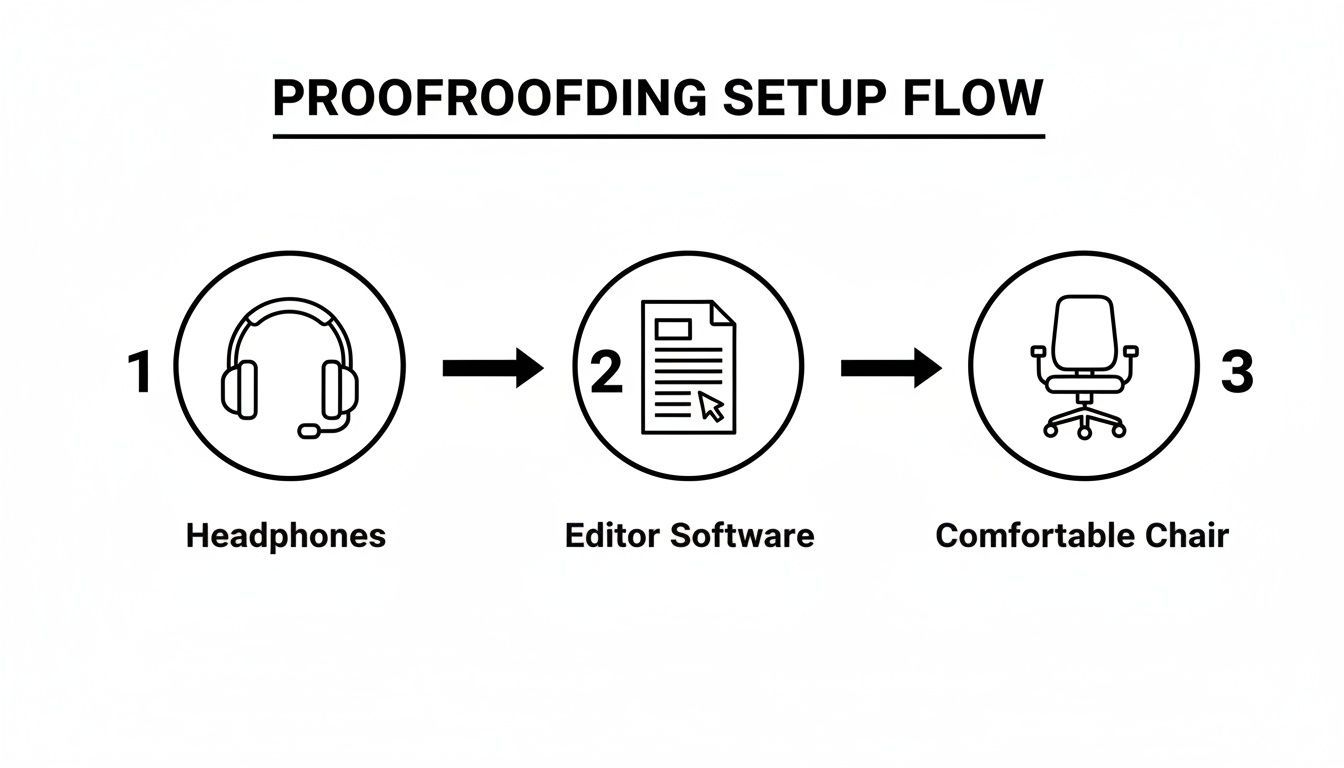
As you can see, it comes down to the basics: good headphones for clear audio, an editor that doesn't get in your way, and a space where you can actually focus. Once you have that sorted, you’re ready to dive in.
The Quick Cleanup Pass
First things first, let's tackle the low-hanging fruit. Before I even press play on the audio, I run a quick spell check and grammar check on the raw transcript. This initial sweep catches all the obvious typos and simple mistakes, clearing out the noise so I can focus on the important stuff later.
Don't overthink this part. You're just tidying up, fixing things like "teh" or a misplaced comma. It’s a five-minute job that makes the next pass much, much smoother.
The Deep Listening Pass
This is where the real work begins. For this pass, you’ll listen to the audio from start to finish while reading the transcript. The goal is simple: make sure the text is a 100% accurate reflection of what was said.
Here are a few tricks I’ve picked up over the years to make this easier:
- Adjust Playback Speed: Don't be a hero and try to keep up with fast talkers. Slow the audio down. For tricky sections with heavy accents or dense jargon, dropping the speed to 0.75x can be a lifesaver.
- Use Timestamps as Bookmarks: If you come across a section that's really garbled or unclear, don't get stuck. Just drop a timestamp or a note like
[CHECK]and move on. You can circle back later without losing your flow. - Focus Only on Accuracy: Resist the urge to fix formatting or punctuation right now. Your only job during this pass is to ensure word-for-word accuracy. Did they say "affect" or "effect"? Is that name spelled right? That's all that matters here.
The Final Fine-Tuning Pass
Once you’re confident the words are right, it’s time for the final polish. Now, you’ll read through the transcript one last time without the audio, focusing completely on readability and consistency. This is what separates a good transcript from a great one.
If you’re interested in the entire process from start to finish, we've covered it all in our detailed guide to AI audio transcription.
During this last read-through, keep an eye out for these details:
- Consistent Speaker Labels: Are all the speakers identified correctly every single time?
- Correct Punctuation: Does the punctuation truly match the speaker's cadence and tone? A comma in the wrong place can change the entire meaning of a sentence.
- Formatting: Make sure things like timestamps, paragraph breaks, and any other client requests are formatted consistently from top to bottom.
By breaking your proofreading into these three distinct passes—cleanup, listening, and fine-tuning—you create a system that catches everything. It transforms what can feel like an overwhelming task into a clear, manageable, and highly effective workflow.
Common Transcription Errors and How to Catch Them
A truly great transcript goes way beyond just being typo-free; it has to be accurate in meaning. The real skill is spotting the tricky stuff—homophones like 'their' vs. 'there,' phrases the AI totally bungled, mixed-up speaker labels, and punctuation that flips the entire context of a sentence. Developing an ear for these specific mistakes is what separates the pros from the amateurs.
Think of yourself as a detective. You're not just scanning for obvious clues like spelling errors; you're hunting for the subtle mistakes that AI and beginners almost always miss. These are the kinds of errors that can completely warp the meaning of a conversation.
This is exactly why a human in the loop is so crucial. The U.S. transcription market hit an incredible USD 30.42 billion in 2024, and that growth is fueled by industries where precision is everything. An error in a legal or medical transcript isn't just a minor mistake—it can have serious, real-world consequences, which keeps skilled proofreaders in high demand.
Misheard Words and Homophones
This is, without a doubt, the most frequent error you'll encounter. Homophones—words that sound the same but have different meanings—are a classic AI stumbling block. An algorithm struggles to know if a speaker meant "their," "there," or "they're" based on context alone.
Keep an eye out for these usual suspects:
- its / it's: One shows possession (its), the other is a contraction of "it is" (it's). Easy to mix up.
- affect / effect: Are we talking about the action (affect) or the result (effect)?
- to / too / two: This one trips up even the most advanced automated tools.
It's not just single words, either. Entire phrases can get garbled. A speaker might say "for all intents and purposes," but the AI spits out "for all intensive purposes." They sound alike, but one is correct and the other is just wrong. Your job is to catch it.
Punctuation That Changes Everything
Punctuation isn't just about following rules; it’s about capturing the rhythm and intent of the speaker. A misplaced comma can change everything. To get good at this, having a solid grasp of basic grammar rules is non-negotiable.
Here’s a classic example of why it matters:
- Without a comma: "Let's eat grandma." (Which is… not great.)
- With a comma: "Let's eat, Grandma." (A perfectly normal invitation to a meal.)
That tiny comma carries a whole lot of weight. As you proofread, listen carefully for pauses and changes in tone. Is that a brief pause for a comma, or has the speaker finished their thought, signaling a period?
A transcript’s accuracy hinges on more than just the words themselves. It’s about ensuring speaker labels are correct, punctuation reflects the flow of speech, and the final text is a faithful record of the original conversation.
Incorrect Speaker Labels
Another big one, especially with AI-generated drafts, is misattributed speech. This happens all the time when multiple people are talking over each other or in rapid succession. The AI might assign a line to Speaker 1 when it was clearly Speaker 2.
This can completely derail the meaning of a discussion. As you listen, focus on the unique sound of each person's voice. If you’re working in an editor like the one in WhisperAI's AI transcription tool, you can often reassign a speaker with a single click, which is a massive timesaver. The important thing is to be vigilant and confirm every single speaker tag.
To help you stay organized, here's a quick checklist of the most common errors I see day-to-day.
Common Transcription Error Checklist
| Error Category | What to Look For | Example Fix |
|---|---|---|
| Homophones | Words that sound alike but have different spellings and meanings. | Change "I went there" to "They took their car." |
| Misheard Words | Slang, jargon, or names the AI didn't recognize. | Change "ice water in his veins" to "ice water in his fangs." |
| Punctuation | Missing or misplaced commas, periods, or question marks. | Change "Let's eat Grandma" to "Let's eat, Grandma." |
| Speaker Labels | Incorrectly assigned speech, especially in multi-speaker audio. | Reassign a line from "Speaker 1" to "Speaker 2" after listening. |
| Numbers & Data | Inaccurate figures, dates, or monetary amounts. | Change "twenty twenty three" to "2023" or "$20.23". |
| Grammar & Syntax | Awkward phrasing or run-on sentences that don't reflect speech. | Break a long sentence into two for clarity and flow. |
Keep this list handy as you work. Over time, spotting these errors will become second nature, turning a good transcript into a flawless one.
Advanced Proofreading for Niche Industries
If you've got the basics down, the next step is to specialize. This is where you can truly set yourself apart and become an invaluable asset to your clients. Mastering proofreading for specific industries like legal, medical, or academic fields is about much more than just catching typos. It’s a deep dive into specialized language, tricky audio, and very particular formatting rules.
When you move into specialized work, you're not just a proofreader anymore; you're becoming an expert. You’ll find yourself wrestling with some seriously challenging audio—recordings filled with thick accents, constant background noise, or a chaotic mix of people talking over one another. This kind of work demands more than just a good ear.
You need to have a few tricks up your sleeve. For instance, when I’m trying to decipher a really strong accent, the first thing I do is slow the audio down to 0.75x speed. It makes a world of difference. When there’s a lot of crosstalk, I’ll focus on transcribing just one person first, then go back and weave in the other speakers using timestamps to keep the overlapping dialogue in sync.
Meeting the Demands of Specialized Fields
Every niche has its own set of non-negotiable rules. A one-size-fits-all approach just doesn't work when precision is paramount.
- Legal Transcription: This area is all about absolute, verbatim accuracy. You have to capture every single "um," "ah," and false start exactly as it was spoken. The formatting is also incredibly rigid, often requiring specific line numbers, margins, and even certified signature pages. We cover this in-depth in our guide to legal transcription.
- Medical Transcription: Terminology is the biggest hurdle here. You simply must be familiar with a vast vocabulary of complex medical terms, drug names, and procedures. A single mistake isn't just a typo; it could have real-world consequences for a patient's care.
- Academic Transcription: This usually means working with dense, jargon-heavy language from university lectures or research interviews. Getting it right is crucial for maintaining the integrity of a researcher’s data and the credibility of their findings.
The real skill in niche proofreading is becoming a subject matter expert. You're not just typing out words; you're accurately documenting critical conversations within a specialized context.
These high-value sectors are built on the foundation of expert proofreading. The legal transcription market alone is valued at USD 2.62 billion, and it runs on a 99%+ accuracy standard for court records. Likewise, the medical transcription industry, worth USD 3.3 billion, relies on meticulous proofing to handle complex terminology. In fact, a skilled human reviewer can slash AI-generated errors by up to 40%. You can see more stats on the transcription services market on DittoTranscripts.com.
Your Secret Weapon: A Personal Glossary
Here’s a pro tip that has saved me countless hours: build a personal glossary. Whether it’s for a specific client or an entire industry, start a running list of recurring jargon, company-specific acronyms, or tricky proper nouns as you come across them.
This simple habit pays off in two huge ways. First, it makes you dramatically faster on future projects. Second, it shows a level of commitment that clients notice and appreciate. You’re no longer just a proofreader; you're a specialist who understands their world.
Your Top Transcript Proofreading Questions, Answered
Let's dig into some of the most common questions I hear about proofreading transcripts. Getting these fundamentals right will help you work with more confidence and turn in a polished, professional final product every time.
How Long Should It Take to Proofread an Hour of Audio?
There's no magic number, but a solid rule of thumb is to plan for 2 to 4 hours of proofreading for every hour of recorded audio. Think of that as your baseline for quoting a project or scheduling your time.
Of course, this can swing pretty wildly. If you're working with pristine audio of a single, clear speaker, you might lean closer to the 2-hour mark. But throw in a few curveballs—like multiple people talking over each other, heavy background noise, or complex technical jargon—and you'll easily need 4 hours or more to do the job right.
Is Proofreading a Transcript Different from Regular Proofreading?
Yes, and it's a critical distinction. When you're proofreading a standard document, like an essay or a report, your world is the text itself. You're hunting for errors in grammar, spelling, and style.
Proofreading a transcript is a completely different beast. It's a two-part job where you're constantly cross-referencing the written text against the original audio. You're not just fixing a typo; you're verifying that what's written is exactly what was said. This means catching misheard words, correcting speaker labels, and ensuring the nuance of the conversation wasn't lost. It's all about fidelity to the recording.
A regular proofreader makes sure a document is well-written. A transcript proofreader makes sure a document is a faithful, accurate record of a spoken event.
Can I Just Use AI Tools to Proofread My Transcript?
AI and grammar checkers are fantastic assistants, but they can't be the final authority. I always recommend using them for an initial cleanup. They're great at catching simple typos and obvious grammatical blunders, which definitely saves some time.
But you can never rely on an AI for the final sign-off. An automated tool can't listen to the audio to know a speaker said "their" instead of "there." It won't catch a misidentified speaker in a rapid-fire discussion, and it has no idea if a sentence is grammatically perfect but completely misrepresents what was actually said. That last, critical layer of accuracy requires a human ear and good old-fashioned judgment.
Ready to streamline your workflow with top-tier AI and an intuitive editor? WhisperAI provides the perfect starting point for your proofreading process, delivering highly accurate drafts you can polish to perfection. Discover the difference with WhisperAI's transcription service.