10 Best Practices for Knowledge Management in 2025
Discover 10 actionable best practices for knowledge management. Our guide covers systems, culture, and strategy to build a smarter, more efficient team.
tl;dr: Mastering Knowledge Management
Think of this guide as your roadmap to actually using your company's collective brainpower, not just storing it. We're skipping the jargon and diving into ten real-world strategies for effective knowledge management. You'll get actionable steps for everything from setting up a central knowledge hub (KMS) and nurturing expert groups (Communities of Practice) to using storytelling, creating clear how-to guides (SOPs), and learning from every project with After Action Reviews. We'll also cover how to map out who knows what, get new hires up to speed faster, and protect your most valuable ideas. It's all about making sure your team's hard-won insights fuel growth instead of getting lost in the shuffle.
Let's be honest, "knowledge management" often sounds like a corporate buzzword for a dusty digital filing cabinet nobody uses. But what if it was the secret weapon driving your team's innovation and efficiency? Every single day, brilliant ideas and solutions pop up in meetings, project debriefs, and even casual chats—and then, poof, they vanish. Teams end up reinventing the wheel, new hires feel lost trying to find basic info, and a huge chunk of expertise walks out the door every time someone leaves. This information chaos is a silent killer of productivity.
This article is your game plan to fix that. We're cutting through the fluff to give you a clear, actionable guide to the best practices for knowledge management. Forget vague theories. You're getting a detailed breakdown of ten specific strategies that will help you build a culture where intelligence is shared, not hoarded. We'll cover everything from capturing the goldmine of information shared in meetings to creating systems that make it easy to find the right person or document when you need it. To truly unlock your team's collective genius, it helps to see what others are doing. For instance, these 8 Knowledge Management Best Practices for Creators offer some great, modern perspectives.
By putting these practices into play, you can build a smarter, more resilient organization where your institutional knowledge isn't just stored—it's actively used to solve problems, speed up projects, and empower every single person on your team.
1. Implement a Centralized Knowledge Management System (KMS)
A Knowledge Management System (KMS) is just a fancy term for a central, digital home for all your company's important information. It's your organization's "single source of truth," designed to capture, store, and share knowledge so that everyone can find what they need. This breaks down the invisible walls (or "silos") that spring up between departments. Think of it as a shared company brain that’s always on and accessible to everyone.
These systems bring together everything from official documents and project plans to informal tips and a directory of who knows what. By putting all this institutional knowledge in one place, a KMS ensures that crucial info doesn't get buried in email chains, stuck on someone's hard drive, or lost forever when an employee moves on. Platforms like Microsoft SharePoint, Confluence, and Notion are popular choices for building this kind of knowledge hub. For a deeper look at what makes up a good KMS, check out this explainer on What Is a Knowledge Management System? from SAI.
Actionable Steps for Implementation:
Setting up a KMS is one of the most crucial best practices for knowledge management because it gives all your other efforts a solid foundation. The secret to making it work is to weave it into daily routines, not make it another chore.
- Establish Clear Governance: Decide who can add, edit, and archive content. A simple style guide helps keep everything consistent and easy to read.
- Integrate into Workflows: Connect your KMS with the tools your team already lives in, like Slack, Microsoft Teams, or your project management software. This makes contributing feel natural.
- Provide Role-Based Training: Don't just show people how to use the platform; show them why it makes their job easier. A project manager will use it differently than a designer.
- Incentivize Contribution: Give a shout-out or a small reward to people who actively share their knowledge. Recognizing contributors encourages everyone to participate.
2. Cultivate Communities of Practice (CoP)
Communities of Practice (CoP) are simply groups of people who share a common passion or profession and get together to learn from each other. Unlike formal project teams, CoPs are usually self-organizing. They're driven by a genuine desire to solve problems, sharpen skills, and innovate in their field. They are the engine that turns individual know-how into a powerful collective asset.

This idea isn't new. It was famously seen in action with Xerox technicians who shared repair tips over lunch, which massively improved their efficiency. Today, you see it in Google's internal special interest groups that spark new products or in open-source developer communities. For teams spread across the globe, technology is key to making these connections happen. You can learn more about bridging these gaps by using real-time translation for global teams.
Actionable Steps for Implementation:
Nurturing CoPs is one of the most effective best practices for knowledge management because it taps into people's natural drive to learn and connect. Your job is to facilitate, not force.
- Define a Clear Purpose: Every community needs a "why." Is it to tackle a specific business challenge? Or to explore a new technology? Make the goal clear.
- Appoint a Facilitator: Designate a leader to schedule meetups, guide discussions, and keep the group on track.
- Provide Dedicated Resources: Give the CoP company time, a small budget for tools, and a space (digital or physical) to meet. This shows you value their effort.
- Document and Share Learnings: Make sure the brilliant ideas and solutions from the group are captured and shared with the rest of the company, often through your KMS.
- Recognize Contributions: Celebrate the community's wins. This encourages people to keep participating and shows the rest of the organization that this work matters.
3. Mentoring and Apprenticeship Programs
Mentoring and apprenticeship programs are how you bottle lightning. They formalize the transfer of "tacit knowledge"—that hard-to-write-down wisdom people gain from years of experience. By pairing seasoned experts with newer colleagues, you create a direct pipeline for passing on skills, industry insights, and the unwritten rules of your company culture. It’s a human-to-human approach that turns abstract knowledge into real-world skills.
Unlike a static how-to guide, a mentor can offer context, nuance, and personalized advice that puts a junior employee on the fast track. Great examples include the SCORE program that mentors entrepreneurs or "reverse mentoring" at companies like PwC, where junior staff teach senior leaders about new tech. These relationships ensure critical expertise doesn't just stay in one person's head—it gets passed on and evolves with the next generation.
Actionable Steps for Implementation:
A mentorship program is one of the most valuable best practices for knowledge management because it directly addresses the transfer of wisdom that formal systems can't capture. Success hinges on good structure and genuine commitment.
- Establish Clear Learning Objectives: Work with mentees to figure out exactly what they want to learn. This gives the relationship a clear focus.
- Match Mentors and Mentees Thoughtfully: Don't just look at job titles. Consider personalities, communication styles, and specific skills to create a pairing that will click.
- Provide Mentor Training: Being an expert doesn't automatically make you a great teacher. Give your mentors some basic training on coaching and giving constructive feedback.
- Use Mentoring Agreements: A simple document outlining expectations, confidentiality, and how often they'll meet can set the relationship up for success.
- Measure Outcomes: Track the program's success. Use feedback surveys from mentees, skill assessments, and even promotion rates to show the value and find ways to improve.
4. Foster a Culture of Storytelling and Narrative Knowledge
Data is great, but people are wired to remember stories. Fostering a culture of storytelling means using narratives to share organizational knowledge. This method wraps up important context, hard-won lessons, and practical wisdom in a package that’s engaging and easy to remember. Raw data just can't compete with that.
Stories turn abstract lessons into something tangible. Think about NASA's Oral History Project, which preserves the human side of space exploration, or how military teams use After-Action Reviews (AARs) to tell the story of a mission to improve for the next one. These narratives make complex information easy to grasp and ensure that key insights are understood and stick around. When you embed knowledge in a story, you make it relatable and much easier to recall when it matters most.
Actionable Steps for Implementation:
Storytelling is one of the most compelling best practices for knowledge management because it connects with people on an emotional level, which dramatically boosts retention. The goal is to make sharing experiences a normal part of your company's DNA.
- Create Story Collection Templates: Develop a simple template that guides people to share the key parts of a story: the challenge, the actions they took, the result, and the main lesson.
- Establish Forums for Sharing: Set aside time in all-hands meetings, team huddles, or company newsletters for employees to share their stories of success, failure, and innovation.
- Record and Archive Narratives: Use audio or video to capture these stories in their original voice. Transcribing them makes the content searchable and accessible to everyone. Tools that help you streamline content transcription can turn hours of talk into a treasure trove of written knowledge.
- Train and Reward Storytellers: Offer workshops on how to tell a good story and publicly recognize employees who share impactful ones. This shows you value their contributions and inspires others to do the same.
5. Develop Comprehensive Documentation and Standard Operating Procedures (SOPs)
Systematic documentation, especially creating Standard Operating Procedures (SOPs), is how you turn individual expertise into a reliable, company-wide asset. SOPs are simply detailed, written instructions that standardize how you do routine tasks. They ensure that everyone performs those tasks consistently and correctly. This is the foundation of quality control, scaling your business, and effective training.
By documenting your processes, you create a trustworthy reference that cuts down on errors, makes onboarding new hires a breeze, and preserves crucial know-how, even when people leave. It turns the unwritten "way we do things around here" into something tangible and repeatable. It's essential for any organization that wants to be more efficient, predictable, or needs to meet industry standards.

Actionable Steps for Implementation:
Creating solid documentation is one of the most foundational best practices for knowledge management because it makes excellence repeatable. The key is to treat these documents as living resources that grow with your company, not static files that collect digital dust.
- Assign Clear Ownership: Every SOP needs a designated owner who is responsible for keeping it accurate and up-to-date. This creates accountability.
- Use a Simple, Consistent Format: Create a standard template for all SOPs. Include sections for purpose, scope, step-by-step instructions, and responsibilities.
- Incorporate Visual Aids: Use screenshots, diagrams, flowcharts, and even short video clips to make things clearer. A picture is often worth a thousand words of dense text.
- Schedule Regular Reviews: Set up a regular schedule (like quarterly or annually) to review and update your procedures. This prevents outdated information from causing problems.
6. Expert Networks and Knowledge Mapping
While a KMS is great for storing documents, your most valuable knowledge often resides in the minds of your people. Expert networks and knowledge mapping are all about identifying who knows what within your organization and making their expertise easy to find. It treats your team members as the critical knowledge assets they are.
Instead of just searching a database for a file, this approach lets an employee quickly find the right person to help solve a tricky problem. It creates a living, breathing directory of skills and experience, preventing knowledge from getting stuck with one person or walking out the door when they leave. Think of it like an internal LinkedIn for your company. Big consulting firms like Deloitte have used these systems for years to staff projects with the perfect experts, proving just how powerful this human-centric method can be.
Actionable Steps for Implementation:
Building an expert network is one of the most dynamic best practices for knowledge management because it taps into the deep, experience-based wisdom that's almost impossible to write down. The goal is to make finding an internal expert as easy as a Google search.
- Map Existing Expertise: Start by using data from HR systems or project management tools to create an initial map. Then, let people fill out their own profiles with specific skills and project experience.
- Establish Clear Inquiry Protocols: Protect your experts from being bombarded with questions. Set up a simple system, maybe through a specific Slack channel or a ticketing system, to make sure inquiries are clear and directed to the right person.
- Validate and Endorse Skills: Let colleagues endorse each other's skills, just like on LinkedIn. This adds a layer of credibility and makes the network more reliable.
- Integrate Mentoring and Sharing: Connect your expert network to your mentorship programs. This not only solves immediate problems but also helps transfer deep knowledge from senior experts to junior team members over time.
7. Conduct After Action Reviews (AARs) and Retrospectives
An After Action Review (AAR), or retrospective, is a structured chat held after a project or a major event to figure out what happened and what can be learned. This process, made famous by the U.S. Army and now a staple in Agile software development, is about creating a culture of continuous improvement. It systematically looks at what was supposed to happen, what actually happened, and why there was a difference, resulting in concrete steps for next time.
This practice turns both successes and failures into valuable institutional knowledge. Instead of making the same mistakes over and over, AARs help you learn and adapt. Google’s "blameless postmortems" are a great example of how this process can drive excellence. By focusing on the process, not the people, these reviews create a safe space for teams to be honest about what they've learned. Capturing these conversations is key, and you can learn more about how AI audio transcription can create an accurate record.
Actionable Steps for Implementation:
Using AARs is one of the most proactive best practices for knowledge management because it creates a direct feedback loop from action to insight. The goal is to make reflection a routine, blameless part of how you operate.
- Establish a No-Blame Framework: The facilitator's number one job is to make sure the conversation is about "what" and "why," not "who." Psychological safety is essential for honest reflection.
- Schedule Promptly and Consistently: Hold the AAR within a day or two of the event. This ensures everyone's memory is still fresh.
- Document and Assign Action Items: Capture the key takeaways and specific action items in your KMS. Every action item needs an owner and a deadline to ensure it gets done.
- Follow a Structured Format: Use a simple set of questions to guide the discussion: What did we expect to happen? What actually happened? Why was there a difference? What will we do differently next time?
8. Integrate Learning and Collaboration Platforms
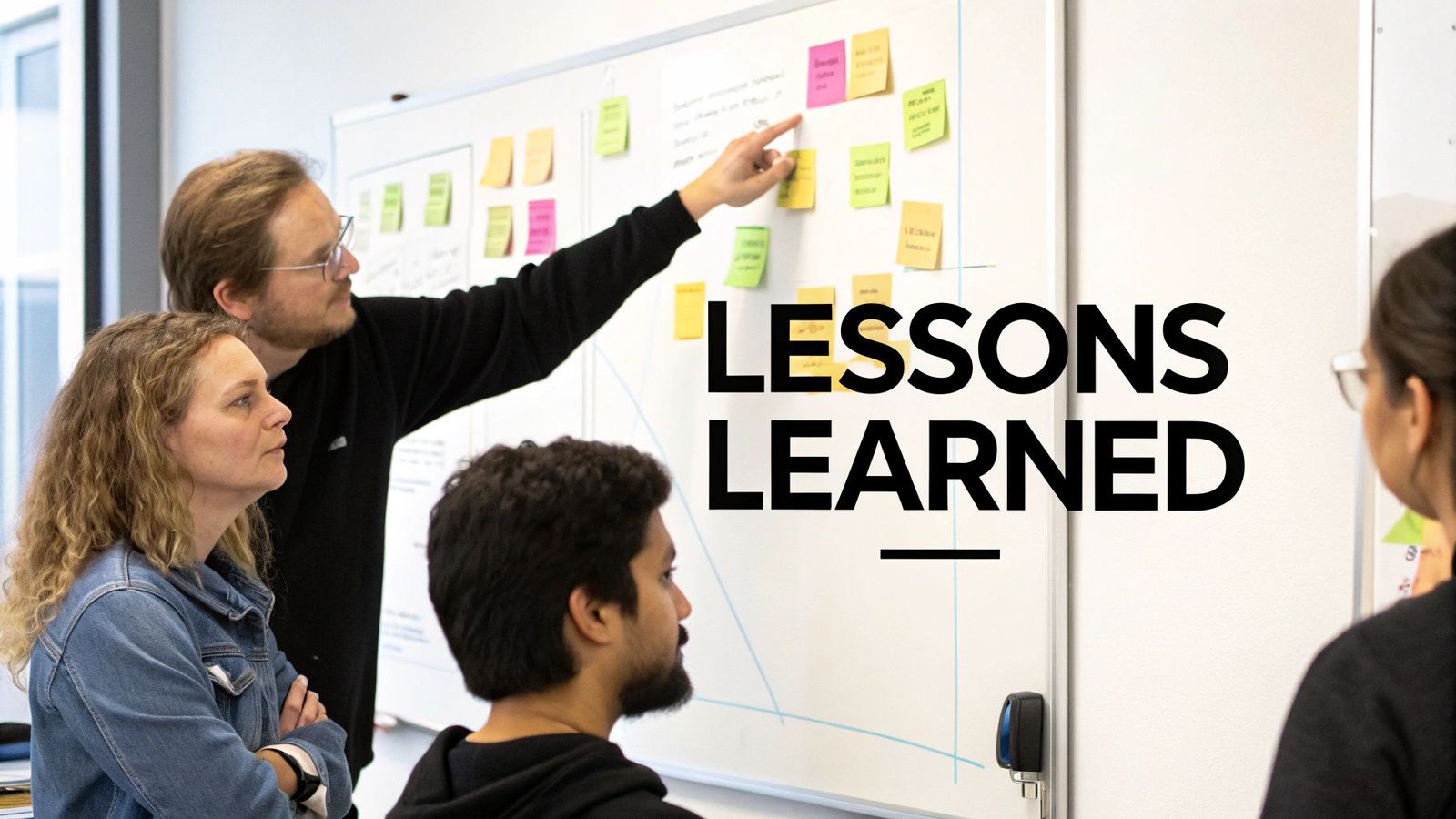
Pairing a Learning Management System (LMS) with collaborative social platforms gives you the best of both worlds. An LMS is great for delivering structured, formal training, while platforms like Slack or Teams are perfect for informal, peer-to-peer knowledge sharing. This combination covers both "book smarts" (formal knowledge) and "street smarts" (practical wisdom) by mixing curriculum-based learning with real-time conversation.
Together, these systems create a complete learning ecosystem. For example, an employee could take a project management course on the LMS and then jump into a dedicated Slack channel to discuss how to apply those lessons with colleagues. This approach ensures that formal training gets reinforced and put into context through ongoing, organic chats, making the knowledge stick. Integrating these platforms is a key step among the best practices for knowledge management because it bridges the gap between learning something and actually doing it.
Actionable Steps for Implementation:
A successful integration turns learning from a one-off event into a continuous, collaborative habit. The goal is to create a culture where people are empowered to both learn formally and share what they know freely.
- Combine Formal and Social Learning: After someone completes a training module in the LMS, direct them to a specific forum or channel to talk about it and share how they're using it.
- Establish Community Guidelines: Set clear rules for your social platforms to keep discussions productive and respectful. Appoint community managers to guide conversations.
- Gamify the Experience: Use badges, points, and leaderboards in both the LMS and collaborative tools to encourage participation. Give public kudos to top contributors.
- Integrate with Performance Management: Link the skills developed in the LMS to performance reviews and career paths. This shows a clear return on investment for everyone. For more on how learning tech is changing, explore the use of AI in education on the WhisperAI Education page.
9. Knowledge Transfer and Onboarding Programs
Knowledge transfer and onboarding programs are structured processes for getting new hires up to speed. This is way more than just a welcome packet; it’s a full-blown strategy for transferring both explicit knowledge (how to do the job) and tacit knowledge (how things really work around here). A great onboarding program dramatically shortens the time it takes for a new hire to become a productive, integrated member of the team.
These programs are vital for preventing knowledge loss and ensuring everyone is on the same page. By creating a standardized path for new team members, you can be sure they get all the crucial information they need, rather than relying on hit-or-miss, on-the-fly training. Think of Google's comprehensive onboarding that focuses on role clarity, or Zappos' famous culture-immersion program. They make knowledge transfer a deliberate, repeatable, and effective process.
Actionable Steps for Implementation:
Structured onboarding is one of the most critical best practices for knowledge management because it sets the tone for an employee's entire journey with your company. A great program reduces ramp-up time, boosts retention, and reinforces your culture of shared knowledge from day one. You can get more insights from the HR Professional's Guide to AI Transcription.
- Create an Onboarding Playbook: Document the entire onboarding process in your KMS. Include checklists, training materials, key contacts, and cultural guides. This becomes the go-to resource for every new hire.
- Assign a Mentor or Buddy: Pair each new employee with an experienced team member. This gives them a friendly face to go to with questions and helps transfer all that informal knowledge that isn't written down.
- Develop a Role-Specific Roadmap: Create a clear 30, 60, and 90-day plan with specific goals and milestones. This gives new hires a clear path to success.
- Measure and Iterate: Use surveys and check-ins to get feedback from new hires on their experience. Use that data to constantly improve the program for the next wave of employees.
10. Intellectual Capital and Assets Management
Intellectual Capital and Assets Management is the strategic process of identifying, protecting, and leveraging your company's intangible assets. This includes things like patents, trademarks, proprietary processes, and trade secrets. This practice takes knowledge management to the next level—it's not just about sharing information, it's about treating your most valuable knowledge as a core business asset that gives you a competitive edge.
From Coca-Cola's secret formula to Apple's design patents, many companies are defined by their unique knowledge. Managing this intellectual capital properly prevents it from being lost, copied, or undervalued. It requires a systematic approach to treating knowledge as a portfolio of valuable assets that can drive innovation, create barriers for competitors, and even generate revenue. This is one of the most advanced best practices for knowledge management, as it directly connects knowledge to business value.
Actionable Steps for Implementation:
Effective intellectual capital management isn't a one-time thing; it's an ongoing process. It's about building a framework to recognize and protect valuable knowledge from the moment it’s created.
- Conduct Regular IP Audits: Systematically review your operations to identify and catalog all your potential intellectual assets. This includes everything from software code to marketing strategies.
- Establish Strong Documentation and Protection Protocols: Implement clear procedures for documenting new inventions. Use Non-Disclosure Agreements (NDAs) and confidentiality agreements to protect sensitive information.
- Integrate IP into the Development Lifecycle: Build IP considerations right into your product development process. Don't wait until the end to think about patenting something.
- Train Employees on IP Awareness: Teach your team what intellectual property is and why it's important to protect it. This creates a culture where everyone understands the value of the knowledge they create and use every day.
10 Knowledge Management Best Practices — Comparison
| Approach | 🔄 Implementation complexity | ⚡ Resource requirements | 📊 Expected outcomes | 💡 Ideal use cases | ⭐ Key advantages |
|---|---|---|---|---|---|
| Knowledge Management Systems (KMS) | High — enterprise integration, governance | High — software, IT, content curation, maintenance | Centralized searchable knowledge, faster decisions, knowledge preservation | Large or distributed organizations needing single source of truth | Reduces silos, speeds information access, improves onboarding |
| Communities of Practice (CoP) | Medium — facilitation and coordination | Low–Medium — member time, facilitator support, light platforms | Peer learning, innovation, cross-functional knowledge sharing | Practice improvement, innovation, tacit knowledge exchange | Fosters innovation and culture, builds informal mentoring |
| Mentoring & Apprenticeship Programs | Medium — matching and program structure | Medium — mentor time, training, coordination | Accelerated skill development, higher engagement and retention | Onboarding, succession planning, deep skill transfer | Personalized learning, strong interpersonal networks |
| Storytelling & Narrative Knowledge | Medium — collection, curation, facilitation skills | Low–Medium — recording tools, skilled facilitators, curation time | Memorable tacit insights, contextualized lessons learned | Cultural transmission, complex decision rationale, onboarding | High engagement, preserves context and judgment |
| Documentation & SOPs | Medium–High — standardization, version control | Medium — writers, reviewers, document systems, reviews | Consistent, auditable processes, reduced errors, compliance | Regulated operations, repeatable tasks, quality control | Ensures consistency, scalable operations, compliance-ready |
| Expert Networks & Knowledge Mapping | Medium — mapping, validation, governance | Low–Medium — directory tools, upkeep, verification | Faster expert lookup, identifies knowledge risks and gaps | Project staffing, rapid consultation, mentoring matchmaking | Connects the right experts quickly, reveals dependencies |
| After Action Reviews (AAR) & Retrospectives | Low–Medium — facilitation and follow-up discipline | Low — facilitator/time, documentation of findings | Timely lessons learned, continuous improvement, team learning | Post-project reviews, incidents, agile teams | Captures fresh insights, prevents repeat mistakes, builds safety |
| LMS & Collaborative/Social Learning Platforms | High — platform selection, instructional design | High — licensing, content production, moderators, analytics | Scalable training, measurable outcomes, blended social learning | Compliance training, large-scale upskilling, blended programs | Scales learning, tracks progress, supports social knowledge sharing |
| Knowledge Transfer & Onboarding Programs | Medium — cross-functional coordination, program design | Medium — mentors, materials, HR coordination | Faster time-to-productivity, better retention, cultural fit | New hire integration, role handovers, critical role transitions | Accelerates productivity, improves retention and cultural fit |
| Intellectual Capital & Assets Management | High — legal, valuation, protection processes | High — legal fees, IP experts, monitoring systems | Protected IP, monetization opportunities, strategic valuation | R&D-heavy firms, patented products, M&A due diligence | Preserves competitive advantage, enables licensing and valuation |
From Theory to Transformation: Your Next Steps in Knowledge Management
Working through these ten best practices reveals a core truth: great knowledge management isn't about buying one piece of software. It’s about building a living, breathing ecosystem where information flows freely and expertise is shared generously. This isn't just a nice-to-have; it's a strategic imperative that will change how your entire organization learns, innovates, and grows.
We’ve covered a full toolkit—from the organized digital libraries of a KMS and the crystal-clear instructions of SOPs to the human-to-human connections of CoPs and mentorships. We've seen how AARs turn experiences into wisdom and how Expert Networks make hidden talent visible. Each of these practices is a piece of the puzzle to building a smarter, more resilient company.
The Core Takeaway: Integration Over Isolation
Here's the most important part: these practices work best together. Your KMS is only as good as the knowledge you capture from your AARs. Your mentoring programs become even more powerful when supported by the learning content in your LMS. The stories shared in your CoP can become the basis for new, better SOPs.
The goal isn't to do all ten things at once. That's a recipe for burnout. The goal is to see them as interconnected parts of a bigger strategy. Real transformation happens when these elements work together, creating a culture where sharing knowledge is as natural as breathing. That is the heart of mastering the best practices for knowledge management.
Your Actionable Next Steps
Start small, but start now. Don't try to boil the ocean. Instead, pinpoint your company's biggest knowledge-related headache and pick one or two practices that directly address it.
- Is valuable expertise walking out the door when employees leave? Start with a solid Knowledge Transfer program and a mentorship initiative.
- Are teams constantly reinventing the wheel or making the same mistakes? Prioritize After Action Reviews and get serious about your SOPs.
- Is innovation stuck in silos? Launch a Community of Practice to get your passionate experts talking to each other.
Once you have a starting point, run a small pilot. Measure the results, get feedback, and tweak your approach before you roll it out company-wide. This iterative process builds buy-in and shows real value from the get-go.
Unlocking Your Hidden Knowledge Base
A huge first step is looking at how you capture knowledge right now. So much of your organization's most valuable expertise is shared out loud—in meetings, training sessions, and client calls. This spoken knowledge is often your biggest untapped resource. It's filled with context and nuance, but it disappears the second the meeting ends.
This is where modern technology is a game-changer. By transcribing your audio and video content, you can turn hours of fleeting conversations into a permanent, searchable knowledge base. This text can feed your KMS, become the raw material for SOPs, serve as training content for your LMS, or provide shareable insights for your CoPs. You're effectively creating a rich new layer of intelligence that supports almost every practice we've discussed.
Ultimately, adopting these best practices for knowledge management is an investment in your people and your future. It's about creating an environment where every person is empowered to contribute, learn, and grow. You're not just organizing information; you're building a smarter, more agile organization that's ready for anything. The journey begins not with a massive overhaul, but with a single, smart step.
Ready to unlock the vast knowledge hidden in your meetings and conversations? WhisperAI offers best-in-class transcription to automatically convert your spoken expertise into accurate, structured text. Start building a richer, more searchable knowledge base today by visiting WhisperAI and see how easy it is to capture what truly matters.