How to Improve Note Taking Skills for Maximum Recall
Learn how to improve note taking skills with a modern workflow. Discover methods and AI tools that transform how you capture and organize important information.
tl;dr: The best way to improve your note-taking skills is to use a hybrid approach. During a meeting or lecture, use a classic method like Cornell or outlining to capture the main ideas and stay engaged. At the same time, record the audio. Afterward, use an AI transcription service to get a perfect transcript. By combining your focused notes with the full text, you get the best of both worlds: active learning and a complete, searchable record.
The secret to leveling up your note-taking isn't about choosing between a pen and paper or some fancy AI tool—it's about making them work together. Picture this: you're in a meeting, and instead of frantically trying to type every word, you're using a simple system like the Cornell Method to jot down the big ideas, questions, and action items. You’re actually listening and processing, not just transcribing.
Meanwhile, you're quietly recording the audio. Later, you can run that recording through a service like whisperai.com/ai-transcription to get a flawless, word-for-word transcript. By merging your focused, high-level notes with that complete text, you create a powerful knowledge asset you can actually use, without the stress of trying to capture everything in real-time.
Your Guide to Unlocking Better Note Taking

We've all been there: sitting in a meeting, frantically trying to scribble down every last word, only to look back at a page of chaotic, unusable notes. It’s a common frustration, and frankly, it's exhausting. It feels like you're missing the conversation because you're so busy trying to write it down.
But what if you reframed note-taking? Instead of seeing it as a tedious chore, think of it as a skill that helps you listen better, understand complex topics more deeply, and recall information when you need it most. It's about engagement, not just documentation.
This guide will walk you through a modern, hybrid approach that blends classic strategies with today’s smart technology. This process is designed to reduce your mental strain during the meeting itself. By letting tech handle the heavy lifting of capturing every detail, you can focus on what truly matters—understanding the conversation as it unfolds.
For a fascinating look at how our brains process information and why this matters for learning, I highly recommend exploring the principles of Cognitive Load Theory. It really explains why trying to do too much at once just doesn't work.
Finding Your Foundational Note Taking Method
The secret to better note-taking isn't finding one perfect system. It's about building a toolkit. The best method for you is the one that actually clicks with how your brain works, not one you have to force yourself to use.
Let’s look at a few solid methods you can adapt for just about any situation.
For the Visual Thinkers: The Mapping Method
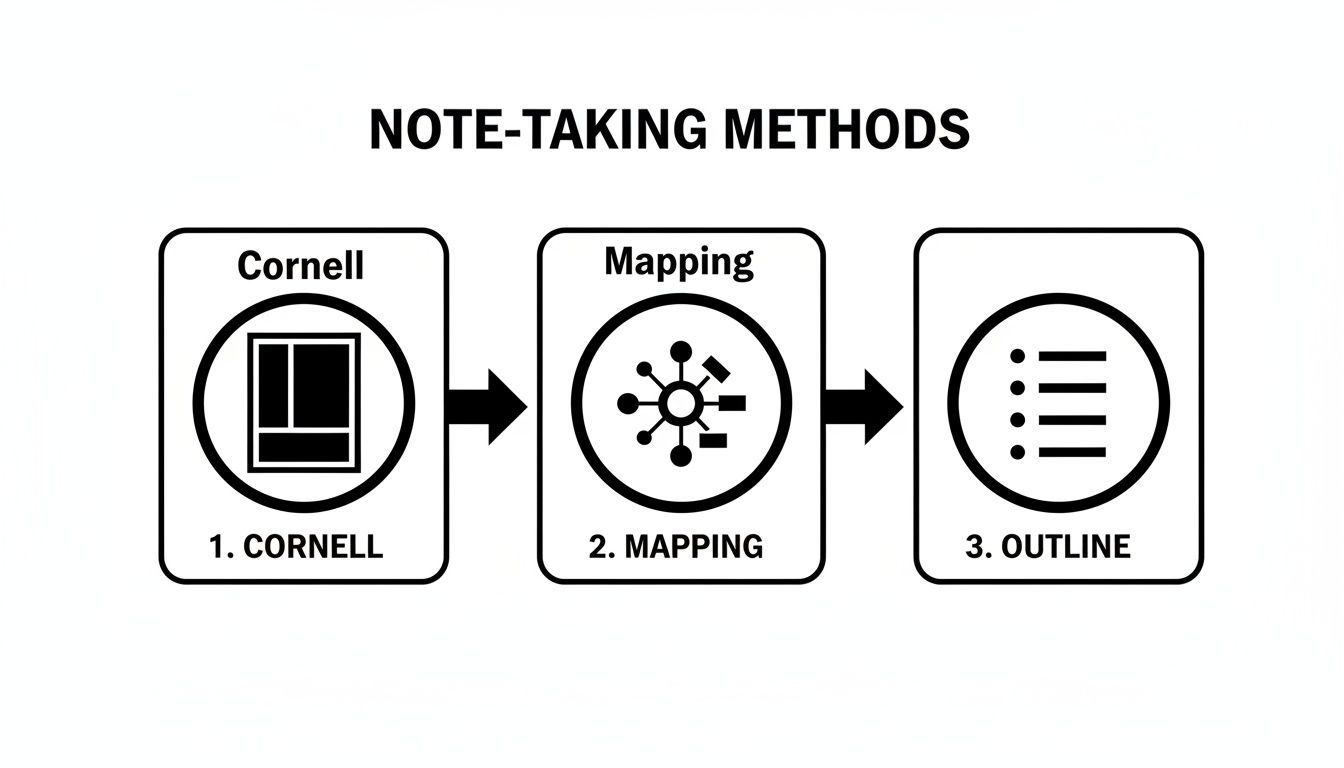
If you think in pictures and connections, the Mapping Method will feel like a breath of fresh air. It’s perfect for brainstorming sessions or complex lectures where seeing the relationship between ideas is everything. You simply start with a main idea in the center and branch out with related concepts.
This creates a non-linear, visual map of the conversation, letting you see the big picture at a glance. It's less about order and more about flow.
For the Structure-Seekers: The Outline Method
For those of us who need a bit more order, the Outline Method is a reliable classic. This is your standard, hierarchical system using bullet points and indentation to organize information logically as you hear it. It's probably how you were taught to take notes in school.
It's my go-to for meetings with a clear agenda or presentations that follow a predictable path. It just makes sense and is easy to scan later.
For the Active Learners: The Cornell Method
And then there's the Cornell Method, which is a powerhouse for anyone who wants to do more than just record information. It forces you to actively process what you’re hearing on the spot, which is a game-changer for retention.
You divide your page into three sections:
- A large column for your main notes.
- A smaller side column for key questions and cues.
- A summary section at the bottom to distill the most important takeaways.
This built-in review process is what makes it so effective for really learning the material, not just copying it down.
The goal isn’t to master just one system, but to become flexible. Knowing which method to pull out for the right context is the first real step toward turning your notes from a simple transcript into a tool for real understanding and better personal productivity.
When you start pairing these foundational skills with the right digital tools, things get even better. Platforms like Notion can be incredibly powerful, but you have to know how to use them. To get a head start, check out these 10 tips to get the most out of Notion.so.
Choosing the right approach can feel overwhelming, so I've put together a quick comparison to help you decide which method might work best for you depending on the situation.
Which Note Taking Method Is Right for You
| Method | Best For | Strengths | Weaknesses |
|---|---|---|---|
| Mapping Method | Brainstorming, complex topics, visual learners | Shows relationships, flexible, great for big-picture thinking | Can get messy, not ideal for linear information |
| Outline Method | Structured lectures, meetings with agendas | Organized, logical flow, easy to review | Can be too rigid for creative sessions, hard to add new ideas later |
| Cornell Method | Studying, retaining information, active learning | Promotes active recall, organized, excellent for review | Requires more effort upfront, can be slow for fast-paced talks |
Ultimately, the best way to find what works is to just try them. Pick one that seems like a good fit for your next meeting or lecture and see how it feels. You might be surprised by what sticks.
Bringing AI Into Your Note-Taking Workflow
This is where traditional note-taking methods get a powerful boost. Imagine being completely dialed-in during a meeting or lecture, not stressed about catching every single word. That's what this modern approach makes possible.
The strategy is straightforward: use your go-to manual method—like one of the classics shown below—to jot down big-picture ideas, questions that pop into your head, and any clear action items. While you're focused on actually participating, you also hit record on the audio.
Later, you just feed that recording into an AI transcription service. The result? A perfect, word-for-word transcript. This two-pronged attack enhances your own skills—you focus on understanding the why, while the AI handles the what.
The Power of an AI Safety Net
This hybrid workflow has become a real game-changer, mostly because AI transcription is just so darn accurate now. The market for AI note-taking tools was valued at $2.1 billion and is expected to reach $12.8 billion by 2033. That’s a massive jump, and it shows just how many professionals are leaning on this tech to be more effective.
Services like WhisperAI are especially good at this, reliably picking up technical jargon, different accents, and even filtering out background noise. If you want to dive deeper, we have a whole guide on AI audio transcription.
This isn't about replacing your ability to take good notes. It’s about supercharging it. You capture the essential insights by hand, and the AI provides a perfect, searchable safety net for every detail you might have missed.
Turning Raw Transcripts Into Actionable Knowledge

Getting an accurate transcript is a huge win, but it’s really just the starting point. The real value comes from turning that wall of text into something you can actually use. A raw transcript is data; a refined transcript is knowledge.
Think of it this way: your handwritten notes are the map, and the transcript is the detailed terrain. Use your notes to quickly skim the full transcript and pinpoint the most important moments, saving you from having to read every single word.
This is where you transform a fleeting conversation into a permanent, organized record.
From Text to Task
Your first pass-through of the transcript shouldn't be passive reading. You need to actively pull out the essentials and give them structure.
- Highlight Key Decisions: Get your highlighter tool ready. Mark every final decision, major agreement, or "aha!" moment so they stand out immediately on future reviews.
- Define Action Items: Hunt down every task that was assigned. Don't just copy it—rephrase it as a clear, actionable command. For example, "Alex will look into the numbers" becomes "Alex: Pull Q3 sales data for Friday's meeting."
- Extract Important Quotes: Snip out any powerful statements, key phrases, or soundbites that perfectly capture the core ideas of the discussion.
This refinement process is what truly improves your note-taking skills. It shifts the transcript from being a passive record into an active tool for follow-up, reference, and deeper understanding.
Building this structured document is infinitely more reliable than trying to recall who said what a week later. If you're looking for a solid tool to get that initial transcript, check out our guide on finding a great audio to text converter.
It's no surprise that the market for these tools is booming. The note-taking app market was valued at $7.79 billion in 2023 and is expected to reach $22.57 billion by 2030. You can discover more about these market trends here.
Alright, let's put theory into practice. Knowing how to do something is one thing, but actually building a skill that sticks takes repetition. The best way to make this new hybrid note-taking workflow feel like second nature is to start small.
You don’t want your first test drive to be a high-stakes board meeting. That’s way too much pressure.
Instead, find some low-stakes opportunities to build your confidence. Think about your next casual team check-in, an interesting industry podcast you’ve queued up, or even a compelling TED Talk you’ve been meaning to watch. These are the perfect training grounds to work out the kinks.
Your First Practice Run: A Simple Game Plan
The goal for your first attempt isn't perfection—it's just about getting comfortable with the process. Pick a short podcast or a low-key meeting and just follow the flow.
- During the Event: Forget trying to capture everything. Just focus on jotting down the big ideas, any questions that pop into your head, and maybe a few striking quotes. Stick to your favorite manual method—pen and paper, a notes app, whatever—but keep it minimal. Your primary job is to be present and listen, not to act like a court reporter.
- Afterward: This is where the magic happens. Take your audio recording and run it through a reliable service like WhisperAI’s AI transcription.
- Review and Refine: Now, open up the transcript and use your handwritten notes as a roadmap. They'll help you jump to the most important parts. From there, you can easily pull out any action items, highlight key decisions, and maybe add a quick summary at the top for context.
This isn’t just a niche trick; it’s quickly becoming how things get done. A 2023 report found that 46% of business users are already relying on advanced note-taking tools. If you're curious, you can learn more about these note-taking trends.
Got Questions About Upgrading Your Note-Taking?
As you start mixing timeless note-taking skills with new tech, you're bound to have a few questions. I've been there. Let's tackle some of the most common ones I hear.
How Long Does It Really Take to Get Good at a New Note-Taking Method?
Honestly, you'll likely start feeling comfortable with a system like the Cornell Method or mind mapping within a week or two of using it consistently. The trick isn't just about following the rules; it's about making the system work for you and how you think.
What's interesting is that bringing an AI tool into the mix can actually shorten that learning period. When you're not scrambling to write down every single word, your brain is free to focus on the big picture and connect the dots. That's the real goal of note-taking, isn't it?
My Advice: Forget about perfection right out of the gate. Focus on building the habit. Try out your new method on something low-stakes, like a podcast or a casual team meeting. This builds confidence before you take it into a high-pressure client call or a critical lecture.
Is It Awkward to Record Meetings for My Notes?
This is a big one, but it really just boils down to being upfront about it. It’s not rude at all, as long as you ask for permission before you hit the record button.
I’ve found a simple, direct approach works best: "Hey, do you mind if I record this just for my notes? It really helps me stay engaged in our conversation." Most people are fine with it and even appreciate that you're committed to getting the details right. Just make sure you're clear on your company's recording policy or any local laws.
Can AI Transcription Just Replace My Manual Notes Altogether?
Not quite. It's much more effective to think of them as a tag team. Each has a specific job to do, and they work together brilliantly.
- Manual Notes Boost Your Brain: The physical act of jotting down key ideas—whether by hand or typing—is crucial for actually cementing that information in your memory. This is where the real learning happens.
- AI Transcription Catches Everything Else: Think of the AI transcript as your flawless, searchable safety net. It’s the verbatim record that guarantees no detail, quote, or number gets missed.
The best workflow uses both. You take your own notes to capture your in-the-moment thoughts and key takeaways, and the transcript provides the complete, accurate record you can clean up and refer back to later. You get the benefit of active listening and total recall.
Ready to create a flawless, searchable record of every important conversation? WhisperAI provides professional-grade AI transcription that captures every detail with unmatched accuracy, letting you focus on what truly matters. Explore the power of perfect notes with our AI transcription service today.