European transcription: A Practical Guide to Multilingual Compliance
European transcription: a concise guide to multilingual challenges, GDPR compliance, and AI solutions for accurate results in Europe.
tl;dr: Transcription in Europe is uniquely complex. You're not just converting audio to text; you're navigating 24+ official languages, countless dialects, and the world's strictest data privacy law (GDPR). Success requires an AI solution built for this reality—one that can handle multilingual conversations, understand regional accents, and guarantee your data stays secure within the EU.
Transcription in Europe is a different beast altogether. It's not just about turning audio into words; it’s about navigating a rich, complex tapestry of languages, dialects, and some of the world's strictest data privacy laws. Think of it less like a simple typing task and more like the work of a skilled UN interpreter—someone who needs deep cultural and legal context, not just fluency.
What Is European Transcription?
At its heart, European transcription is the process of converting speech from audio or video into written text, but with a crucial twist: it's built to handle the unique linguistic and regulatory landscape of Europe. This isn't your standard, one-size-fits-all transcription service. It has to account for the continent's staggering diversity.
Let's take a common scenario: a business meeting in Brussels. In a single conversation, you might hear French, Dutch, and English, often in the same sentence. This is called code-switching, and it's where most generic transcription tools completely fall apart, leaving you with a jumbled, useless mess of a script. A true European transcription solution, however, is designed to manage this kind of complexity with ease.
To really get a handle on it, let's look at the three pillars that define this work. Each brings its own unique challenges, but also shows a clear path forward—especially when you bring modern AI into the picture.
The Three Pillars of European Transcription
- Linguistic Diversity: Europe has 24 official EU languages and over 200 spoken languages in total. That's before you even get to the thousands of regional dialects and accents that can completely change how words are pronounced and used.
- Regulatory Compliance: The General Data Protection Regulation (GDPR) is the law of the land, and it's not something you can ignore. Any transcription involving personal data must follow its strict rules on how data is stored, processed, and secured. Getting this wrong can lead to massive fines—up to €20 million or 4% of your company's global annual turnover.
- Industry-Specific Nuances: A legal deposition in Paris uses a completely different vocabulary than a medical conference in Berlin. High-quality transcription needs to understand this specialized terminology to be accurate and truly useful.
Transcription in Europe isn't just a technical task; it's a strategic process. Getting it right means balancing linguistic accuracy with unwavering legal compliance, a challenge where advanced AI now offers a powerful advantage.
This guide is your practical roadmap. We'll dive into each of these pillars, breaking down the specific hurdles you'll face and showing you how to manage transcription accurately and securely across the entire continent.
The Unique Challenges of Transcribing in Europe
Transcribing audio in Europe isn’t like working in a more linguistically uniform place, such as North America. It’s a lot like trying to navigate a bustling international food market instead of a single supermarket aisle—the variety is immense, and you need a specialized touch to get things right. The continent's rich mix of languages and cultures creates some very specific, practical hurdles that standard transcription tools often stumble over.
Simply put, a one-size-fits-all approach to European transcription is destined to fail because the audio itself is rarely one-size-fits-all.
The Complexity of Multilingual Audio
Picture a typical business meeting in Frankfurt between German executives and their partners from the UK. The conversation might start in German, switch to English to nail down a technical point, and then flip right back. This mixing of languages, known as code-switching, is incredibly common across European business, research, and even daily life.
Most generic transcription software just hears this as noise. It will likely try to process the entire conversation in a single language, leaving you with a nonsensical script riddled with errors. A truly effective European transcription platform has to be smart enough to detect and accurately transcribe multiple languages within the same audio file, sometimes even within the same sentence. Without that, the final text is all but useless.
A transcription model that can't handle code-switching in a European context is like a GPS that only recognizes highways—it's completely lost once you turn onto a local road. It fails to capture how people actually communicate.
Navigating Accents and Dialects
The sheer diversity within a single language is also staggering. The French spoken in Paris sounds quite different from the French you'll hear in Marseille or Brussels. In the same way, the Spanish used in Madrid has distinct phonetic and vocabulary differences from the Catalan-accented Spanish spoken in Barcelona. These aren't just subtle quirks; they can fundamentally change pronunciation and word choice, which easily trips up AI models trained only on a "standard" version of the language.
For instance, a standard Spanish model might completely misinterpret words or phrases from an Andalusian speaker, leading to serious inaccuracies. A robust European transcription solution needs to be built on AI trained with huge datasets that account for all these regional variations.
This linguistic depth sets a very high bar for accuracy. It requires much more than basic language support; it demands a deep, nuanced understanding of how people actually talk across the continent.
The Problem of Industry-Specific Jargon
The final layer of complexity is all the specialized terminology. Every industry has its own unique vocabulary, and this challenge is magnified across Europe’s diverse markets.
- Legal Sector: A legal deposition at the EU Parliament in Brussels will be packed with complex jargon specific to European law.
- Medical Field: A medical consultation in a German hospital will use precise clinical terms where there is absolutely no room for error.
- Finance: A banking conference in Zurich will be full of financial terminology unique to Swiss and European markets.
Generic transcription models don't have the context for this kind of specialized language and often produce phonetic guesses that are wildly incorrect. This can have serious consequences, turning a critical legal record or a patient's medical history into a document filled with dangerous mistakes. To achieve real accuracy in European transcription, you need a system that can recognize and correctly spell this niche terminology.
Transcription work in Europe is a specialized field with a unique set of obstacles. The table below breaks down some of the most common challenges you're likely to encounter.
Key Transcription Challenges in Europe
| Challenge Type | Description | Example Scenario |
|---|---|---|
| Multilingual Audio (Code-Switching) | Speakers switch between two or more languages in a single conversation, confusing models trained on one language. | A business call between a French and Dutch team where technical terms are in English. |
| Regional Accents & Dialects | Strong regional accents or dialects deviate significantly from the "standard" version of a language, causing misinterpretations. | A customer service call with a speaker from Naples, Italy, whose dialect confuses a standard Italian AI model. |
| Industry-Specific Terminology | Niche jargon from fields like law, medicine, or finance is not recognized by general-purpose transcription models. | Transcribing a clinical trial report that includes highly specific pharmaceutical drug names and medical procedures. |
| Data Privacy & Residency (GDPR) | Strict regulations require that personal data be processed and stored within the EU, complicating the use of non-compliant cloud services. | A university researcher transcribing sensitive interviews must ensure their transcription provider is GDPR-compliant and stores data locally. |
Navigating these challenges requires more than just a good piece of software; it requires a solution specifically designed for the complexities of the European continent.
Navigating GDPR and Data Security in Transcription
When you're working with European transcription, it’s impossible to ignore the four most important letters in data privacy: GDPR. The General Data Protection Regulation isn't just a guideline—it's a strict legal framework that dictates exactly how audio and text data must be handled in Europe. Getting this wrong is simply not an option.
Think of GDPR as a digital passport for personal information. It controls where that data can go, who can look at it, and why. Ignoring these rules comes with serious consequences, including fines that can reach €20 million or 4% of a company's global annual turnover. The reputational damage can be just as costly.
This entire framework rests on a few core ideas that directly affect any transcription project.
Core GDPR Principles for Transcription
Getting a handle on these concepts is the first step to creating a process that’s fully compliant. They aren't just legal buzzwords; they're the practical ground rules for managing data responsibly.
- Data Residency and Sovereignty: At its core, this means that data from EU citizens should stay within the EU. Storing and processing it on European servers keeps it under European legal protection.
- Data Minimization: Only transcribe what you absolutely need. If you’re analyzing a customer service call for product feedback, for instance, there's no reason to capture and store personal details that aren't relevant to that goal.
- Purpose Limitation: You have to be crystal clear about why you're transcribing something and stick to that reason. You can't transcribe a team meeting for internal notes and then decide to use those same transcripts for a marketing campaign without getting fresh, explicit consent.
Building a Compliant Workflow
Making sure your transcription process is up to snuff requires a forward-thinking approach. Security and compliance can’t be an afterthought; they need to be baked in from the very beginning.
The heart of GDPR is accountability. It puts the responsibility squarely on organizations to prove they are actively protecting personal data—and that includes every audio file and its transcript.
A great way to strengthen your security is to adopt a Zero Trust security model, which treats every access request with suspicion and verifies it rigorously. This ensures that only authorized individuals can access sensitive transcription data, aligning perfectly with GDPR's demands.
Choosing a transcription partner who gets these rules is essential. For a clear idea of what to look for, you can see how we approach it by reviewing https://whisperai.com/privacy.
The United Kingdom is a perfect example of this in action. It's a major market where cloud-based transcription has taken off, driven by the need to meet strict GDPR standards. The UK’s National Health Service even reported a 40% drop in administrative tasks by using transcription software, proving that strong compliance and great efficiency can absolutely go together.
Ultimately, handling data security in Europe means treating people's information with the respect it deserves. When you build your workflow around GDPR's principles, you do more than just avoid legal headaches—you build lasting trust with your customers and partners across the continent.
How AI Transcription Tackles Europe's Unique Challenges
Let's be honest, transcribing audio from across Europe is a huge headache. You're not just dealing with different languages, but with a complex mix of regional accents, industry jargon, and strict GDPR rules. Traditional transcription methods and generic software just can't keep up, often leading to frustrating inaccuracies and serious compliance risks.
This is exactly where a modern, enterprise-grade AI transcription platform comes in. It’s not just another tool; it's a complete solution designed specifically for these thorny European challenges.
It All Starts with Smarter Training
Think of an AI model like someone learning a language. If they only read formal textbooks, they’ll be completely lost in a real-world conversation full of slang and regional dialects. It's the same with AI. An engine trained only on "standard" German will stumble badly when it hears a speaker with a thick Bavarian accent.
The best enterprise platforms get around this by training their AI on massive, diverse datasets. We're talking countless hours of real-world audio from all over Europe, which teaches the AI to:
- Handle Code-Switching: Seamlessly follow and transcribe conversations that jump between languages, like a meeting that switches from French to English and back again.
- Recognize Dialects: Accurately capture what’s being said, whether it’s a speaker from Naples or Milan, Lisbon or Porto.
- Understand Jargon: Process highly specialized terminology from legal, medical, or financial fields without mangling the words into nonsense.
This level of accuracy is what turns European transcription from a high-effort, error-prone chore into a smooth and reliable workflow.
Built for Scale and Strict Compliance
Accuracy is one thing, but businesses and researchers also generate a staggering amount of audio. Enterprise AI is built to handle this volume. These platforms are designed to scale, letting you process thousands of hours of audio without the system grinding to a halt.
For many organizations, providing broad access is also a key goal, which is why AI auto-captioning for enhanced accessibility has become so important.
More critically, the best solutions are designed with compliance baked in from the start. They offer features specifically for meeting GDPR, like on-premise deployment options and tough security protocols. This means your sensitive data stays secure and within European legal boundaries, making AI a powerful and safe strategic asset.
The growth here is undeniable. In the medical sector alone, the European transcription market is expected to jump from USD 0.88 billion to about USD 3.24 billion by 2033. You can read the full research on the European medical transcription software market to see the trends.
This blend of accuracy, scale, and security makes a modern AI platform an essential partner for anyone working with European audio. To see how this same technology helps with live communication, check out our guide on how AI can support real-time translation for global teams.
Best Practices for Your Transcription Workflow
Getting European transcription right involves more than just hitting the record button. A solid, repeatable process is what separates a garbled mess from an accurate, secure, and compliant transcript. It saves a lot of headaches and costly fixes later on.
The whole thing starts with picking the right tool for the job. Don't just look at the advertised accuracy rates. You need to dig deeper. Does the platform truly support the specific European languages and dialects you're working with? Can you confirm it’s fully GDPR compliant and offers data storage within the EU? Nailing this first step sets you up for success.
Preparing Your Audio for Maximum Quality
A simple truth in transcription is that your output can only ever be as good as your input. Garbage in, garbage out. To give any transcription software a fighting chance, you have to start with clean audio.
- Kill the Background Noise: Find a quiet room. Street noise, office chatter, or even a humming air conditioner can tank your accuracy.
- Use a Decent Microphone: Your laptop's built-in mic just won't cut it for important recordings. A dedicated external microphone captures voices with far more clarity, which makes a world of difference.
- Speak Clearly: Ask speakers to face the microphone and talk at a natural, steady pace. Mumbling, crosstalk, and rapid-fire speech are the enemies of an accurate transcript.
Review and Edit for Perfection
For anything important—be it legal proceedings, medical notes, or academic research—the automated transcript should be treated as a first draft. Always have a human give it a final look.
This human review step is where you catch the nuances the AI missed, correct specialized terminology, and fix any misunderstood words. It's an essential quality check. To really dive into the nitty-gritty of perfecting your process, take a look at our complete guide to AI audio transcription.
This simple visual breaks down why a dedicated AI solution is so critical for navigating the complexities of European transcription.
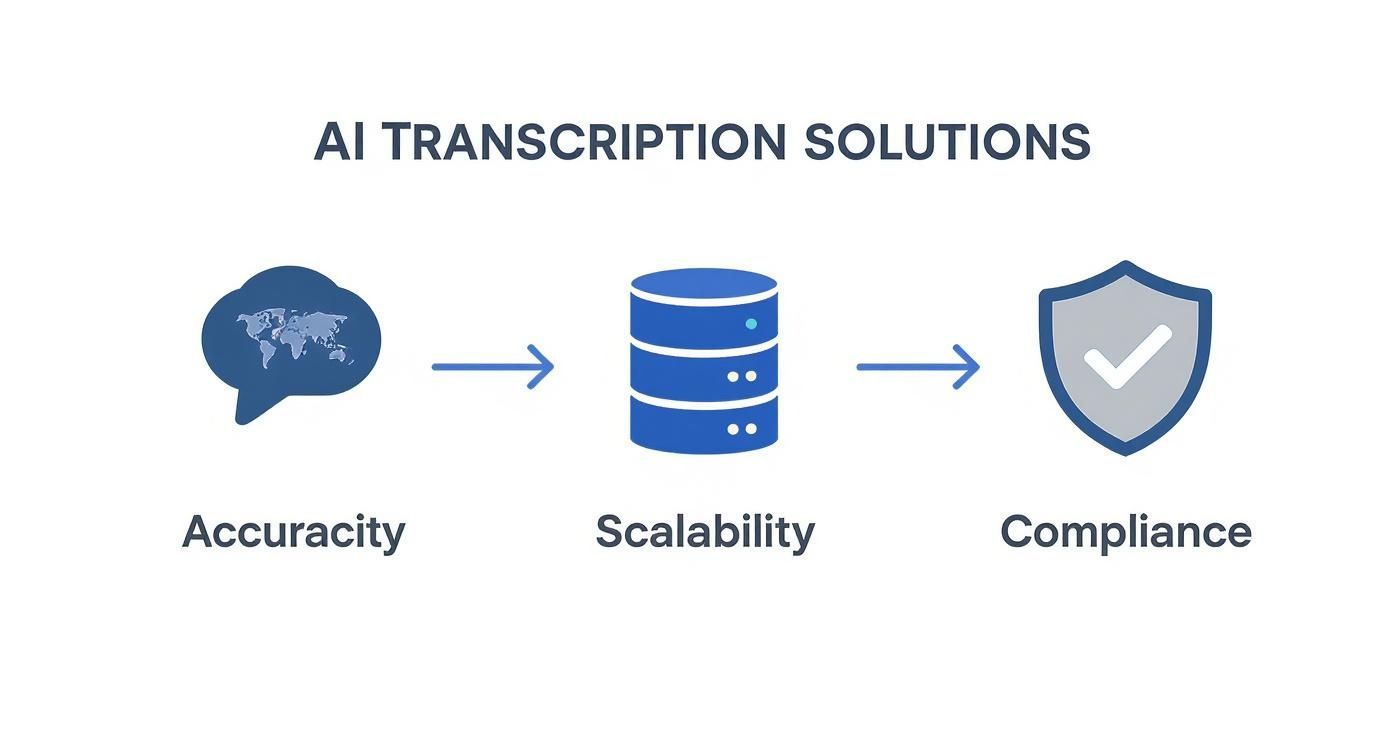
It really shows how the right platform has to balance three key things: pinpoint accuracy, the ability to handle huge volumes of audio, and strict compliance with Europe's unique regulatory demands.
What's Next for Transcription in Europe?
Looking ahead, the world of European transcription is being reshaped by two major forces: government policy and technology. Across the continent, there's a huge push for things like standardized digital health records and tougher documentation rules. This isn't just a small shift; it's creating a massive demand for transcription services that are both reliable and incredibly accurate.
We see this playing out most clearly in healthcare. Telemedicine has exploded in recent years, and it absolutely depends on accurate transcription to create a reliable record of every virtual consultation. This simple act of turning a conversation into a searchable document is vital for ensuring good patient care and protecting everyone involved.
The Big Picture: Economic and Policy Shifts
Countries that spend a lot on healthcare, like Germany and France, are really leading the charge here. Along with the UK, they’re setting the pace with their advanced digital health systems. To put it in perspective, healthcare spending in the European Union recently hit about €3,865 (USD 3,805) per person, which is a staggering 10.4% of the EU’s GDP. That number tells you just how serious the investment in digital tools has become. You can dig deeper into the European medical transcription market on imarcgroup.com.
This financial push is backed by real policy changes. A few key things are driving the momentum:
- Tougher Documentation Rules: New regulations demand that organizations keep meticulous records, which makes automated transcription less of a "nice-to-have" and more of a necessity.
- The Rise of AI Tools: Companies are actively looking for smart AI solutions to help them manage the ever-growing mountain of audio data they have to deal with.
- Pan-European Health Records: The European Commission is working hard to create standardized digital health records that work seamlessly across all member states.
Where the Technology is Headed
The technology itself is also moving at an incredible speed. We're quickly going past basic speech-to-text and entering an era where AI is woven directly into how we work every day. It won't be long before real-time transcription and translation during multilingual meetings are just standard features, instantly breaking down language barriers.
The future of European transcription isn’t just about getting words on a page. It’s about deeper integration and real intelligence. AI is evolving from a simple scribe into an active assistant—one that understands context, pulls out key action items, and offers up insights as they happen.
This isn’t just a market that’s growing; it’s getting smarter and more indispensable. For any organization working in Europe, keeping an eye on these developments is critical. The ability to handle audio data efficiently and securely is quickly becoming a major key to success.
Got Questions About European Transcription? We’ve Got Answers.
When you're dealing with audio from Europe, a few common questions always pop up. It’s a unique landscape, so let's clear up some of the most frequent queries we hear.
What Makes European Transcription So Tricky?
It really boils down to two things: the sheer variety of languages and strict data privacy laws. Europe is a mosaic of languages, dialects, and accents packed into a small space. For a transcription tool to be accurate, it needs to be trained on hyper-local audio data.
On top of that, you have the General Data Protection Regulation (GDPR). It sets a global standard for data privacy, enforcing rules on how personal information is collected, stored, and used that are much tougher than what you’d find in other parts of the world.
How Do I Know if a Transcription Service is GDPR Compliant?
Don't just take their word for it—look for concrete proof. A truly compliant provider will be transparent about their practices.
Here’s what to check for:
- Data residency in the EU: They must guarantee your data stays within European borders.
- End-to-end encryption: Your files should be protected from the moment you upload them.
- A solid Data Processing Agreement (DPA): This is a legally binding contract that outlines exactly how they handle your data.
Be direct. Ask potential vendors where their data centers are and what specific security measures they have in place. It's the only way to be sure you're meeting your legal obligations.
What’s a Realistic Accuracy Rate for European Languages?
With a good AI tool and clear audio, you can expect accuracy rates north of 95% for common European languages like French, German, or Spanish.
But "ideal conditions" are rare. Real-world factors like background noise, thick accents, or specialized jargon can definitely knock that number down.
For anything important—legal proceedings, medical notes, critical research—always plan for a final human review. It’s the only way to catch nuances and ensure the final transcript is 100% reliable.
Ready to tackle your European transcription challenges with confidence? WhisperAI offers enterprise-grade accuracy, scalability, and GDPR compliance, turning hours of complex audio into searchable text in minutes. Discover the #1 AI Transcription solution today at https://whisperai.com.