A Guide to the Transcript of Deposition: Your Key to Legal Testimony
Discover what a transcript of deposition is and why it's a critical legal tool. Learn how it's created, used, and secured to gain a strategic edge.
tl;dr: A transcript of deposition is the official written record of sworn testimony given before a trial. It’s an essential tool for legal teams to understand the facts, prepare for court, and hold witnesses accountable for their statements. Modern AI transcription tools like those from whisperai.com/ai-transcription are now making this process faster, more affordable, and more accessible than ever, giving legal professionals a significant advantage.
So, what exactly is a transcript of deposition? Simply put, it's the official, word-for-word written account of testimony given by a witness under oath. This doesn't happen in a courtroom but in a less formal setting, yet the words carry the full weight of the law. Think of it as freezing a witness's story in time, creating a definitive record that can be analyzed, challenged, and used throughout a legal case.
The Power of the Official Record
Let me paint a picture for you. Imagine you're deep in a high-stakes corporate lawsuit. After months of discovery, you're finally deposing a key executive. Under the pressure of questioning, they make a single, seemingly minor admission—a detail that completely contradicts the company's entire defense. That one sentence, captured precisely in the official transcript of deposition, becomes the "smoking gun" that can dismantle their whole case, often forcing a favorable settlement.

This isn't just something you see in movies; it happens all the time in real-world litigation. The deposition transcript is far more than just a stack of paper. It’s the very bedrock of legal strategy.
Here are a few of its most critical functions:
- Locking in Testimony: It creates an unchangeable record of a witness's statements. This prevents them from conveniently changing their story later on the stand.
- Uncovering Facts: Depositions allow attorneys to dig into every detail of a case without the time pressures of a courtroom, which often reveals crucial information that was previously hidden.
- Challenging Credibility: If a witness’s trial testimony suddenly differs from what they said in their deposition, the transcript becomes your best weapon. You can use it to impeach them, showing the jury that their story has changed.
The Bedrock of Legal Strategy
Because it holds so much power, the accuracy of a transcript is absolutely non-negotiable. In the fast-paced world of legal proceedings, these documents are the unsung heroes of justice. To put it in perspective, in 2023 alone, over 3,200 transcript disputes were filed in U.S. courts because of alleged misreporting of key statements. That staggering number shows just how thin the margin for error is—a single missed word or phrase can genuinely alter the course of a trial.
For modern law firms, getting the most out of these records often means using effective legal practice management software. These tools are indispensable for organizing, searching, and managing huge volumes of testimony, turning a simple document into a dynamic strategic asset.
A deposition transcript transforms spoken words into a permanent, verifiable record. It’s the closest thing to a truth serum in the legal world, holding everyone accountable to what they said under oath.
At the end of the day, the transcript is a great equalizer. It ensures that facts, not just fading memories, form the foundation of a case. This is precisely why services like WhisperAI's AI-powered transcription are becoming so valuable. They offer legal teams a way to get fast, accurate, and searchable transcripts, allowing them to start building their case almost immediately. You can learn more about the advantages of AI transcription and see how it's changing the legal field.
A deposition transcript wears many hats throughout the legal process. The table below breaks down its key roles from the discovery phase all the way to the courtroom.
Key Functions of a Deposition Transcript at a Glance
| Function | Description | Impact on a Case |
|---|---|---|
| Fact-Finding Tool | Allows attorneys to gather information and assess the strengths and weaknesses of a case before trial. | Helps shape the entire legal strategy and can lead to early settlements. |
| Testimony Preservation | Creates an official record of a witness's sworn statement, especially for those who may be unavailable for trial. | Ensures critical testimony is not lost due to time, illness, or other factors. |
| Impeachment Material | Used in court to challenge a witness's credibility if their trial testimony contradicts their deposition. | Can significantly weaken the opposing party's case by showing a witness is unreliable. |
| Motion Support | Provides concrete evidence (quotes, admissions) to support pre-trial motions, such as a motion for summary judgment. | Strengthens legal arguments and can resolve parts of a case without a full trial. |
| Trial Preparation | Helps attorneys prepare for witness examinations, craft opening and closing statements, and anticipate opposing arguments. | Leads to a more organized, persuasive, and effective presentation in the courtroom. |
As you can see, the transcript is much more than a simple record; it's a multi-purpose tool that is fundamental to nearly every stage of litigation.
What Exactly Is a Deposition Transcript?
Think of a deposition transcript as the official game tape from a high-stakes legal match. At first, it looks like just a dense stack of paper, but it's really a precise, word-for-word record of sworn testimony. Every question, every answer, every hesitation—it's all captured for attorneys to analyze later.
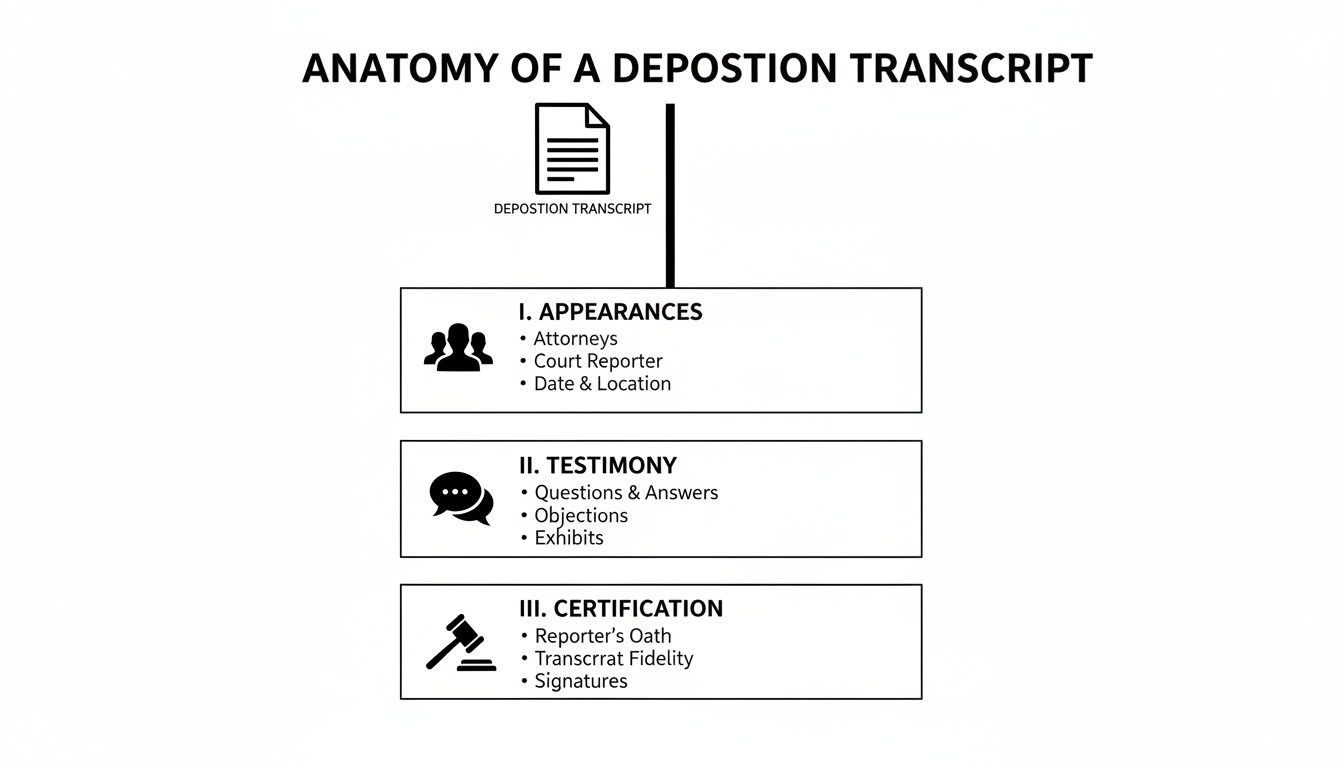
This isn't just a simple conversation written down. It's a formal legal document with a specific structure, and each part plays a role in giving it power in court. Once you understand its basic anatomy, the whole thing becomes much less intimidating and a lot more useful.
Breaking Down the Key Components
A standard deposition transcript is organized in a way that’s consistent across most jurisdictions. It’s a bit like a book: it has a cover page, a list of characters, an index of props, the main story, and a final, sworn statement from the author guaranteeing its truth.
- Title Page: This is your cover. It immediately tells you the "who, what, where, and when" of the deposition. You’ll find the case name, case number, the court where the lawsuit is pending, the name of the deponent (the person testifying), and the date and location it all took place.
- Appearances Page: Think of this as the cast list. It identifies every attorney in the room, which party they represent, and includes their contact information. The court reporter who created the record is also listed here.
- Exhibits List: If documents or objects were shown to the witness during their testimony, they’re marked as exhibits. This page serves as a handy index, listing each exhibit so you can easily find the discussion related to it in the testimony.
These first few pages set the stage perfectly, giving anyone—especially a judge—the complete context of who was there and what was discussed.
The Heart of the Transcript: Testimony and Certification
Naturally, the core of the document is the testimony itself. This is the verbatim, question-and-answer dialogue between the lawyers and the witness, usually presented in a two-column format. Down the left-hand side, you'll see page and line numbers. Those numbers are crucial, as they allow lawyers to cite specific parts of the testimony with precision.
For instance, an attorney in a court filing might reference "page 72, lines 10 through 15" to quote a key admission from the witness.
After the last question is answered, the final piece of the puzzle is added: the Certification Page.
This is the court reporter’s sworn oath. By signing it, they declare under penalty of perjury that the transcript is a complete, true, and accurate record of the proceeding. This signature is what officially transforms the document from a simple script into a powerful piece of evidence that can be used in court.
Without that certification, a transcript has no legal authority. It's the seal of authenticity that gives the words inside their weight. As law practices adopt more modern tools, services that provide a fast, accurate draft while respecting these legal standards are invaluable. For example, advanced AI transcription can turn hours of spoken testimony into a searchable, text-based document almost immediately, helping legal teams get a head start on their case strategy.
How Transcripts Are Made: Old School vs. New Tech
A deposition transcript can be created in two main ways. The first is the traditional route: a court reporter manually records the testimony in real-time. The second is by using modern AI transcription to convert the audio or video into text within minutes.
While a court reporter provides the final certified product, AI offers incredible speed and cost-efficiency for creating initial drafts. This lets legal teams get to work almost instantly.
The Traditional Path: The Certified Court Reporter
For decades, the only way to get a transcript of deposition was through a highly skilled court reporter. Sitting in on the deposition, they use a special stenotype machine to capture every question, answer, and sidebar conversation in a form of shorthand. This isn’t just about fast typing; it’s a complex system that records sounds and phrases phonetically.
After the deposition ends, the reporter’s real work begins. They translate their stenographic notes into a clean, readable transcript, proofreading and formatting it to meet strict legal standards. This human touch ensures high accuracy but also means a built-in delay. It often takes a week or more to get the final, certified transcript back.
The Modern Leap: AI Transcription Services
The new-tech approach sidesteps this manual process completely. With services like WhisperAI, legal teams can get a working draft transcript almost immediately. The process is dead simple: you just upload the audio or video file from the deposition to a secure platform.
Powerful AI algorithms then get to work, analyzing the recording and generating a detailed text version in a matter of minutes, not weeks. To see how this technology works, you can dig deeper into AI audio transcription and its applications.
This fast turnaround is a huge advantage. Attorneys can start reviewing testimony, pulling out key quotes, and preparing motions right away. While this initial AI-generated document isn't a certified record for court filings, it's an incredibly valuable working draft that can kickstart your case strategy.
The move from stenography to artificial intelligence reflects a bigger trend in the legal field. In 2023, the global legal transcription market was valued at $3.5 billion and is projected to hit $6.0 billion by 2032. This growth is being driven almost entirely by AI and machine learning, which offer major cost savings and impressive accuracy.
Court Reporter vs AI Transcription: A Head-to-Head Comparison
So, how do these two methods really stack up? Each has its place in the legal workflow, but their strengths shine at different stages of the litigation process. One delivers a final, court-ready document, while the other provides immediate intelligence.
Here’s a direct comparison to help you see the key differences.
| Feature | Traditional Court Reporter | AI Transcription (WhisperAI) |
|---|---|---|
| Speed | 7–14 business days for a final certified transcript. | A draft transcript is available in minutes. |
| Cost | Higher, often charged per page. | Significantly lower, typically based on audio length. |
| Certification | Provides a legally certified final document for court. | Creates a non-certified but highly accurate working draft. |
| Accessibility | Limited to the final document delivery schedule. | Immediate access for the entire legal team to review. |
| Workflow Impact | Delays the start of post-deposition work. | Allows for immediate case analysis and strategy planning. |
Ultimately, many legal teams are finding a sweet spot with a hybrid approach. They use AI transcription for its speed to get an early strategic edge, all while waiting for the court reporter to deliver the final, certified document required for official filings. It’s the best of both worlds.
Making a Transcript Legally Bulletproof
A simple text file from a recording won't cut it in court. For a transcript of deposition to be more than just words on a page, it has to meet strict legal standards. This formal process transforms a document into a powerful piece of evidence, ensuring its authenticity and integrity are beyond question.
Think of it like minting a coin. A plain metal disc has little value, but once it’s stamped with an official seal and verified for weight and purity, it becomes recognized currency. A transcript goes through a similar "minting" process to become legally sound.
The Foundation of Trust: The Certification
The most important step is certification. This isn't just a rubber stamp; it’s a sworn statement made by the court reporter under penalty of perjury.
At the end of every official transcript, you'll find a certification page. By signing it, the reporter personally guarantees that the document is a complete, true, and verbatim record of the sworn testimony. This signature is the bedrock of the transcript's legal authority. Without it, the document is essentially hearsay and carries no weight in court.
Maintaining the Chain of Custody
Just like physical evidence in a criminal case, a deposition transcript needs a clear chain of custody. This is a legal principle ensuring the document hasn't been tampered with from the moment it’s created to the moment it's presented in court.
For a transcript, the chain of custody looks something like this:
- Creation by a Neutral Officer: The court reporter, an impartial third party, creates the official record.
- Secure Delivery: The final, certified transcript is sent directly to the legal teams, often through a secure portal or bonded delivery service.
- Official Filing: When submitted to the court, the transcript is filed in a way that preserves its original, untampered state.
If this chain is broken at any point, the opposing counsel could challenge the transcript's authenticity, potentially getting it thrown out as evidence.
A certified transcript with an unbroken chain of custody is presumed to be accurate. The burden of proof then shifts to anyone who wants to challenge its content, which is an incredibly difficult hurdle to overcome.
The Witness Review and Errata Sheet
After the transcript is finished, the deponent—the witness who gave the testimony—usually gets a chance to review it for accuracy. This is their opportunity to point out any errors they believe were made in transcribing what they said.
This isn't a do-over to change their story. Instead, corrections are made on a document called an errata sheet, where the witness must list:
- The page and line number of the testimony in question.
- The text as it appears in the transcript.
- The corrected text.
- A reason for the change.
Both the original testimony and the errata sheet become part of the official record. If a witness makes a major change, you can bet the opposing lawyer will use the original statement at trial to attack their credibility, asking why their story suddenly changed.
For a deeper dive into the nuances of transcription in the legal field, you can check out our guide on legal transcription best practices.
These formal procedures—certification, chain of custody, and witness review—aren't just bureaucratic hoops to jump through. They are essential safeguards that ensure every transcript of deposition is a reliable and trustworthy account of sworn testimony, making it an unshakeable pillar of the legal process.
Turning a Transcript into a Strategic Weapon
Once the deposition ends and the certified transcript arrives, the real work begins. This isn't just a dusty record to be filed away; it's a strategic blueprint that can fundamentally alter the course of your case. For a sharp legal team, that transcript is a goldmine—a tool for building arguments, prepping for trial, and gaining a serious competitive edge.
The transcript is the bedrock of modern litigation, a fact reflected in a booming market. The court reporting industry is expected to grow to $7,500 million by 2025 and continue expanding at a 7.8% CAGR through 2033, thanks to increasingly complex cases worldwide. With remote video depositions jumping 25% between 2022 and 2024, the need for precise, synchronized transcripts has never been more critical.
Drafting Motions That Win
One of the transcript's most powerful immediate uses is in drafting pre-trial motions, especially a motion for summary judgment. This is where you ask the court to rule in your favor without a trial, arguing that the facts are so one-sided that no reasonable jury could find for the opposition.
To pull this off, you need cold, hard proof. The deposition transcript delivers just that. Attorneys meticulously scan the testimony, pulling direct quotes and critical admissions from the opposing party or their witnesses. These verbatim statements become the undeniable evidence that anchors the motion, making it infinitely more compelling than a simple summary of events.
The "Smoking Gun": Exposing Contradictions at Trial
Picture this: in a personal injury case, the defendant swears during his deposition that he was "not distracted at all" and had "both hands on the wheel" just before the collision. But later, you get his phone records, and they show a text sent from his phone at the exact moment of the crash.
At trial, your lawyer calmly asks the driver to repeat what he said in his deposition. He does, confidently. Then, the lawyer presents the phone records. The contradiction is devastating and immediate. The driver's credibility is instantly destroyed in front of the jury—not just because he was texting, but because he lied about it under oath. The transcript was the smoking gun that laid the trap.
This classic courtroom maneuver is called impeachment. It's one of the most effective ways to use a deposition transcript to highlight inconsistencies, destroy a witness's credibility, and completely change the momentum of a trial.
Mastering this process is key to building a strong case. To get the most out of these documents, it helps to understand the role of a modern document review attorney, who specializes in sifting through materials like these to find the nuggets that matter for litigation strategy.
Preparing Your Own Witnesses for the Stand
A transcript isn't just for attacking the other side—it’s also an indispensable tool for preparing your own team. Before your witness ever takes the stand at trial, their attorney will have them carefully review their own deposition transcript.
This review accomplishes a few vital things:
- It refreshes their memory. Months, or even years, can go by between a deposition and a trial. The transcript helps the witness lock in the precise details they gave under oath.
- It ensures consistency. There’s nothing worse than a witness unintentionally contradicting their earlier testimony. This review prevents those unforced errors that open the door to a brutal cross-examination.
- It identifies weak spots. An attorney can use the transcript to pinpoint where a witness’s testimony was confusing or shaky, and then work with them to strengthen and clarify those answers for trial.
Making Transcripts Dynamic and Actionable
Technology has completely changed how legal teams work with transcripts. What used to be a static, printed document is now a dynamic, searchable powerhouse. With platforms like WhisperAI's AI transcription service, legal teams can do so much more.
- Instant Search: Find any keyword or phrase across hundreds of pages in a matter of seconds. No more manual scanning.
- Annotate and Collaborate: Leave notes, highlight key admissions, and share insights with your entire team in a secure, centralized digital space.
- Create Video Clips: For video depositions, you can isolate and create short, high-impact clips of crucial testimony. Playing these for a judge or jury adds a visual and emotional punch that a block of text simply can't match.
By using these modern tools, legal professionals can squeeze every last drop of strategic value out of a transcript of deposition, turning sworn testimony into their most powerful advantage.
Keeping Sensitive Testimony Secure
Deposition transcripts are often filled with incredibly sensitive information. We're talking about private medical histories, personal financial records, and sometimes even the crown jewels of a company—its trade secrets. Keeping this testimony under lock and key isn't just a good idea; it’s a fundamental legal and ethical duty.

The first line of defense is purely legal. Tools like redaction allow you to meticulously black out specific pieces of information—think Social Security numbers or proprietary formulas—before a transcript is filed or shared.
For broader protection, a judge can issue a protective order. This sets strict ground rules for how all confidential information in a case is handled, dictating who gets to see it and for what purpose.
The Digital Fortress Protecting Your Transcript
When you move from paper to digital transcription, the security stakes get even higher. You’re handing over sensitive audio and video, so you need absolute confidence in the platform you’re using. The best services are built like a digital Fort Knox.
In today's world, a simple password just doesn't cut it. Legal professionals need ironclad proof that their client's data is safe from breaches and prying eyes. This is where certifications like SOC 2 compliance become critical—it's an independent audit that verifies a service provider is serious about protecting client privacy and data.
To earn that trust, top-tier services use a multi-layered security approach. At WhisperAI, we've built a comprehensive security framework designed to give legal teams total peace of mind. You can see for yourself how WhisperAI ensures data protection and meets the toughest industry standards.
When evaluating any transcription service, here are the non-negotiable security features to look for:
- 256-bit Encryption: This is the gold standard. It scrambles your files while they're being uploaded and keeps them scrambled while they're stored.
- GDPR and SOC 2 Compliance: These certifications aren't just acronyms; they are proof that a provider follows strict international privacy laws and has passed rigorous security audits.
- Secure Access Controls: You should have full control over who on your team can view, edit, or download transcripts. This ensures sensitive testimony is shared only on a need-to-know basis.
By making these security measures a priority, you can use a transcript of deposition effectively without ever putting confidential testimony at risk.
Your Deposition Transcript Questions, Answered
If you're new to the legal world, it’s easy to get lost in the jargon and procedures. The deposition transcript is one of those crucial documents that often brings up a lot of questions. Let's clear up some of the most common ones.
How Long Until I Get the Transcript?
Patience is a virtue here. With a traditional court reporter, you can expect the final, certified transcript to land on your desk in about 7 to 14 business days. This isn't just dead time; the reporter is busy translating their shorthand, meticulously proofreading the text, and going through the formal certification process.
Of course, sometimes you need it yesterday. Most court reporting agencies offer expedited services for an extra fee, which can get you the transcript in just a couple of days. This is also where AI transcription has become a game-changer for many legal teams. An AI service can produce a rough draft almost instantly, letting you start your review and analysis while the official version is being prepared.
Who Foots the Bill for the Transcript?
Simple—the party that scheduled the deposition pays the bill. This initial cost covers the court reporter's time for attending the deposition and creating that single, original, certified transcript.
What if the other side wants a copy? They'll have to buy their own from the court reporting agency. These costs are all part of the litigation budget, and sometimes, the winning party can get these expenses covered by the losing side at the end of the case.
A lot of people assume the transcript is just rolled into their lawyer's fees, but that's not the case. It's a separate and often substantial cost that needs to be factored into your case strategy from the start.
Can You Change Your Testimony After the Deposition?
Yes, you can, but there are big strings attached. It's not like you can just go back and rewrite your answers. After the deposition, the witness gets a chance to review the transcript and point out any mistakes. This is done using a formal document called an errata sheet.
On this sheet, the witness has to state the original testimony, what they want to change it to, and why. But here’s the critical part: the original answer doesn't disappear. It stays right there in the record. If you make a major change, you can bet the opposing counsel will bring it up at trial to challenge your credibility.
Ready to turn hours of audio into an accurate, searchable transcript in minutes? WhisperAI provides enterprise-grade security and near-human accuracy, helping legal teams gain a strategic edge. See how you can improve your workflow with AI transcription from whisperai.com/ai-transcription.