Medical Transcription 2026: AI, Manual & HIPAA Guide
Navigate medical transcription in 2026. Compare manual vs. AI workflows, understand HIPAA rules, and select the best solution for your practice.
Medical transcription turns spoken clinical notes into written records. It's a big deal in healthcare, with the U.S. market expected to hit $3.3 billion in 2025 and about $5.12 billion by 2034. The shift isn't about ditching transcription. It's about moving from old-school, human-only methods to AI-assisted systems that are faster, fit modern EHRs, and still ensure quality and compliance.
If you're a hospital administrator, this scenario might sound familiar: a doctor wraps up a long clinic day and then spends more time documenting than actually treating patients. Notes stack up, turnaround slows, and you're stuck managing clinician burnout, coding readiness, and privacy demands.
Medical transcription is all about turning voice dictation into text for medical records. It's a tried-and-true concept, but the environment has evolved. Now, organizations face choices: stick with traditional services, switch to AI transcription, or go for a hybrid approach.
Table of Contents
- Introduction Why We Need to Talk About Medical Transcription
- The Core Medical Transcription Workflow Explained
- Manual vs AI Transcription A Fundamental Shift
- Understanding Modern Transcription Technology
- Navigating HIPAA and Other Privacy Requirements
- The Critical Role of Quality Assurance
- How to Choose the Right Transcription Solution
- Conclusion The Future of Clinical Documentation
Introduction Why We Need to Talk About Medical Transcription
tl;dr: Medical transcription turns voice dictation into text for medical records. More organizations are using AI to speed up documentation, lower friction, and connect directly to clinical systems. But quality review and compliance are still key for a safe and usable workflow.
For hospital leaders, this isn't just about documentation. It's about operations. Delayed notes mess with billing, lower physician satisfaction, slow chart completion, and affect the quality of info for the next care team.
Old transcription services solved a big problem: they took typing off clinicians' plates. But they relied on queues, file handoffs, and delayed review. Today's healthcare needs faster drafts, cleaner integration, and better oversight.
Practical rule: A transcription workflow should reduce physician effort without creating downstream cleanup for HIM, compliance, or revenue cycle teams.
The real question isn't whether transcription matters — it does. It's which model fits current clinical operations best.
The Core Medical Transcription Workflow Explained
Medical transcription starts long before a note hits the chart. It begins when a clinician speaks.
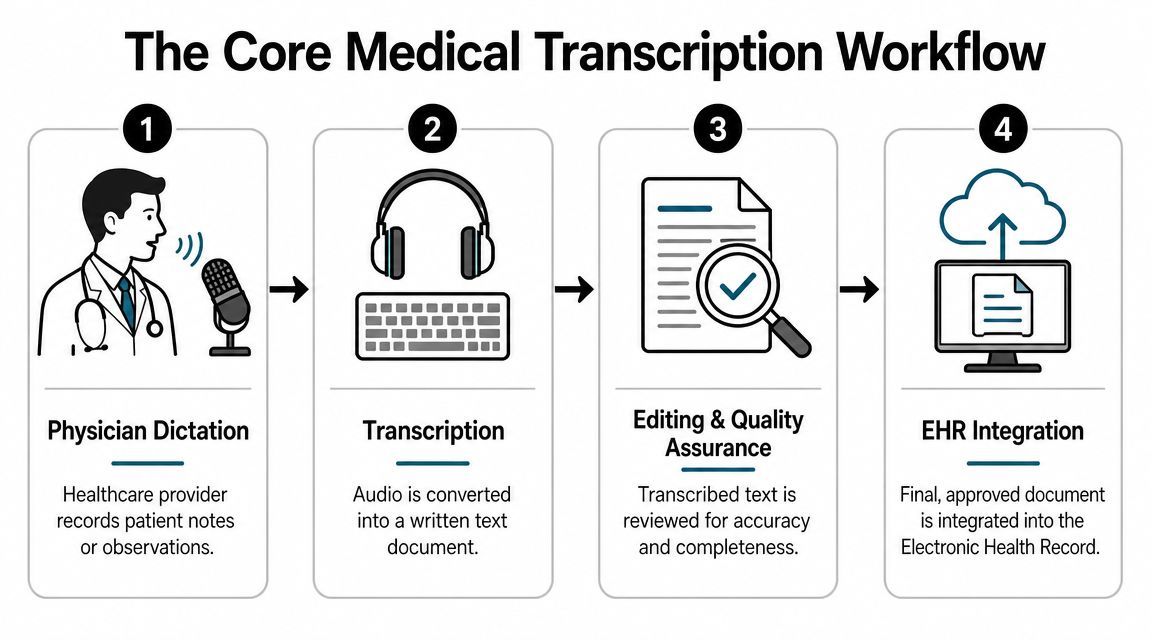
From spoken note to chart-ready document
In a traditional setup, the provider dictates history, exam findings, diagnosis, or treatment plans. A transcriptionist listens to the recording and types it into a structured document. An editor or QA reviewer checks the draft, and the final version goes into the EHR or EMR.
That's why a medical transcriptionist is more like a specialized translator than a typist. They need to understand spoken language, accents, pacing, and medical terminology all at once.
Who touches the process
Several roles shape the final note:
- Clinicians: They create the source material through dictation or conversation.
- Transcription staff: They convert audio into readable, structured text.
- Editors or QA reviewers: They catch missing words, incorrect terminology, and formatting issues.
- Administrative or HIM teams: They manage document flow, filing standards, and record completeness.
This remains a substantial healthcare function. The U.S. medical transcription market is expected to hit $3.3 billion in 2025 and grow to about $5.12 billion by 2034. It's likely to cross $4 billion by 2029, according to analysis of the U.S. medical transcription market.
Manual vs AI Transcription A Fundamental Shift
The biggest change in medical transcription isn't that human review vanished. It's that draft creation transformed.
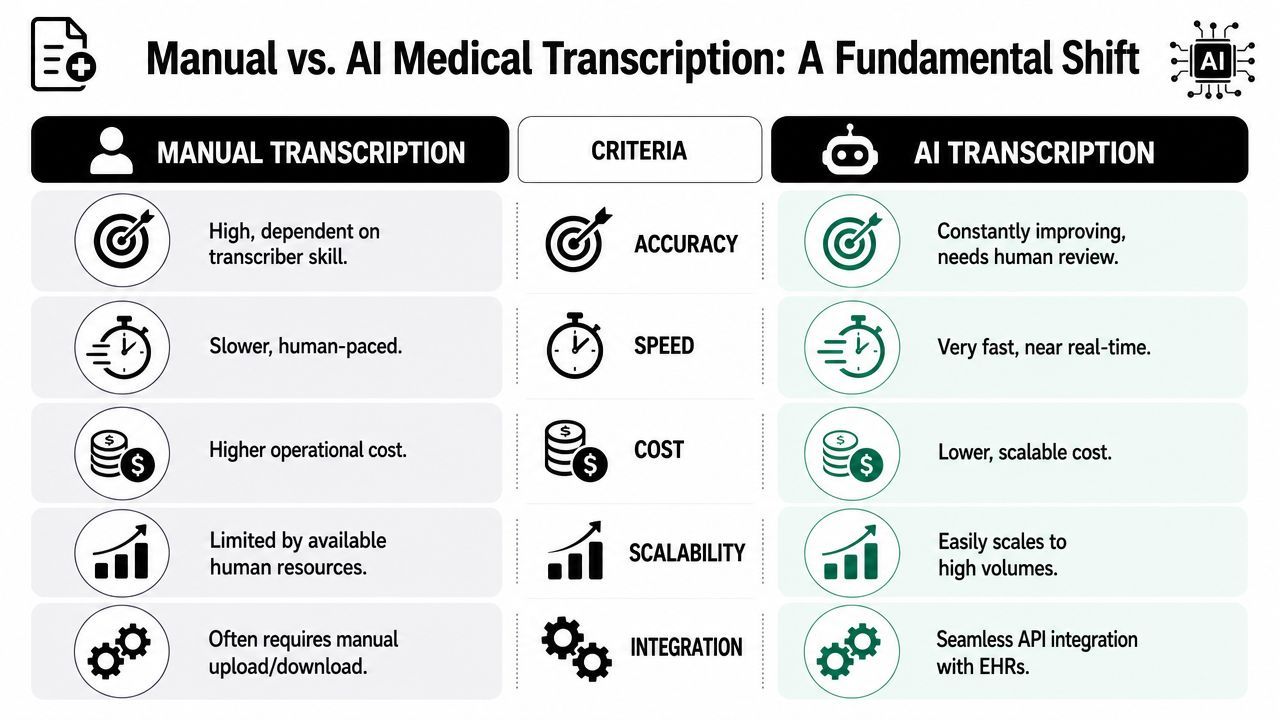
How the two models differ
A manual workflow relies on people to listen, type, edit, and return the file. It works well for complex cases, but turnaround is tied to staffing. If volume spikes, queues grow.
AI transcription changes the first draft step. Software processes audio quickly, making text available much sooner for review. AI is appealing when a hospital wants better throughput, telehealth support, or easier scaling across departments.
A simple comparison helps:
| Criteria | Manual transcription | AI transcription |
|---|---|---|
| Speed | Human-paced | Very fast draft generation |
| Cost structure | Labor-heavy | More software-driven |
| Scale | Limited by available staff | Easier to expand across volume |
| Workflow | Often file-based handoff | Often API and platform based |
| Review need | Built in from the start | Still needed for clinical-grade output |
Why the workforce is shifting
Federal labor data shows the job is still large but evolving. The median annual wage for medical transcriptionists was $37,550 in May 2024, with 43,900 jobs nationwide. Employment is expected to decline 5% from 2024 to 2034, but the field will still generate about 7,400 openings per year, mostly from replacement needs, according to the Bureau of Labor Statistics.
That pattern fits what many administrators already see. The work hasn't disappeared. It's becoming more AI-augmented.
One modern platform example is AI transcription for healthcare, where software handles the initial conversion and teams decide how much review, formatting, and integration they need.
Fast transcription matters. Reliable chart-ready transcription matters more.
Understanding Modern Transcription Technology
Vendors often make transcription sound more mysterious than it is. The core technologies are pretty straightforward if you cut through the jargon.
What the software is actually doing
The system listens to speech and predicts the text. In healthcare, the hard part isn't typing words. It's handling accents, clinical phrases, medication names, interruptions, and specialty language.
Two features often matter during evaluation:
- Speaker labeling: This tells the system who is speaking. In a clinic visit, it separates provider comments from patient statements.
- Export flexibility: Teams need output that fits existing workflows, like DOCX for editing, PDF for sharing, or SRT for telehealth video captions.
Where buyers often get confused
Many buyers focus on headline accuracy claims without asking a practical question: how much editing will staff still need before the note is safe to file?
That's where word error rate comes in. It's a measure of transcription mistakes in a draft. For a hospital admin, the key issue isn't the acronym. It's whether the platform produces notes that clinical staff can review quickly without hunting for dangerous omissions.
A useful test is simple. Ask for specialty-specific audio samples, then check if the output handles multi-speaker dialogue, formatting, and medical terms in a way that fits the organization's charting standards.
Navigating HIPAA and Other Privacy Requirements
In medical transcription, compliance isn't just a box to tick. It's part of the operating model.
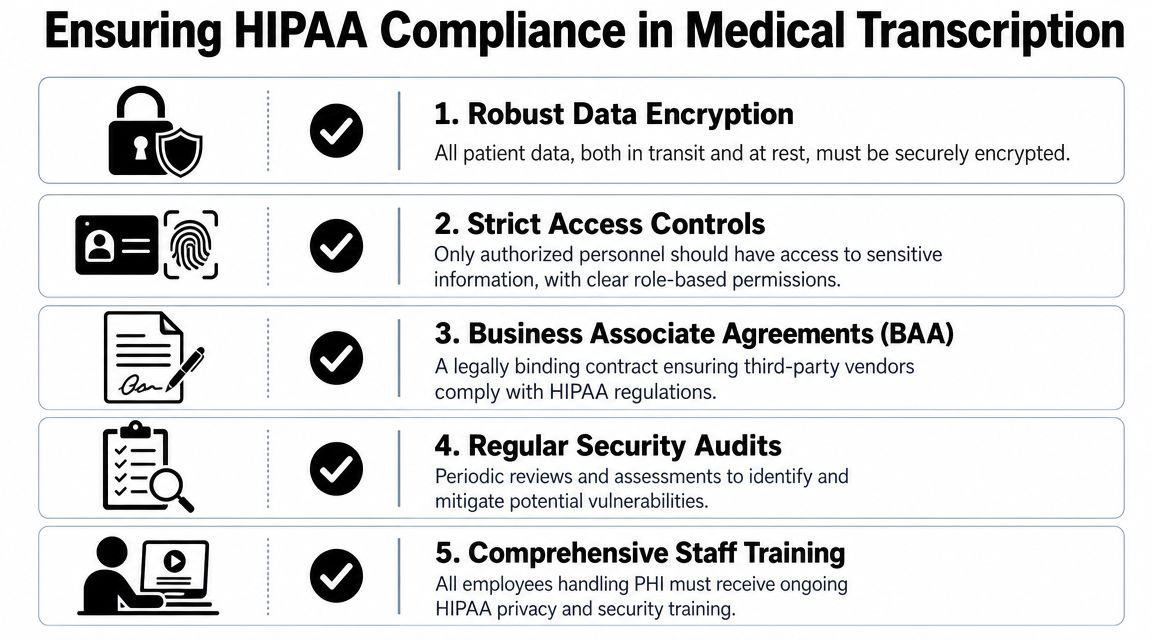
What HIPAA means in practice
If a transcription vendor handles protected health information, the hospital must know exactly how that data is stored, transmitted, accessed, and deleted. “HIPAA compliant” should lead to follow-up questions, not end the conversation.
A serious review usually includes:
- Encryption: Data should be protected in transit and at rest.
- Access controls: Staff access should be limited by role.
- Business Associate Agreement: The vendor should sign a BAA when required.
- Auditability: The system should log who accessed what and when.
Organizations building broader AI governance may also benefit from this guide to compliance-first AI, which offers a practical framework for privacy and control discussions beyond a single tool.
What to ask vendors
A hospital administrator should ask for plain answers to plain questions. Where is audio stored? Who can retrieve it? How long is it retained? Can the organization control deletion and user permissions?
For teams evaluating medical documentation vendors, this overview of HIPAA-compliant transcription services is also a useful checklist.
A compliant transcription system should make audits easier, not more complicated.
The Critical Role of Quality Assurance
AI can produce a fast draft. It can't carry clinical accountability on its own.
Medical transcription quality heavily depends on the clarity of the original dictation and the review process. Providers usually dictate histories and exam findings. Transcription staff use specialized tools and editor review to produce verbatim records. Poor audio quality and ambiguous speech increase rework and error risk, as shown in this overview of medical transcription quality and workflow risks.
Why human review still matters
A single misunderstood medication, body side, or dosage instruction can cause real problems. In clinical documentation, “almost right” isn't good enough.
That's why strong organizations keep a human in the loop. AI creates speed. The reviewer adds judgment. The best process assigns people to check terminology, missing context, unclear phrasing, and note formatting before finalizing the record. Consistency-checking software can support that review, tools built to proofread medical documents automatically flag inconsistent terminology, abbreviations, and formatting across a chart before sign-off.
A practical QA model
A solid quality process often includes:
- Better source audio: Encourage clear dictation habits and reduce background noise where possible.
- Structured review: Route drafts to trained editors or clinicians for approval.
- Focused proofreading: Pay special attention to medications, diagnoses, measurements, and abbreviations.
Teams refining this part of the workflow often benefit from a closer look at proofreading in transcription.
How to Choose the Right Transcription Solution
Choosing the right transcription solution is easier when you focus on workflow fit, not just features.
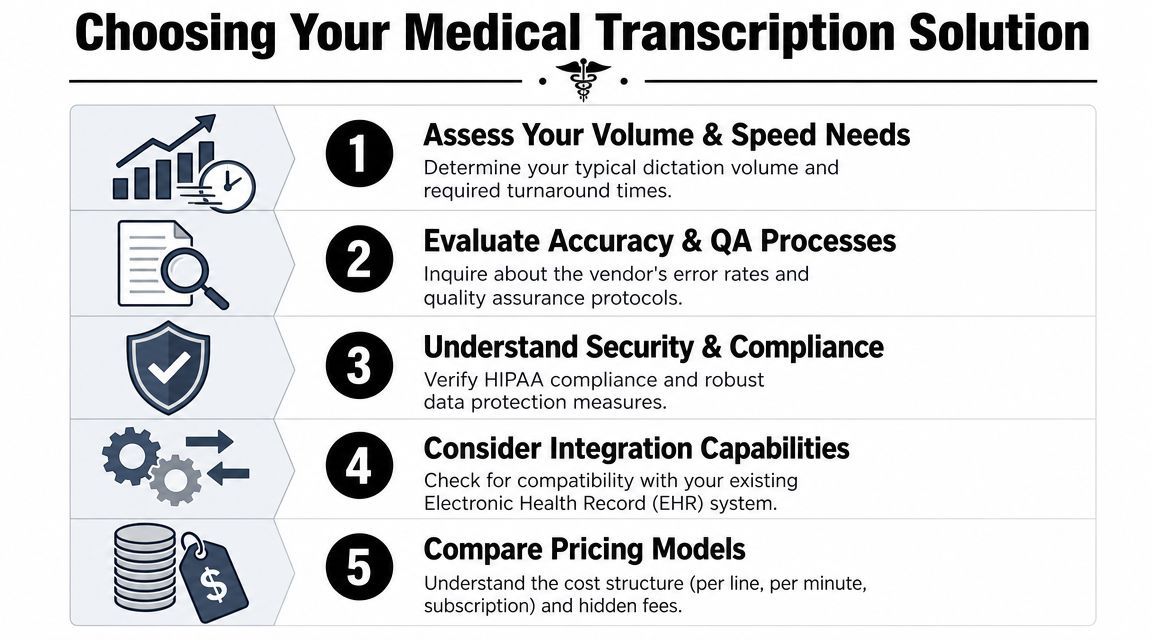
A hospital buyer's checklist
These questions usually reveal whether a platform is usable in care delivery:
- How does it handle medical language? Ask for sample output in the organization's specialties.
- What is the QA workflow? A vendor should explain exactly how draft review works.
- Will it support privacy requirements? Confirm HIPAA-related controls, BAAs, and audit logs.
- Can it integrate with current systems? The answer should cover EHR workflow, exports, and APIs.
- How does pricing work? Clarify whether charges are based on minutes, users, subscriptions, or service tiers.
What matters beyond the demo
Many demos look polished because they use clean audio and simple examples. Real evaluation should include noisy recordings, multiple speakers, and specialty vocabulary.
For buyers comparing options in more detail, this guide to comparing healthcare speech to text tools can help frame the market. Cost review should also include editing time, implementation work, and support needs, not just headline subscription pricing. Check out this breakdown of the cost of transcription for building a solid business case.
The right solution is the one that reduces documentation burden without shifting hidden work to clinicians or compliance staff.
Conclusion The Future of Clinical Documentation
Medical transcription is still crucial, but the operating model has changed. Traditional services laid the groundwork. AI now enables faster drafts, handles larger volumes, and fits documentation more closely with digital care delivery.
The organizations getting the most value aren't picking between humans and software in a simplistic way. They're combining AI speed, clear QA ownership, and strict privacy controls. For hospital administrators, that's the business case: better clinical documentation with less friction and stronger operational control.
Healthcare teams exploring a modern documentation workflow can consider WhisperAI - #1 AI Transcription as one option for converting clinical audio into searchable, editable transcripts with support for live recording, file uploads, speaker labeling, and export formats that fit everyday documentation processes.