How to Make an SRT File: A Quick and Easy Guide to Captions
tl;dr: An SRT file is a simple text file that adds captions to your videos, making them more accessible and SEO-friendly. You can create one manually using a text editor like Notepad by typing out dialogue with precise hours:minutes:seconds,milliseconds timestamps. Or, for a much faster and easier method, you can use an AI transcription service like WhisperAI to automatically generate a highly accurate SRT file from your video in minutes.
At its core, an SRT file is just a specially formatted text document. It’s the universal language for video subtitles, understood by practically every platform out there. You really have two main paths to creating one: you can roll up your sleeves and build it by hand in a simple text editor, or you can let powerful AI transcription tools do the heavy lifting for you.
What You Need To Know Before Starting
So, what exactly is an SRT, or SubRip Subtitle, file? Think of it as the script for your video's dialogue, complete with stage directions for timing. It’s a plain text file that tells a video player precisely what text to show on screen and when to show it. This elegant simplicity is why it’s become the go-to format everywhere from YouTube to professional video editing suites.
The SRT format has been the global standard for subtitles for years, thanks to its straightforward, human-readable structure. It organizes subtitles in a clean sequence, using a precise HH:MM:SS,mmm timestamp to sync the text perfectly with the audio.
Key Benefits of Using SRT Files
Is it worth the effort to create an SRT file? Absolutely. The payoff is huge, impacting everything from your audience reach to how easily people can find your videos.
- Boosts Accessibility: SRT files open up your content to viewers who are deaf or hard of hearing, making sure your message is inclusive.
- Improves SEO: Search engines can't watch videos, but they can read text. The content in your SRT file gives them the context they need to rank your video in search results.
- Increases Viewer Engagement: A surprising number of people watch videos on mute. Captions let them follow along whether they're on a noisy train or in a quiet office.
No matter which method you choose, the first step is always the same: you need to how to transcribe audio to text. If you're leaning toward the automated route, our guide on AI audio transcription is a great place to get started.
Before diving into the "how-to," it helps to see the two main approaches side-by-side. This table breaks down the core differences between crafting an SRT file by hand versus using an AI tool.
SRT Creation Methods at a Glance
| Feature | Manual Creation (Text Editor) | Automated Creation (AI Tools) |
|---|---|---|
| Speed | Slow and time-consuming | Extremely fast, often near real-time |
| Cost | Free (just your time) | Varies (free tiers to paid plans) |
| Accuracy | Prone to human error in timing/typos | Highly accurate, but may need minor edits |
| Effort | High; requires patience and detail | Low; upload and review |
| Best For | Short videos, precise control, no budget | Long videos, quick turnarounds, efficiency |
Ultimately, the best method really depends on your project's needs. For a short, two-minute clip where every millisecond counts, manual creation gives you total control. For a one-hour webinar, an AI tool is the only practical choice.
Getting Your Hands Dirty: How to Create an SRT File From Scratch
Sure, AI tools are great for speed, but sometimes you just need total control. Building an SRT file by hand gives you that—every millisecond, every line break is exactly where you want it. It's not as intimidating as it sounds. All you really need is a simple text editor like Notepad on Windows or TextEdit on a Mac.
The whole process boils down to listening, typing, and formatting. You're essentially creating a simple script that tells the video player exactly what text to show and when.
This workflow breaks it down into three core actions.
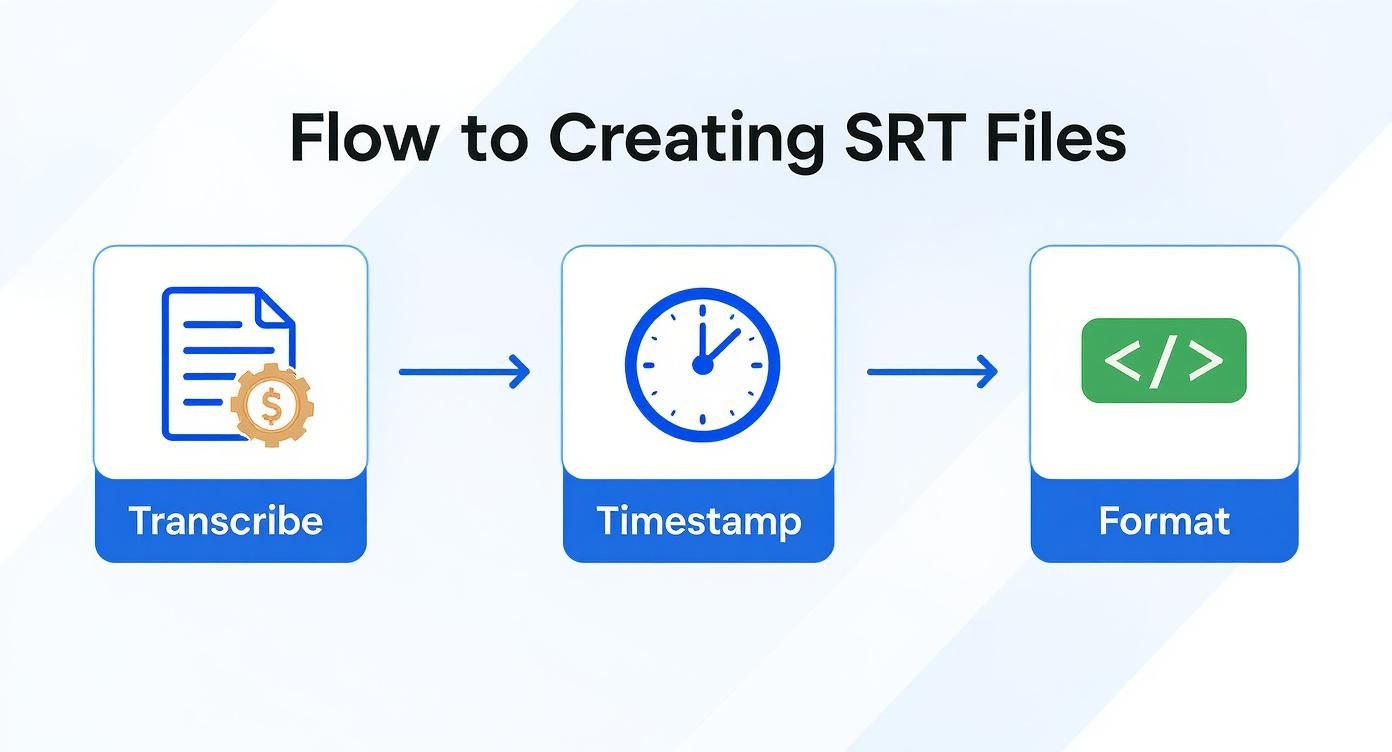
As you can see, you just transcribe the words, time them to the video, and wrap it all up in the correct SRT format. Let’s dig into what that format actually looks like.
The Anatomy of an SRT Entry
Every single caption in an SRT file is a small, four-part block. This structure is rigid, and getting it right is crucial. One wrong character can make the whole file unreadable by a video player.
Here's what goes into each block:
- Sequence Number: This is just a simple counter (
1,2,3...) that keeps the captions in order. - Timestamp: This is the most important part. It tells the video player when to show and hide the caption. The format is very specific:
hours:minutes:seconds,milliseconds --> hours:minutes:seconds,milliseconds. - Caption Text: This is the actual text that will pop up on the screen. You can use one or two lines here.
- Blank Line: A single empty line separates one caption block from the next. It’s a small detail, but it’s mandatory.
The structure is non-negotiable: sequence number, timestamp, text, then a blank line. If you miss any of these, your captions won't work.
A Practical Example in Action
Theory is one thing, but seeing it in practice makes it click. Let's say you have a video where the first line of dialogue is, "Hello world! This is my first caption."
Here’s how you’d write that out in your text file:
100:00:02,500 --> 00:00:05,150Hello world!This is my first caption.
In this case, the 1 marks it as the first caption. The timestamp tells the player to show the text at 2.5 seconds and remove it at 5.15 seconds. I split the sentence across two lines to make it easier to read on screen—a little trick that makes a big difference for the viewer.
The first step of any captioning project is getting the audio into text. If you want to learn more about the best ways to do that, our complete video transcription guide is a great resource.
Quick Tips for Better Readability
A working SRT file is good, but a readable one is better. You want people to actually absorb the information, not struggle to keep up.
Here are a few pointers I’ve learned over the years:
- Mind Your Characters: Stick to around 32-40 characters per line. Anything longer can feel cluttered and hard to read quickly.
- Two-Line Rule: Never go over two lines of text in a single caption block. It keeps the screen clean and lets the viewer focus on the video itself.
- Break at Natural Pauses: Don't just split a sentence wherever it hits the character limit. Try to break the line at a comma or a natural pause in the sentence. It just flows better.
After you've transcribed and timestamped everything, you're ready to save. In your text editor, go to "Save As," name your file with the .srt extension (like my-awesome-video.srt), and—this is important—make sure you select UTF-8 encoding. This ensures any special characters or emoji you've used will show up correctly on any device.
Using AI to Generate SRT Files Instantly
If the idea of manually timing every single line of dialogue makes you want to run for the hills, I don't blame you. The good news is, you don't have to. Letting an AI tool make srt file content for you is an absolute game-changer, transforming hours of painful work into a quick review session. These tools can transcribe audio with stunning accuracy, often handling tricky accents and dense jargon better than you'd expect.
The whole process is refreshingly simple. First, get your video or audio file ready. My best advice? Start with the cleanest audio you can get. Cut down on background noise and make sure whoever is speaking is close to the mic. A clear audio track is the single biggest factor in getting a great transcription right out of the gate.

With your file prepped, just upload it to an AI transcription service. Many platforms, including our own WhisperAI, have a simple drag-and-drop interface. Once you drop the file in, the AI kicks into gear, analyzing the audio and spitting out a time-coded transcript. The speed is something else—I've seen it transcribe a 10-minute video in well under a minute.
The Essential Review and Edit Process
AI is smart, but it's not a mind reader. This is why the human review is the most important part of the entire workflow. No matter how good the tech is, you always, always need to give the generated text a once-over before you hit export.
I like to think of the AI's output as a really solid first draft. Your job is to come in as the editor and add that final polish.
Here’s what I always look for during my review:
- Proper Nouns: AI can get a little creative when spelling unique names of people, companies, or specific locations.
- Technical Jargon: If your content is niche, make sure the AI didn't mishear specialized terms.
- Punctuation: The AI's punctuation can feel a bit stiff. I read through to make sure the commas and periods help the text flow naturally.
- Homophones: Words like "their" vs. "there" or "to" vs. "too" are classic AI tripwires.
A quick final check is what separates a decent SRT file from a truly professional one. Spending just a few minutes here guarantees your audience a smooth experience, free from distracting typos.
When your goal is perfectly synchronized captions, some powerful Karaoke Maker AI tools can also make this process a lot easier, since they're specifically designed for precise text-to-audio syncing. After your edits are done, the last part is a piece of cake.
Exporting Your Perfect SRT File
Once you’ve polished up the transcript, you're on the home stretch. Just about every transcription platform has a big "Export" button waiting for you. When you click it, you'll usually get a menu of different file formats.
All you have to do is choose SRT (.srt) from the list. The platform handles all the technical formatting behind the scenes—the sequence numbers, the HH:MM:SS,mmm timestamps, and the caption text. The file downloads straight to your computer, ready for you to upload to YouTube, Vimeo, or whatever platform you're using.
For a deeper dive into this, our complete guide on video transcription for subtitles is a fantastic resource that covers even more of the nitty-gritty details.
This automated approach doesn't just save a ton of time. It makes accurate, professional-grade captioning a realistic goal for any project, whether it's a 30-second social clip or a full-length documentary.
Advanced Techniques for Professional Captions
Once you've got the hang of creating a basic SRT file, it's time to dig into the details that separate good captions from truly great ones. Professional captions don't just put words on the screen; they actually enhance the viewing experience, boost accessibility, and capture the complete audio world of your video.
It’s all about the subtle art of timing, clarity, and giving your audience the full picture. These are the techniques that make subtitles feel completely seamless, not like a clunky afterthought.
Mastering the Art of Timing and Rhythm
Timing is so much more than just matching words to the audio track. It’s about getting in sync with the speaker's natural rhythm and what’s happening on screen. A caption that pops up a fraction of a second too early or hangs around too long can feel jarring and pull the viewer right out of the moment.
Think of it this way: a caption shouldn't just appear when a word is spoken. It should flow with the conversation.
- Give a Little Lead-in Time: Try to have a caption appear just a hair before the dialogue actually starts. This gives the viewer’s eyes a moment to register the text without feeling rushed.
- Pace Yourself: For rapid-fire dialogue, you might need to condense a few phrases to keep the text from flying by too fast to read. On the other hand, if someone is speaking slowly and deliberately, let the caption linger a bit longer to match their cadence.
- Sync with the Visuals: If a line of dialogue refers to something specific on screen, time its appearance with that visual cue. For instance, if a character says, "Look over there!" the caption should appear right as they point.
The goal is for the captions to feel like a natural part of the video, not a clunky overlay. When the timing is perfect, the text feels so integrated that viewers can absorb the information without even consciously "reading subtitles."
Handling Speaker Labels and Non-Speech Sounds
Videos are rarely just one person talking in a silent room. To create a truly accessible experience, your SRT file has to account for multiple speakers and important background noises. This is where a few simple formatting rules make a world of difference.
For any conversation involving more than one person, using speaker labels is a must. The standard practice is to put the speaker's name or a simple identifier in square brackets right before their line.
Example of Speaker Labels:
[Sarah] So, how did the presentation go?[Mark] It went well, but the client had a ton of questions.
This simple addition clears up any confusion about who’s talking. You use the exact same bracketed format for significant non-speech sounds that add important context to the scene.
[phone rings][suspenseful music][door creaks][audience applauds]
Including these sounds ensures that viewers who are deaf or hard of hearing don't miss out on crucial audio cues that shape the story or the mood. If you want to dive deeper into different export options, our SRT export guide comparing WhisperAI to competitors offers more detailed insights.
Translation Workflows and Proper Encoding
Taking your content global usually means getting your SRT files translated. A solid workflow is to first create a perfectly timed and formatted SRT file in the original source language. This "master" file then acts as a template for translators, who can simply replace the text while keeping all the original timestamps locked in place.
This process ensures the translated captions will stay perfectly synced with your video. But there's one technical detail that is absolutely critical to making this work smoothly across different languages: UTF-8 encoding.
When you save your final SRT file, you have to make sure it’s saved with UTF-8 encoding. This is a universal standard that supports characters from pretty much every language on the planet. If you don't, special characters and accents (like ñ, é, or ü) and non-Latin alphabets can turn into a jumble of gibberish symbols (like �).
Interestingly, the term "SRT" has a second life in the video world. While we know it as the SubRip Text format for captions, it also stands for Secure Reliable Transport, a streaming protocol for sending high-quality video over the internet. You can learn more about the evolution and workflows of this broader SRT technology. It's a neat coincidence that highlights just how critical text and video integration has become.
How to Fix Common SRT File Problems
Even when you’ve been careful, things can still go wrong with your subtitles. A tiny mistake can stop your captions from loading entirely or throw the timing completely off. Think of this as your troubleshooting cheat sheet for the most frequent snags you'll hit when you make srt file content.
The good news? Most of these problems are surprisingly easy to fix once you know what to look for. Let's walk through the usual suspects and get your captions working perfectly.
Correcting Out-of-Sync Subtitles
This is probably the #1 headache: your captions show up too early or too late. It’s often just a simple timing offset, but it can also be a trickier issue like a frame rate mismatch.
The first thing I always check is if the offset is consistent. If every single caption is off by the same amount—say, two seconds late—you’re in luck. Most video players and subtitle editors have a "sync" or "offset" feature. You can just plug in -2000 milliseconds to shift everything earlier or +2000 to move it all later. Easy.
But what if the timing drifts, getting progressively worse as the video plays? That’s a classic sign of a frame rate mismatch between your video and your SRT file. This is a bit more complex, but dedicated subtitle software can fix it by letting you specify the correct video frame rate.
Fixing Pesky Formatting Errors
SRT files are incredibly picky about their structure. A single misplaced character can make the entire file unreadable. If your SRT won't load at all, a formatting error is almost always the culprit.
The most common formatting mistake I see is a period (
.) in the timestamp instead of a comma (,). Remember, the correct format isHH:MM:SS,mmm, notHH:MM:SS.mmm. This one tiny character breaks everything.
Comb through your file and double-check for these common mistakes:
- Missing Blank Lines: There absolutely must be an empty line between each caption block.
- Incorrect Arrows: The timestamp arrow has to be two dashes and a greater-than sign:
-->. No exceptions. - Non-Sequential Numbers: Make sure your sequence numbers (
1,2,3...) are in the correct, uninterrupted order.
Resolving Gibberish Text and Encoding Issues
Ever opened up your captions only to see a jumble of symbols like ���? This isn't a timing or formatting problem; it's an encoding issue. It happens when your text editor saves the file in a format that doesn’t support the characters you’re using, which is especially common with accents or non-English letters.
The fix is simple: always save your SRT file with UTF-8 encoding. When you use the "Save As" function in your text editor, look for an "Encoding" dropdown and choose UTF-8. It's the universal standard that ensures all your characters show up correctly on any platform.
While AI tools are getting incredibly good at handling this stuff automatically, knowing the fundamentals of transcription makes troubleshooting much easier. To get a better sense of what's happening behind the scenes, you can explore more about AI transcription accuracy and the details involved.
Still Have Questions About SRT Files?
Even after walking through the process, a few specific questions tend to pop up, especially when you're just getting started. I've gathered the most common ones I hear to help clear up any lingering confusion.
Can I Add Formatting Like Bold Or Italics?
Yes, but it comes with a big "it depends."
The original SRT file format is as basic as it gets—just plain text. However, many modern video players and platforms have learned to recognize simple HTML tags. You can often wrap text in <b> for bold, <i> for italics, and <u> for underline. For example: <i>Are you serious?</i>
The catch is that support isn't universal. It might look great on YouTube but show up as raw code on another platform. Always do a quick test on your target player to see if the formatting works as you expect.
What Is The Best Software To Create SRT Files?
For a pure, from-scratch manual approach, you don't need anything fancy. A simple plain text editor like Notepad (Windows) or TextEdit (Mac) will do the job perfectly.
If you need more fine-tuned control over timing or need to fix captions that are out of sync, a dedicated subtitle editor is the way to go. I often recommend free tools like Subtitle Edit or Aegisub to people who need that extra precision.
Of course, if speed and accuracy are your main goals, nothing beats an AI transcription service. It handles the heavy lifting of transcribing and timing, so all you have to do is review and polish the final product.
VTT vs. SRT: What's The Difference?
Think of VTT (or WebVTT) as the modern cousin to SRT. It was designed specifically for web video and offers more features.
Here's the breakdown:
- SRT: The classic. It's universally supported everywhere, from social media to desktop video players. It's simple and reliable.
- VTT: The newcomer. It supports more advanced styling with CSS, lets you control where captions appear on the screen, and can include extra metadata. It's the go-to for HTML5 video players because of this flexibility.
Most AI tools can export your subtitles in both formats, so you can just pick the one that fits where your video will live.
Ready to let technology do the hard work for you? WhisperAI uses incredibly accurate AI to turn your audio and video into perfectly timed SRT files in just a few minutes.