AI Transcription: Your Complete Guide to Audio-to-Text Technology
Discover how AI transcription works. This guide explains the technology, compares it to human services, and shows you how to choose the best tools.
tl;dr: AI transcription is software that listens to your audio or video and automatically types out what's being said. It's incredibly fast, way cheaper than paying a person to do it, and getting more accurate every day. Use it for instant meeting notes, video subtitles, or turning any voice recording into a searchable document.
Your Guide to AI Transcription Technology
Ready to dive into the world of AI transcription? This guide will break down exactly how artificial intelligence turns spoken words into clean, accurate text, a shift that's changing how everyone from media producers to medical researchers works. We’ll start with the basics and build from there, giving you a solid grasp of the tech that powers it all.
Whether you're a YouTuber who needs subtitles, a professional tired of typing up meeting notes, or just curious about how it all works, you'll walk away with a practical understanding of this powerful tool. For more deep dives, you can always explore our other guides on AI.
Understanding the Core Concept
At its heart, AI transcription uses smart algorithms to listen to an audio file and turn it into text. Picture a super-fast typist who never needs a coffee break and can understand dozens of languages. It works by analyzing sound waves, picking out phonetic patterns, and stitching them together into words and sentences just like we do.
This whole process gets rid of the painstaking manual job of typing out recordings. The biggest reasons people are flocking to it are simple:
- Speed: An AI can blaze through hours of audio in just a couple of minutes. The same job would take a human transcriber most of their day.
- Cost-Effectiveness: Automated services are dramatically cheaper than manual transcription, which opens up the technology to everyone, not just big corporations.
- Accessibility: It's the engine behind captions and transcripts that make video and audio content available to people who are deaf or hard of hearing.
Below is a quick look at the core features that make modern AI transcription so effective.
AI Transcription Key Features at a Glance
| Feature | Description | Primary Benefit |
|---|---|---|
| Speed & Scalability | Transcribes hours of audio in minutes. | Frees up valuable time and handles large volumes of content effortlessly. |
| High Accuracy | Modern models achieve up to 99% accuracy. | Delivers reliable text that requires minimal editing for professional use. |
| Speaker Identification | Automatically detects and labels different speakers. | Makes multi-person conversations (meetings, interviews) easy to read and follow. |
| Multilingual Support | Recognizes and transcribes dozens of languages. | Breaks down language barriers for global content and international teams. |
| Cost Efficiency | A fraction of the cost of manual transcription services. | Makes professional-grade transcription affordable for any budget. |
These features combine to create a tool that isn't just a convenience—it's a productivity multiplier.
The Growing Demand for Automated Solutions
The move to automated transcription isn't just a passing trend; it's a massive shift in the market. The global AI transcription industry is set to explode from USD 4.5 billion in 2024 to an estimated USD 19.2 billion by 2034. That's a compound annual growth rate of 15.6%, driven by a huge need for better documentation in fields like healthcare, media, and law.
The real magic of AI transcription is how it turns messy, spoken information into organized, searchable data. An idea mentioned offhand in a meeting or a key point from a lecture is no longer lost to memory—it becomes a permanent, findable asset you can search, analyze, and share whenever you need it.
How AI Transcription Actually Works
tl;dr: At its core, AI transcription uses a technology called Automatic Speech Recognition (ASR) to convert spoken words into written text. Think of it as a digital brain that’s been trained on a massive library of sounds and words. It’s also smart enough to figure out who said what (speaker diarization) and can even identify the language being spoken on its own.
If you pull back the curtain on AI transcription, you’ll find a fascinating process that’s more science than magic. The whole system is built on something called Automatic Speech Recognition (ASR). You can think of ASR as the AI’s digital ears, which have spent countless hours listening to millions of audio recordings to learn the fundamental pieces of human speech—from tiny sounds called phonemes to full words, accents, and sentence patterns.
This extensive training gives the AI model a remarkable ability. When you feed it an audio file, it doesn't just "listen"—it breaks down the complex soundwaves into tiny, analyzable pieces. Then, it plays a high-speed matching game, comparing those pieces to the patterns it already knows to predict the most probable words. It's like a linguistic detective sifting through audio clues to solve the mystery of what was said.
This infographic gives you a simplified look at the core process, showing how raw audio becomes a structured, usable text document.
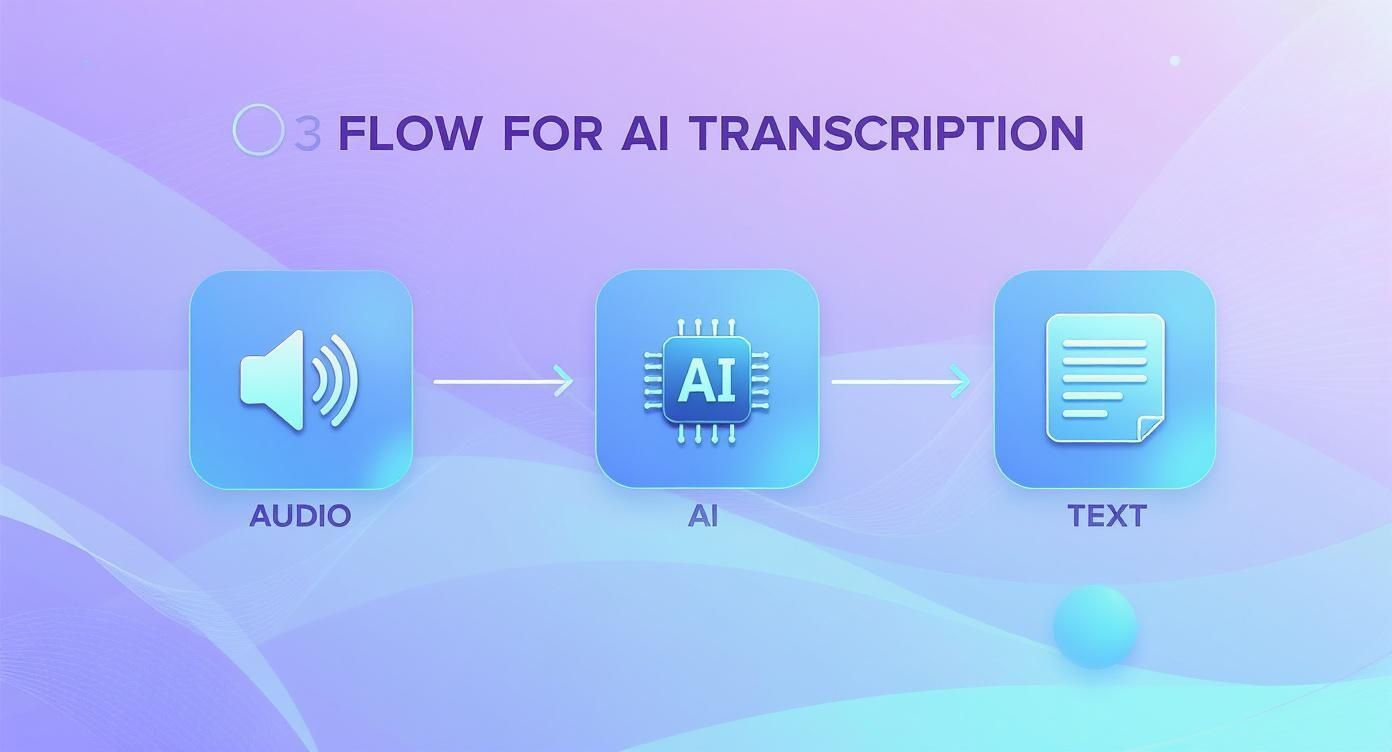
As you can see, the process moves through three key stages, transforming a messy audio stream into an organized text file that’s ready to use.
Identifying Who Said What
Of course, a big block of text isn't very helpful, especially if you had multiple people talking. This is where a critical feature called speaker diarization comes into play. It's the AI's secret weapon for solving the "who said what?" puzzle.
The system analyzes the unique acoustic properties of each person's voice—things like pitch, tone, and speaking rhythm. By recognizing these distinct vocal fingerprints, it can accurately assign different parts of the transcript to the right person, usually labeling them as "Speaker 1," "Speaker 2," and so on. This simple step turns a confusing wall of words into a clean, readable script, which is absolutely essential for meeting notes, interviews, or legal depositions.
Breaking Down Language Barriers
Another incredibly powerful feature is automatic language detection. The best AI transcription models are multilingual, having been trained on diverse audio from dozens of languages. This means you can upload an audio file without even telling the AI what language is being spoken.
The AI simply listens to the first few seconds, identifies the language from its unique sounds and grammar, and then gets to work transcribing it correctly. For global teams, researchers, and content creators dealing with international audio, this feature is a massive time-saver. It just works. If you're curious about what makes one transcription better than another, it's worth learning about what affects AI transcription accuracy to see how these systems perform under different conditions.
The real breakthrough in AI transcription isn't just converting speech to text—it's adding context. By identifying speakers, understanding languages, and even adding timestamps, the AI turns a one-dimensional audio file into a multi-layered, searchable, and highly organized piece of data.
From Soundwaves to Structured Data
When all these technologies come together, the process looks something like this:
- Audio Ingestion: The system takes in an audio file (like an MP3 or WAV). It often pre-processes the audio first, cleaning up background noise and normalizing the volume to make it easier to analyze.
- Speech Segmentation: Next, the AI carves the audio into smaller, manageable chunks, typically using moments of silence as natural break points. This helps isolate individual sentences or phrases.
- Acoustic and Language Modeling: This is the core ASR engine at work. It analyzes each segment, turning soundwaves into phonetic data and then matching that to words from its massive training library.
- Speaker Diarization: At the same time, the model is analyzing vocal characteristics to figure out who is talking and assigns each transcribed piece of text to the correct speaker.
- Final Output: Finally, the system puts everything together. It assembles the text, adds speaker labels, timestamps, and punctuation, delivering a clean, structured document that’s ready to go.
By combining these steps, an AI transcription service turns a simple conversation into a truly valuable asset. It takes something fleeting—spoken words—and makes them permanent, searchable, and easy to work with.
AI Transcription Versus Human Services
tl;dr: The choice between AI transcription and human services boils down to a simple trade-off: speed and cost versus nuance and complexity. AI is incredibly fast and affordable for large volumes of clear audio, while human transcribers excel at interpreting messy recordings with accents, jargon, and overlapping speakers. This section breaks down the pros and cons to help you decide which is right for your project.
Choosing between AI and human transcription isn’t about one being flat-out better than the other. It’s about picking the right tool for the job. Your decision will almost always come down to four key factors: speed, cost, accuracy, and nuance.
Think of an AI transcription service as a sprinter—built for blistering speed and efficiency. It can tear through hours of audio in just a few minutes, making it the perfect choice when turnaround time is everything. Human services, on the other hand, are more like marathon runners, valued for their precision and endurance over the long haul.
This distinction is crucial as the demand for transcription continues to explode. In fact, the U.S. transcription market was valued at USD 30.42 billion in 2024, with projections showing steady growth. This boom is driven by sectors like legal, medical, and media that all depend on accurate documentation. You can dive deeper into the U.S. transcription market trends from Grand View Research.
The Case For Speed and Cost
When your biggest worries are the clock and the budget, AI transcription is almost always the answer. Automated systems can churn out transcripts for a fraction of what a human professional would charge, putting transcription within reach for everyone from solo creators to massive corporations.
This cost-effectiveness means you can afford to transcribe everything, not just the most critical files. A podcaster can generate transcripts for every single episode to boost their SEO, or a company can create a searchable archive of every internal meeting without breaking the bank.
For projects with clear audio and a need for rapid turnaround, AI offers an unbeatable combination of speed and affordability. The efficiency gains allow teams to focus on using the information, not waiting for it.
Human transcription just can’t compete on this scale. The manual process is naturally slow; the industry standard is about four hours of work for every one hour of audio. That time and effort are directly reflected in the higher price tag.
When Nuance and Context Matter Most
Despite the massive advantages of automation, human transcribers still have a serious edge when things get complicated. Humans are masters of context and nuance—skills that even the most sophisticated AI models are still learning.
A human can effortlessly decipher:
- Heavy Accents: They understand regional dialects and unique speech patterns that might completely stump an algorithm.
- Overlapping Conversations: A person can untangle crosstalk and accurately figure out who said what when multiple people are talking at once.
- Technical Jargon: In specialized fields like medicine or law, a human expert knows the lingo and ensures it’s transcribed perfectly.
- Poor Audio Quality: Humans can often make out muffled words or speech buried under background noise where an AI would just give up.
This is precisely why human services remain the gold standard for high-stakes situations. Think legal depositions, patient medical records, or sensitive research interviews where 100% accuracy isn't just a goal—it's a requirement.
AI vs Human Transcription: A Head-to-Head Comparison
To make the choice even clearer, let's put both options side-by-side. This table breaks down where each service shines, helping you match the right method to your specific needs.
| Attribute | AI Transcription | Human Transcription |
|---|---|---|
| Turnaround Time | Minutes to a few hours | Hours to several days |
| Cost | Low (often pennies per minute) | High (priced per minute or hour) |
| Best-Case Accuracy | Up to 99% with clear audio | 99%+ with experienced professionals |
| Handling Complexity | Struggles with accents, noise, crosstalk | Excels at interpreting complex audio |
| Scalability | Excellent; can process vast volumes quickly | Limited by human capacity |
| Ideal Use Case | Meetings, podcasts, general content | Legal, medical, market research |
Ultimately, the best approach is often a hybrid one. Many professionals use an AI service to get a fast, low-cost first draft. Then, they have a human review and edit the document to catch any errors and polish the text for perfect accuracy. This strategy gives you the best of both worlds—the speed of AI combined with the precision of the human touch. To see how different AI services stack up, check out this detailed comparison between WhisperAI and Verbit AI.
Real-World Applications of AI Transcription
tl;dr: AI transcription is a game-changer across many fields. Businesses use it to create searchable meeting records, content creators use it for SEO and accessibility, researchers speed up data analysis, and legal and medical professionals use it to automate documentation, freeing up time for more important work.

The real value of AI transcription isn’t in the technical jargon—it’s in how it solves everyday problems for real people across dozens of industries. It’s a workhorse tool that grabs fleeting spoken words and turns them into assets you can search, share, and act on.
Think about it: for anyone who works with audio or video, this technology completely wipes out the soul-crushing task of typing everything out by hand. That time is instantly freed up for work that actually matters.
Transforming Business and Corporate Meetings
In the business world, meetings drive everything. But what happens when the meeting ends? Ideas and action items often vanish into thin air. AI transcription puts a stop to that by creating an immediate, accurate record of every conversation.
This is huge for remote and hybrid teams. Instead of trying to remember who said what, anyone can just search the transcript. It becomes the single source of truth that keeps everyone on the same page. The demand is exploding, too—the AI meeting transcription market is projected to leap from USD 3.86 billion in 2025 to a massive USD 29.45 billion by 2034. That’s not just growth; it’s a fundamental shift in how we work.
Empowering Content Creators and Media Professionals
If you're a podcaster, YouTuber, or journalist, AI transcription is nothing short of a superpower. It delivers essential assets that used to take a ton of time and money to produce.
- Boost SEO and Get Discovered: Search engines can't watch a video or listen to a podcast, but they love text. Publishing a transcript makes your content fully searchable, pulling in more organic traffic.
- Improve Accessibility: Transcripts and subtitles open up your content to people who are deaf or hard of hearing. It also helps those who just prefer to read or watch without sound.
- Repurpose Content Effortlessly: That one-hour interview can instantly become a blog post, a dozen social media snippets, and a newsletter. The transcript is your raw material for endless new content.
This simple audio-to-text conversion unlocks a ton of creative potential. For a deeper dive, check out our comprehensive guide to transcription for content creators.
AI transcription doesn't just capture what was said; it unlocks the value trapped inside audio and video files. It turns conversations into data that can be analyzed, shared, and repurposed in countless ways.
Advancing Academic and Market Research
Researchers can spend hundreds of hours interviewing people for their studies. The bottleneck has always been transcribing all that audio—a grueling process that slows down the entire project.
AI transcription automates that step, turning hours of audio into text in just a few minutes. Researchers can skip the grunt work and get straight to analyzing their data. And because modern AI is so accurate, the subtle details and nuances in what people say are captured faithfully.
Critical Support for Legal and Healthcare Sectors
In fields where every word counts, AI transcription provides a massive helping hand.
- Legal: Lawyers and paralegals can get a first draft of depositions, client meetings, and court hearings almost instantly. It saves a ton of time and money, and a final human review ensures it's perfect for official records.
- Healthcare: Doctors use it to document patient visits and telehealth calls. They can focus on talking with the patient, knowing the conversation is being accurately transcribed for the medical record, which helps fight administrative burnout.
In both fields, the AI acts as a skilled assistant, handling the heavy lifting of documentation so professionals can focus on what they do best: helping their clients and patients.
How to Choose an AI Transcription Solution
tl;dr: Finding the right AI transcription tool boils down to five things: how accurate it is with your kind of audio, if it supports the languages and accents you need, how well it identifies different speakers, its security standards, and whether the price makes sense for you. For developers, API access is a must. The single best way to get better results? Start with clean audio by using a good mic in a quiet room.
Ready to pick an AI transcription tool? The market is packed with options, but you don't need to get lost in the weeds. By focusing on a few critical factors, you can quickly cut through the marketing fluff and find a service that gives you the speed, accuracy, and security you need.
The real goal is to find a tool that slots right into your workflow, whether you're a podcaster creating subtitles, a researcher combing through interviews, or a team member just trying to document meetings. Your choice directly impacts how good your transcripts are—and how much time you get back.
Evaluate Accuracy for Your Use Case
Not all accuracy is the same. A service might flash a 99% accuracy claim on its homepage, but that number is almost always based on perfect lab conditions: one person speaking clearly into a high-end microphone with zero background noise. Your world is probably a lot messier.
To find what actually works, you have to test services with audio that looks and sounds like your real work.
- For Meetings: Can the tool keep up when multiple people are talking over each other?
- For Technical Content: Does it recognize your industry’s jargon without turning it into nonsense?
- For Global Teams: How does it handle a mix of different accents and dialects?
Almost every service offers a free trial. Use it. Upload a sample of your toughest audio file and see how it performs before you pull out your credit card.
Essential Features to Look For
Beyond just getting the words right, a few key features are what separate a decent AI transcription tool from a great one. These are the things that transform a wall of text into a document you can actually use.
- Language and Dialect Support: First, make sure the service covers all the languages you work with. The best platforms can handle dozens of languages and are smart enough to pick up on regional accents.
- Speaker Identification Quality: If more than one person is talking, good speaker diarization is non-negotiable. The tool needs to clearly tell who said what, turning a chaotic conversation into a clean, readable script.
- API Access for Integration: For developers and larger teams, API access is a total game-changer. It lets you plug the transcription service directly into your own apps, building automated workflows that can process audio at scale.
The best AI transcription solution isn't just the one with the highest accuracy score; it's the one that reliably handles the specific challenges of your audio, from complex vocabulary to multiple international speakers.
Security and Pricing Models
Security should be at the top of your list, especially if you're transcribing sensitive information for legal, medical, or corporate reasons. Look for providers that offer end-to-end encryption and are compliant with standards like GDPR or HIPAA. This is your guarantee that the data is protected every step of the way.
Pricing is the other big piece of the puzzle. The models vary a lot, so you’ll want to find one that matches how you work.
- Pay-as-you-go: Best for occasional users who just need to transcribe a file here and there.
- Subscription Plans: A better deal for regular users. These plans usually offer a block of minutes or hours each month at a lower per-minute cost.
- Unlimited Plans: Perfect for power users and teams that process a ton of audio and want a predictable, fixed monthly bill.
For a detailed look at what's out there, our guide on the best AI transcription apps can help you compare the top services and find one that fits your budget.
A Mini-Case Study: Getting the Best Results
Let's make this practical. Imagine a market researcher who needs to transcribe 20 hour-long customer interviews. The audio quality is all over the place—some were recorded in quiet offices, others in loud coffee shops.
Instead of just dumping the files and hoping for the best, the researcher takes a few smart steps to get the most accurate results possible.
- Audio Prep: They use a free audio editor to run a simple noise-reduction filter on the recordings from the noisy cafes. This quick fix cleans up the background chatter, making it way easier for the AI to hear what's being said.
- Tool Selection: They take a five-minute clip from their trickiest recording and test it on two different AI services. One tool stumbles over the industry-specific terms, but the other—trained on a wider dataset—nails it. They go with the winner.
- Quick Review: After the AI does the heavy lifting, the researcher spends about 10 minutes per transcript scanning for any mistakes, mainly fixing names and niche jargon. This hybrid approach gives them the speed of AI with the polish of a human review.
This whole process proves a simple truth: the quality of your output is directly tied to the quality of your input. Your audio file is the raw material. The cleaner it is, the better the final transcript will be.
Common Questions About AI Transcription
tl;dr: AI transcription is highly accurate (up to 99%) with clear audio but can struggle with noise or thick accents. Reputable services keep your data safe with strong encryption and privacy policies. The best way to get good results is to provide clean audio. And yes, modern AIs are excellent at handling multiple languages and accents.
Even as AI transcription becomes a go-to tool for more people, it's natural to have questions. This technology is being trusted with everything from sensitive business meetings to personal creative projects, so knowing its strengths and weaknesses is key. Let's tackle the most common questions people ask, so you can feel confident putting AI to work.
How Accurate Is AI Transcription?
You might be surprised. Top-tier models can hit up to 99% accuracy under perfect conditions. Think one person speaking clearly into a good microphone with zero background noise. In that kind of ideal setup, the AI is right up there with professional human transcribers.
But let's be real—the real world is messy. Accuracy starts to dip when things get complicated. Heavy accents, people talking over each other, poor audio quality from a laptop mic, or highly specialized jargon can all throw the AI for a loop.
So, while AI is a fantastic way to get a quick and affordable first draft of your meeting notes, interviews, or lectures, it’s always a good idea to have a human give it a final look-over for critical jobs. For legal or medical records where every single word counts, the best approach is often a hybrid: use AI for the heavy lifting and have a person proofread it for perfection.
Is My Data Secure with AI Transcription Services?
This is a big one, and rightly so. You're uploading audio that could contain private conversations or company secrets, and you need to know it’s locked down. Any reputable provider takes this incredibly seriously, building their platforms with multiple layers of security.
Here’s what to look for from a service you can trust:
- End-to-End Encryption: This is non-negotiable. It means your data is scrambled and unreadable both while it’s uploading (in transit) and while it's sitting on their servers (at rest).
- Compliance Certifications: Look for badges of trust like GDPR for European data privacy or HIPAA for health information in the U.S. A certification like SOC 2 shows a company has proven its commitment to strong security controls.
- Clear Privacy Policies: A trustworthy service won't hide the details. They should clearly explain how your data is used, who can access it, and for how long it’s stored.
For organizations with Fort Knox-level security needs, some open-source models can even be self-hosted. This means the entire transcription process happens on your own servers, ensuring your sensitive audio never leaves your sight.
Always take a minute to check out a provider's security and privacy policies before uploading anything sensitive. That little bit of research is well worth the peace of mind.
How Can I Get the Best Transcription Results?
The single biggest thing you can do to get a great transcript is to start with great audio. It’s the classic "garbage in, garbage out" principle. An AI can only transcribe what it can clearly hear, so feeding it a clean recording is the number one way to get an accurate result.
You don’t need a professional recording studio, but these simple steps can make a world of difference:
- Use a Good Microphone: Even an inexpensive external mic will beat the one built into your laptop or phone every time. Get it close to the person speaking to capture their voice directly.
- Record in a Quiet Space: Do what you can to minimize background noise. Busy cafes, echoey conference rooms, or open-plan offices are the enemy of clean audio. A quiet room with carpet and curtains is your best friend.
- Encourage Clear Speaking: When you can, ask people to speak one at a time and not talk over each other. Speech that is clear and well-enunciated is just plain easier for an AI to understand than fast, mumbled chatter.
Taking these small steps before you hit record will save you a ton of editing time on the back end.
Can AI Handle Different Languages and Accents?
Absolutely. This is where modern AI transcription really shines. The best models are trained on gigantic, diverse datasets with audio from hundreds of languages and countless accents and dialects. This global-scale training allows them to recognize and transcribe speech with impressive accuracy, no matter where the speaker is from.
Many of the top tools also feature automatic language detection. You can just upload a file without telling the AI what language it is. The system listens to the first few seconds, figures it out on its own, and applies the right model to get the job done. It's a massive help for anyone working with international content.
While a few exceptionally strong or unique accents can still be a bit tricky, the technology is always getting better. The more voice data these AI models are exposed to from around the world, the smarter they become at understanding the rich diversity of human speech.
Ready to turn your audio into accurate, searchable text in minutes? With WhisperAI, you get business-grade transcription powered by OpenAI’s advanced models. Handle any language, any accent, and any project with our secure, fast, and easy-to-use platform. Try it now and see how much time you can save.