12 Best Free Transcription Software Options in 2025
Discover the 12 best free transcription software tools of 2025. We compare features, accuracy, and use cases to help you find the perfect one.
TL;DR: For technical users who want maximum control and privacy, OpenAI Whisper (and its faster CPU version, whisper.cpp) is the top choice, but requires command-line skills. For a user-friendly, integrated experience, the Audacity + OpenVINO plugin lets you transcribe right inside your audio editor. For quick live dictation, Google Docs Voice Typing is unbeatable. If you just need a transcript from a YouTube video, use YouTube's built-in "Show transcript" feature or Tactiq's free web tool.
Welcome to your definitive guide to the best free transcription software available today. Whether you're a student trying to capture every word of a lecture, a journalist conducting interviews, a podcaster creating show notes, or a researcher analyzing audio data, the need for accurate, fast, and affordable transcription is a common thread. In a world overflowing with expensive services, finding a tool that's genuinely free and actually works can feel like hunting for a needle in a haystack.
That's where we come in. We’ve rolled up our sleeves, tested, compared, and scrutinized dozens of options to bring you a hand-picked list of the top 12 free tools that deliver on their promise. Forget endless Google searches and disappointing trials. This article will walk you through each option's real-world performance, any hidden limitations, and who it’s really for, helping you choose the perfect software to turn your audio into text without opening your wallet. We'll explore everything from powerful, offline desktop apps that keep your data private to handy browser-based tools and even open-source models for the tech-savvy among us.
Of course, the success of any transcription software, free or paid, hinges on clear audio. To dramatically improve the quality of your recordings, think about investing in one of the top microphones for home recording vocals, because better hardware directly translates to fewer transcription headaches.
This comprehensive guide gives you direct links and screenshots for each tool, making it easy to see which platform fits your needs—from business and academic work to content creation and legal documentation. We’ll cover the critical details like accuracy, language support, file limits, and export formats so you can make a smart choice and get straight to transcribing.
1. OpenAI Whisper (GitHub)
Best for: Technical users, developers, and researchers who need maximum privacy and total control over their transcription process without paying per-minute fees. It’s a powerhouse for batch processing large volumes of audio.
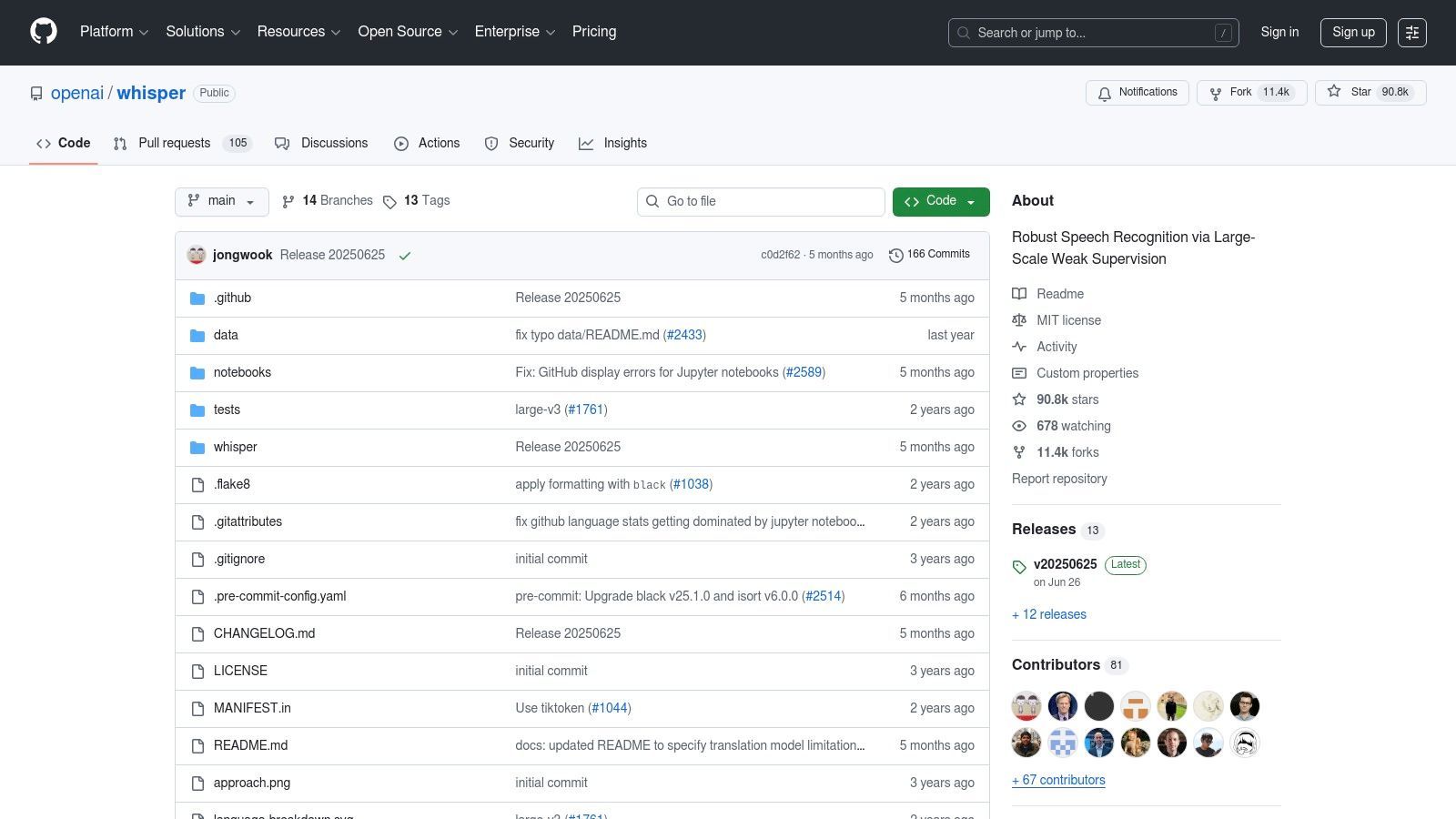
OpenAI Whisper isn't your typical click-and-go website; it's an open-source Automatic Speech Recognition (ASR) model that you run on your own machine. Hosted on GitHub, the project gives you all the code and pre-trained models needed to operate it locally or on a private server. This hands-on approach makes it some of the best free transcription software for anyone who puts data privacy first, as your audio files never leave your system. Whisper is widely praised for its exceptional accuracy, especially with English, and its robust multilingual support that easily rivals many paid services.
Key Features and User Experience
The main advantage here is flexibility. You can choose from multiple model sizes, from a "tiny" version for quick, less precise transcriptions on lower-powered hardware to the "large" model for state-of-the-art results that demand a serious GPU. You'll interact with it through a Command-Line Interface (CLI) or by weaving it into a Python script, which offers endless customization for automated workflows. Since OpenAI doesn't provide a graphical user interface (GUI), the experience is definitely geared toward the technically inclined. For a deeper look at what it can do, check out guides on AI audio transcription.
Setup and Requirements
- Access: Completely free (MIT license) via the official GitHub repository.
- Technical Skill: You'll need to be comfortable with Python and using the command line.
- Hardware: A modern computer can handle the smaller models, but a powerful GPU with plenty of VRAM is strongly recommended for the larger, more accurate models to get decent processing times.
- Pros:
- Totally free with no usage limits or fees.
- Top-tier accuracy and impressive multilingual capabilities.
- Runs locally, guaranteeing 100% data privacy.
- Cons:
- Steep learning curve for non-developers.
- Needs significant local computing power for the best performance.
- No official customer support or user-friendly interface.
2. whisper.cpp (ggml-org)
Best for: People who want fast, offline, and private transcription on everyday hardware like laptops and even edge devices. It’s perfect for those comfortable with a command line who want to run powerful transcription models without needing a high-end GPU.
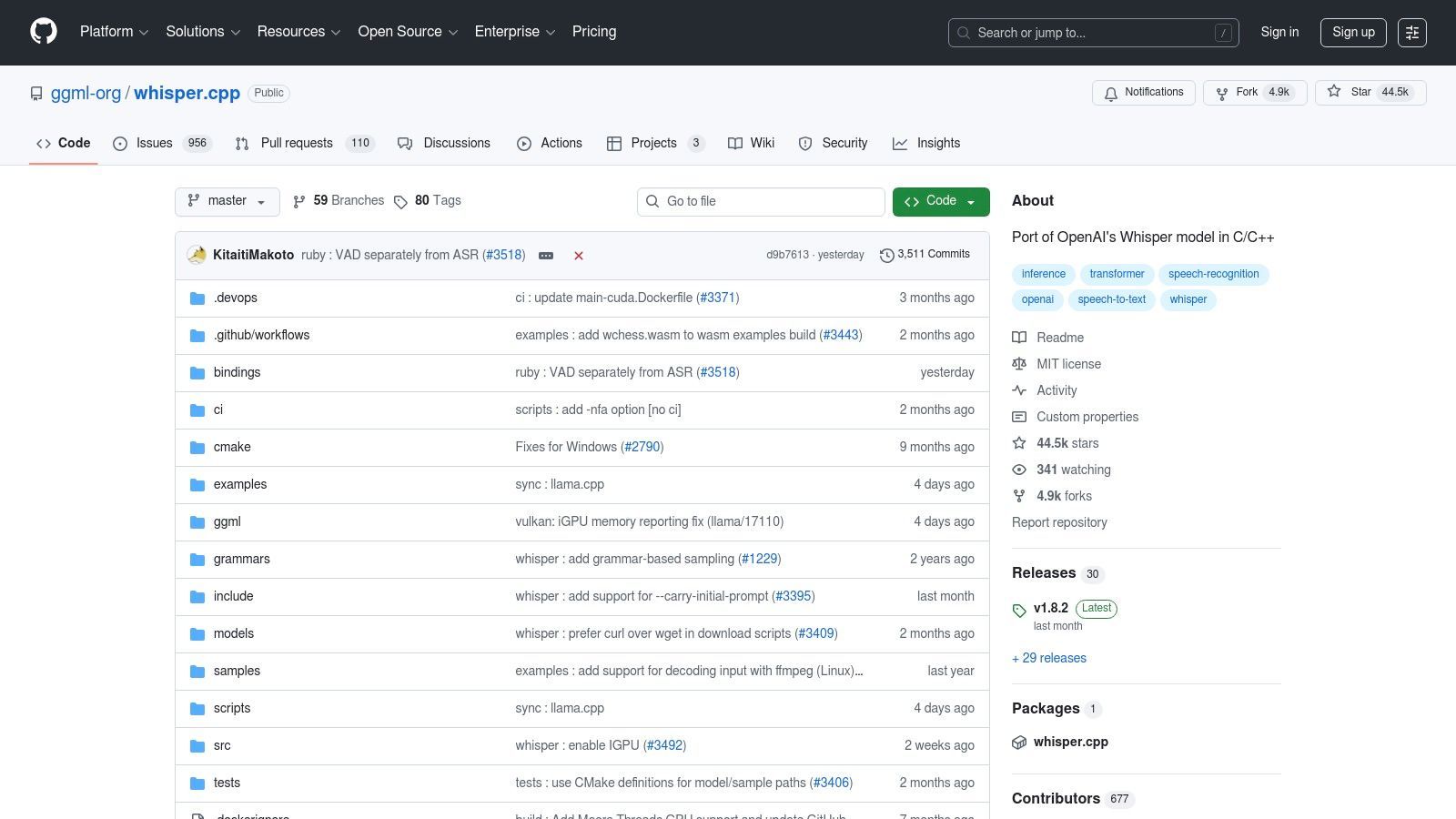
Just like its OpenAI cousin, whisper.cpp isn't a web service but a high-performance C/C++ port of the Whisper model. Hosted on GitHub, its entire reason for being is optimization. It's engineered to run incredibly fast on a wide array of hardware, including systems with limited resources, by using CPU-specific optimizations and smaller, "quantized" models. This makes it some of the best free transcription software for getting near-real-time performance locally, ensuring your audio data stays completely private. Its efficiency on Apple Silicon (M1/M2/M3) and other modern CPUs is a game-changer.
Key Features and User Experience
The user experience is built around a Command-Line Interface (CLI), which is straightforward for technical folks. The project's secret sauce is its quantized models, which are smaller and use less memory, allowing them to run smoothly on devices that would choke on the original Whisper models. It also comes with handy examples, like a real-time transcription tool that uses your computer's microphone, showing its potential for interactive apps. While there's no official graphical interface, its simplicity has inspired the community to build third-party GUIs for it.
Setup and Requirements
- Access: Completely free (MIT license) via the official GitHub repository.
- Technical Skill: Basic command-line know-how is necessary. Building from source might be needed on some platforms.
- Hardware: Runs efficiently on most modern CPUs. Performance is especially great on Apple Silicon and systems with AVX2 support. No powerful GPU is needed.
- Pros:
- Blazing fast performance on CPU, even on modest hardware.
- 100% offline and private, with no data ever leaving your machine.
- Quantized models offer a fantastic balance of speed, accuracy, and low resource use.
- Cons:
- It's a command-line tool, which can be intimidating for beginners.
- Finding and trusting a third-party GUI adds an extra step.
- Setup can involve more technical steps than just installing a piece of software.
3. Vosk Speech Recognition (alphacephei)
Best for: Developers and hobbyists building applications that need offline, real-time speech recognition on low-powered devices like a Raspberry Pi, mobile phones, or desktop apps. It's a top pick for privacy-focused, embedded projects.
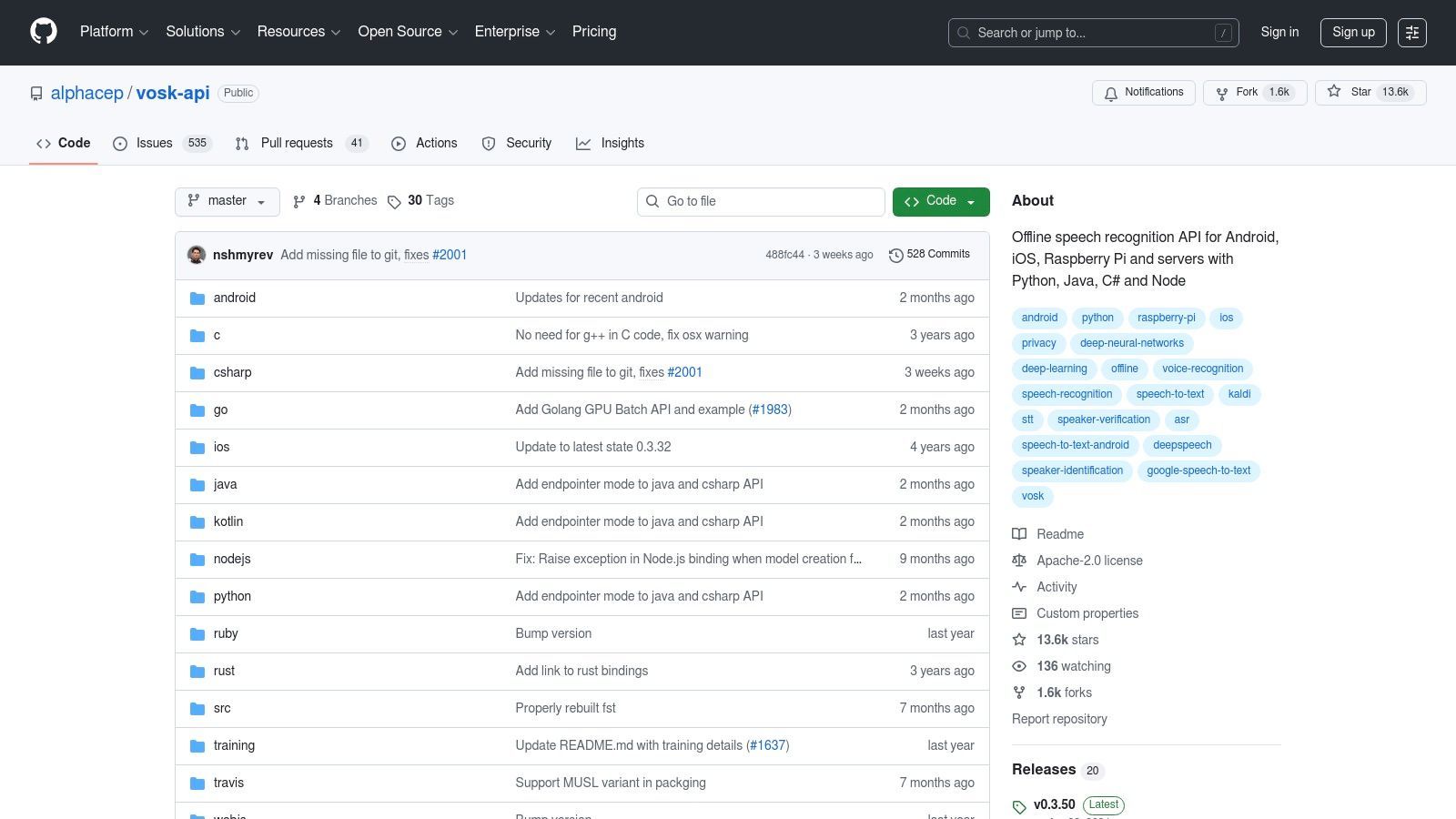
Similar to Whisper, Vosk is an open-source, offline speech recognition toolkit, not a web app. Hosted on GitHub, it specializes in providing lightweight yet powerful transcription capabilities that can run entirely on a local device without an internet connection. This makes it a fantastic example of the best free transcription software for projects where data privacy and resource efficiency are the top priorities. Vosk truly shines in its ability to operate on minimal hardware and offers a streaming API, making it perfect for real-time transcription in applications like voice assistants or live captioning.
Key Features and User Experience
Vosk's main appeal is how accessible it is for developers. It provides support for numerous programming languages, including Python, Java, C#, and Rust, which simplifies integrating it into existing projects. The models are tiny (often 50-200 MB), letting them be bundled within applications for a fully offline experience. The user experience is code-centric, meaning you have to implement the toolkit within your software. Its real-time streaming capability is a key feature, processing audio as it comes in rather than waiting for a whole file to finish. When evaluating different technical options, understanding how various tools function as an audio to text converter is crucial.
Setup and Requirements
- Access: Completely free (Apache 2.0 license) via the official GitHub repository.
- Technical Skill: Best for developers who are comfortable integrating APIs into software.
- Hardware: Extremely lightweight, capable of running on single-board computers like Raspberry Pi, standard desktops, and mobile devices.
- Pros:
- Works completely offline, guaranteeing total data privacy.
- Very low resource requirements, perfect for embedded systems.
- Excellent language support with small-footprint models.
- Cons:
- Transcription accuracy may not be as high as larger models like Whisper.
- Requires programming skills to use; no ready-to-use GUI.
- Setup and integration can be tricky for beginners.
4. Audacity + OpenVINO Whisper Transcription plugin
Best for: Audio editors, podcasters, and content creators who already live in Audacity and want a fully integrated, private, and free workflow for editing and transcribing audio within a single application.
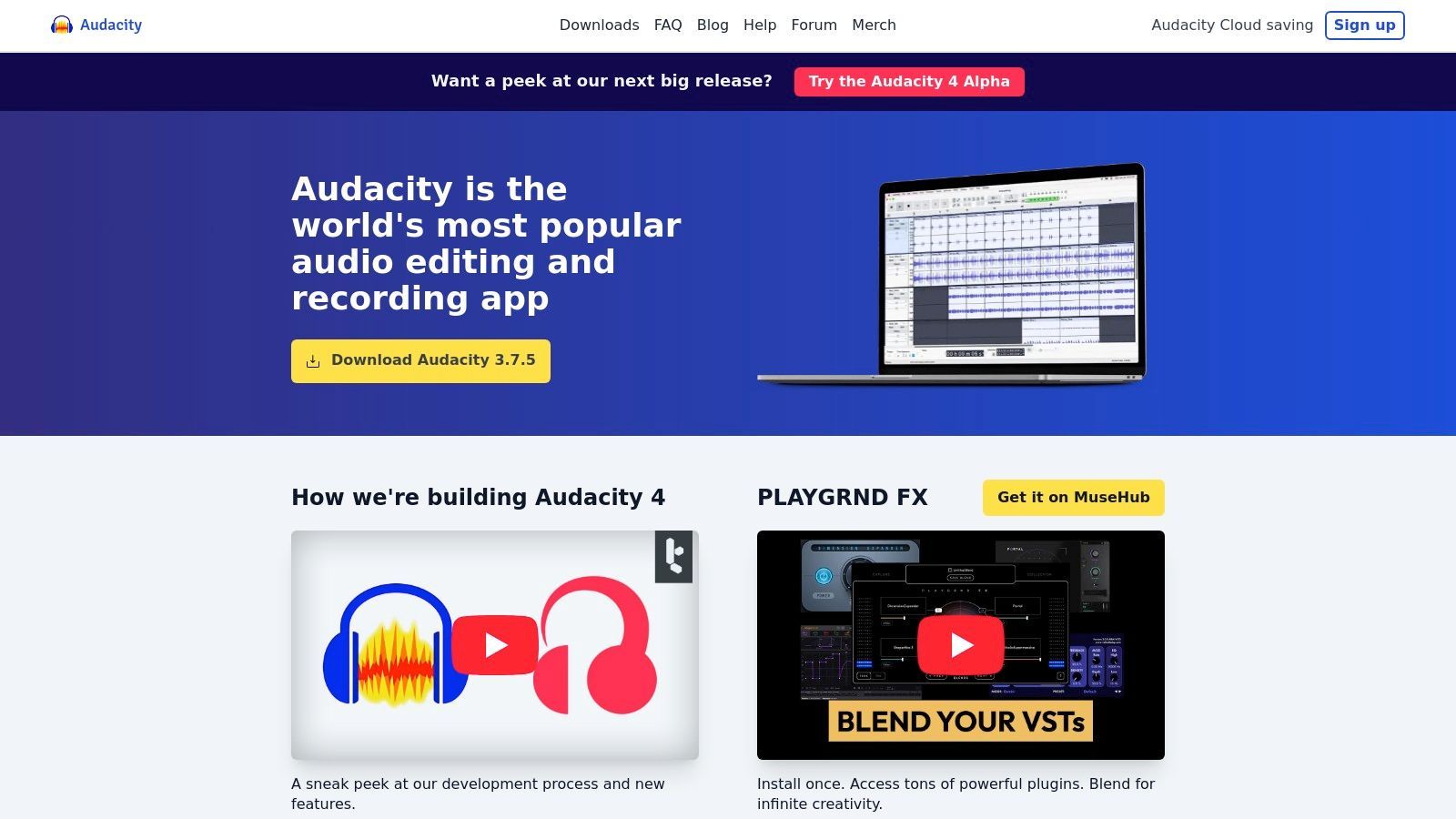
Audacity, the long-reigning champion of free audio editing, has evolved into a powerful transcription tool thanks to Intel's OpenVINO AI plugins. This combination lets you run a version of OpenAI's Whisper model directly inside the Audacity interface. This is a game-changer for anyone who needs to edit audio and generate subtitles or transcripts without ever sending their files to a third-party service, making it some of the best free transcription software for a self-contained production environment. The entire process happens locally on your computer, ensuring complete data privacy.
Key Features and User Experience
The biggest win here is workflow integration. Instead of exporting audio, transcribing it somewhere else, and re-importing the text, you can do it all in one place. The plugin generates a "label track" right on your Audacity timeline, which you can then edit and export as a standard caption file (like .srt). The user experience feels native to Audacity once you get through the initial setup. It also unlocks other AI-powered effects like noise suppression and music separation, all powered by OpenVINO for optimized performance on modern CPUs.
Setup and Requirements
- Access: Completely free. Download Audacity from the official website and then install the free OpenVINO plugins separately.
- Technical Skill: It requires a one-time plugin installation, which might involve a few extra steps compared to web tools but is well-documented.
- Hardware: Runs on Mac, Windows, and Linux. Performance is best on newer CPUs, especially those with hardware acceleration or Intel optimization.
- Pros:
- A truly free end-to-end workflow: edit, transcribe, and export in one app.
- 100% private and offline processing right on your local machine.
- Cross-platform support and access to other useful AI audio effects.
- Cons:
- The initial plugin installation and setup can be a hurdle for non-technical users.
- Transcription speed and accuracy depend entirely on your local hardware.
- Not as dead simple as a drag-and-drop web service.
5. Subtitle Edit
Best for: Video editors, content creators, and professionals who need a powerful, free tool to create, edit, and time-align subtitles with built-in automatic transcription.
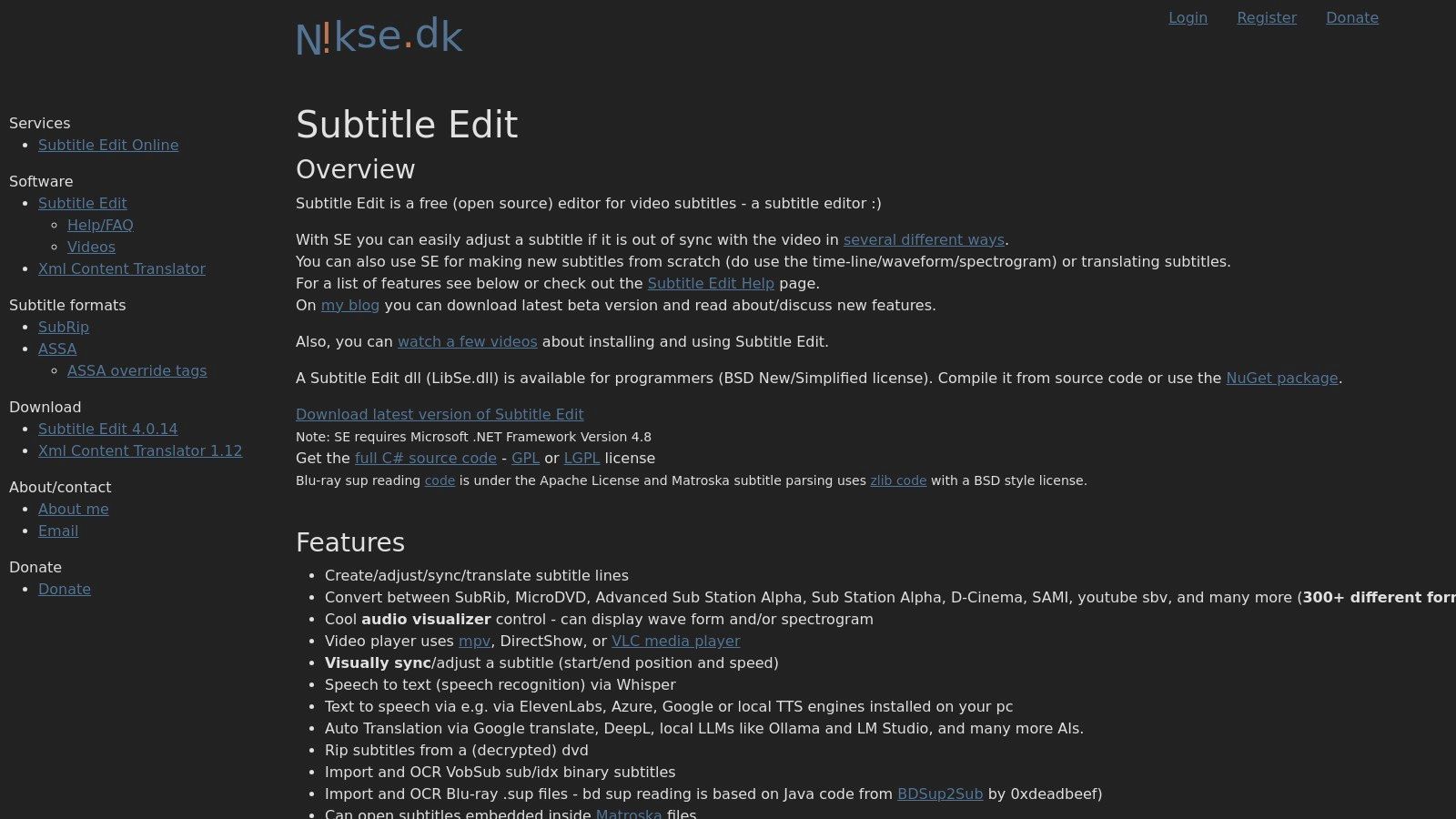
Subtitle Edit isn't a web service; it's a comprehensive, open-source desktop application for Windows and Linux. While its main job is professional-grade subtitle creation and editing, it has evolved to include powerful speech-to-text features. By integrating with engines like Whisper and Vosk, it transforms from a manual editor into some of the best free transcription software for video-focused workflows. This allows you to auto-generate a transcript and then use the software's advanced tools to perfect the timing, formatting, and accuracy directly on a video timeline.
Key Features and User Experience
The software stands out with its feature-packed environment designed for precision. You can visualize the audio via a waveform and spectrogram, making it easy to adjust subtitle start and end times with frame-level accuracy. It supports over 250 subtitle formats, ensuring compatibility with virtually any platform or player. The user interface is dense but functional, giving you all the tools you need for tasks from simple timing tweaks to complex batch conversions and quality checks. For those looking to streamline their post-production, this guide on video transcription for subtitles offers valuable insights.
Setup and Requirements
- Access: Completely free (GPL license) from the official Nikse.dk website.
- Technical Skill: Basic computer skills are enough for simple edits, but using the integrated ASR requires downloading and setting up models like Whisper.
- Hardware: Runs on most modern Windows or Linux machines. A more powerful CPU will significantly speed up the transcription process.
- Pros:
- Professional-grade subtitle editing tools at no cost.
- Direct integration with powerful, local ASR engines ensures privacy.
- Extensive format support and powerful batch-processing features.
- Cons:
- Desktop-only software, with no cloud or collaborative features.
- The initial setup for automatic transcription can be a bit technical.
- The interface can feel overwhelming for newcomers.
6. Google Docs Voice Typing
Best for: Anyone needing a quick, no-setup solution for live dictation, drafting documents, and transcribing short audio clips right inside their word processor. It's perfect for students, writers, and professionals already in the Google Workspace ecosystem.
Google Docs Voice Typing isn't a separate app but a powerful feature baked directly into Google's word processor. This easy access makes it one of the most convenient and best free transcription software options for anyone with a Google account and a microphone. It turns your document into a live transcription canvas, capturing your speech in real-time. While it's mainly designed for dictation, you can use it to transcribe audio played through your computer’s speakers, offering a simple workaround for pre-recorded files without installing any software.
Key Features and User Experience
The user experience is incredibly simple: open a document, go to Tools > Voice typing, and click the microphone icon to start talking. The tool supports numerous voice commands for punctuation and formatting like "period," "new line," or "comma," which helps streamline the dictation process. Since the text appears directly in the document, editing and sharing are a breeze, leveraging the full collaborative power of Google Docs. Its performance is impressive for a free, built-in tool, although it lacks advanced features like speaker identification or timestamping. To see how it stacks up against other mobile options, you can check out these AI transcription apps.
Setup and Requirements
- Access: Completely free with a Google account via Google Docs.
- Technical Skill: None. It's a simple point-and-click feature.
- Hardware: A computer with a modern web browser (it works best in Chrome) and a working microphone.
- Pros:
- Zero cost and instantly accessible within Google Docs.
- Excellent for live dictation and drafting documents hands-free.
- Seamless integration with Google Drive for easy storage and collaboration.
- Cons:
- Not designed for directly transcribing pre-recorded audio files.
- Accuracy heavily depends on microphone quality and background noise.
- Lacks advanced features like speaker labels and automatic timestamps.
7. Live Transcribe (Android)
Best for: Android users who need instant, on-the-go captions for live conversations, especially for accessibility or quick note-taking in meetings and lectures. It shines in real-time performance rather than file-based transcription.
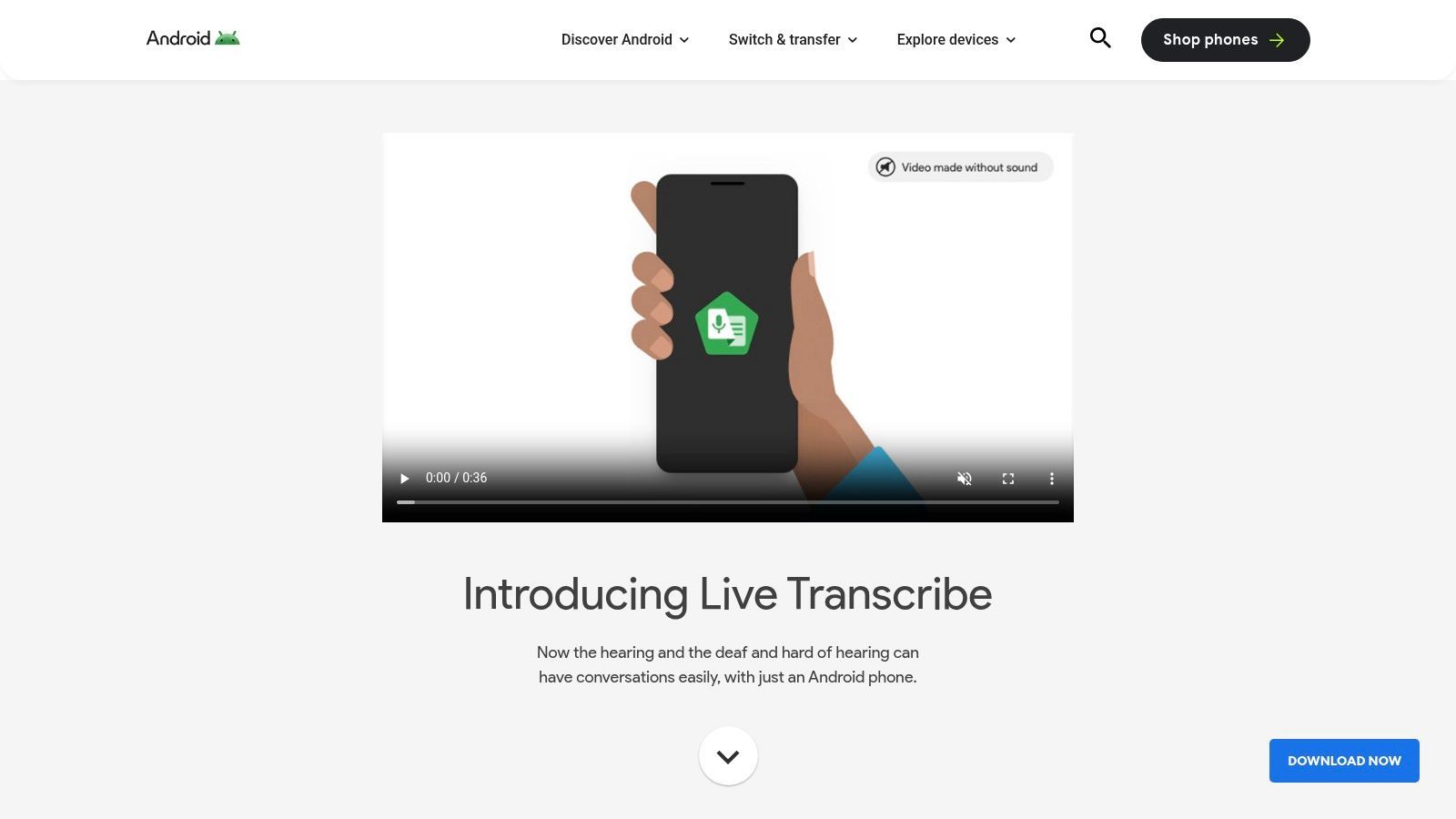
Live Transcribe is a free, accessibility-focused app from Google that turns your Android phone into a powerful real-time transcription device. Instead of uploading audio files, it's designed to listen to the world around you and provide instant captions. This makes it an invaluable tool for the deaf and hard-of-hearing community, but its usefulness extends to anyone who needs to capture spoken words in live settings. Its on-device processing and support for over 70 languages make it some of the best free transcription software for immediate, in-person situations where privacy and speed are key.
Key Features and User Experience
The user experience couldn't be simpler: open the app, and it starts listening. The interface is clean and minimal, focusing entirely on displaying the transcribed text in large, readable fonts. It’s designed for simplicity and immediate use without a complicated setup. While not built for processing pre-recorded audio files, its real-time accuracy is impressive for a mobile app. Transcripts can be saved locally on your device for up to three days, allowing you to copy and paste the text into other applications for later use.
Setup and Requirements
- Access: Completely free on the Google Play Store for devices running Android 5.0 and later.
- Technical Skill: None required. It's an intuitive app designed for everyone.
- Hardware: A compatible Android smartphone or tablet is all you need.
- Pros:
- Excellent real-time transcription for live conversations.
- Completely free with no hidden costs or limits.
- Simple, user-friendly interface perfect for accessibility.
- Strong multilingual support.
- Cons:
- Exclusive to the Android platform; no iOS or web version.
- Not designed for uploading and transcribing audio/video files.
- Transcript saving is temporary (up to 3 days).
8. Recorder by Google (Pixel) / recorder.google.com
Best for: Google Pixel users who need highly accurate, real-time, on-device transcription for interviews, lectures, and meetings, with the bonus of cloud backup and web access.
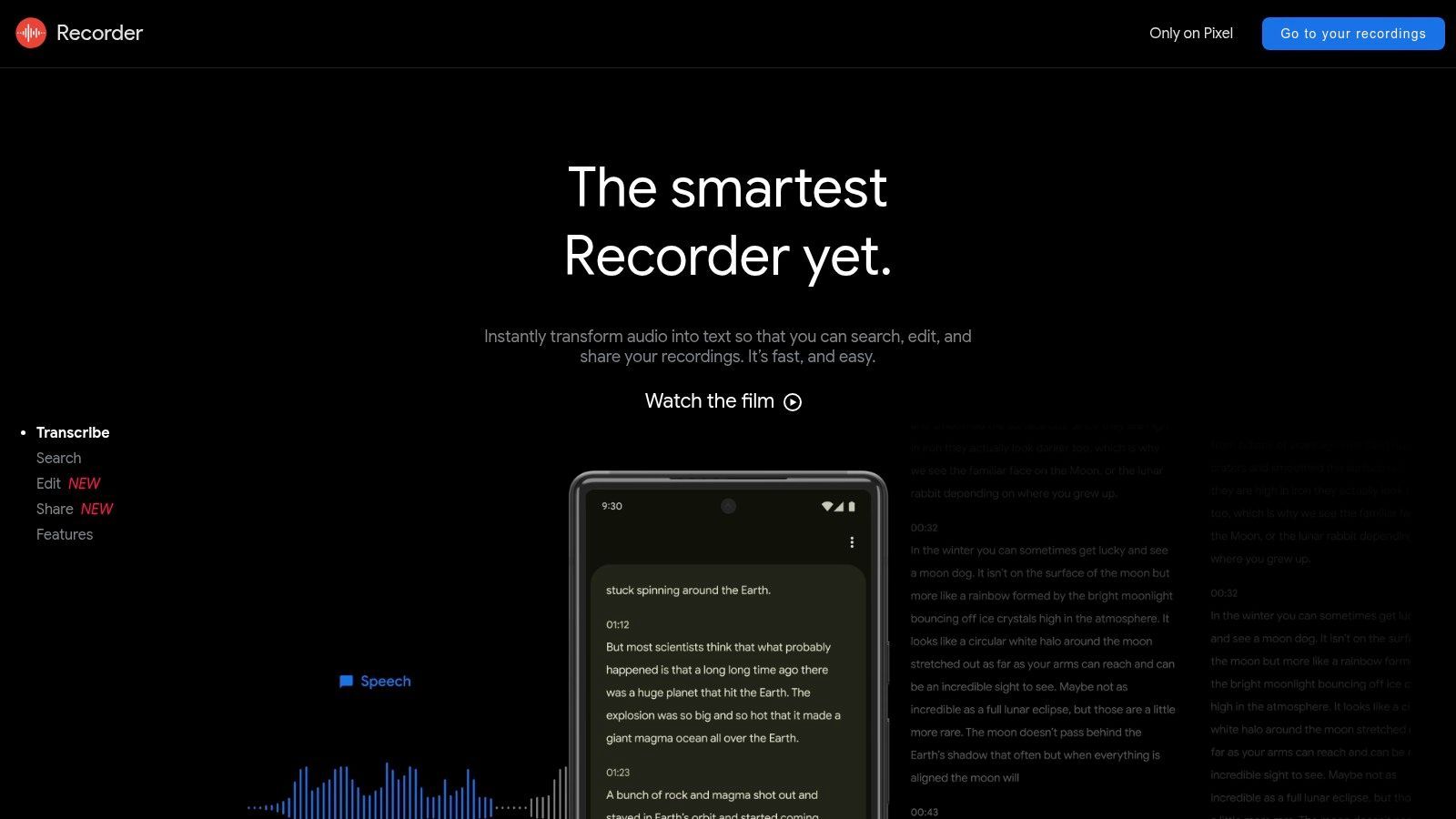
Recorder is a native app exclusive to Google's Pixel phones that offers a seamless recording and transcription experience. It transcribes live and offline, directly on the device, making it an incredibly private and convenient tool for capturing audio on the go. While the recording happens on the phone, the real magic for desktop users is its web interface, recorder.google.com. Here, recordings and their transcripts are automatically synced and backed up, giving you an easy way to access, review, edit, and export your content from any computer. This unique mobile-first, cloud-synced approach makes it some of the best free transcription software out there—if you're in the Pixel ecosystem.
Key Features and User Experience
The user experience is incredibly simple and integrated. You hit record on your phone, and the app transcribes in real time. The transcript becomes instantly searchable, letting you find specific moments in your audio. Advanced features on newer Pixel models, like automatic summarization and speaker labels, add a ton of value. The web platform extends this simplicity, presenting a clean list of your recordings. From there, you can play the audio with synchronized text highlighting, edit the transcript for accuracy, and export the text to Google Docs or a standard .txt file, making it a powerful workflow for students, journalists, and professionals.
Setup and Requirements
- Access: Free, but you need a Google Pixel phone to record. The web portal is accessible at https://recorder.google.com with a Google account.
- Technical Skill: Minimal. The app and website are both extremely intuitive.
- Hardware: A compatible Google Pixel smartphone. Feature availability varies by Pixel model.
- Pros:
- Completely free with high-quality, on-device transcription.
- Secure local processing ensures privacy during recording.
- Convenient cloud sync and backup to a user-friendly web interface.
- Cons:
- Exclusively available on Google Pixel phones.
- Users sometimes report minor syncing issues between the phone and the web.
- Lacks advanced features like custom vocabulary or extensive file import options.
9. Speechnotes
Best for: Anyone needing a quick, browser-based notepad for live dictation, like drafting emails, taking notes, or writing content without typing. It's a go-to for instant speech-to-text in a simple interface.
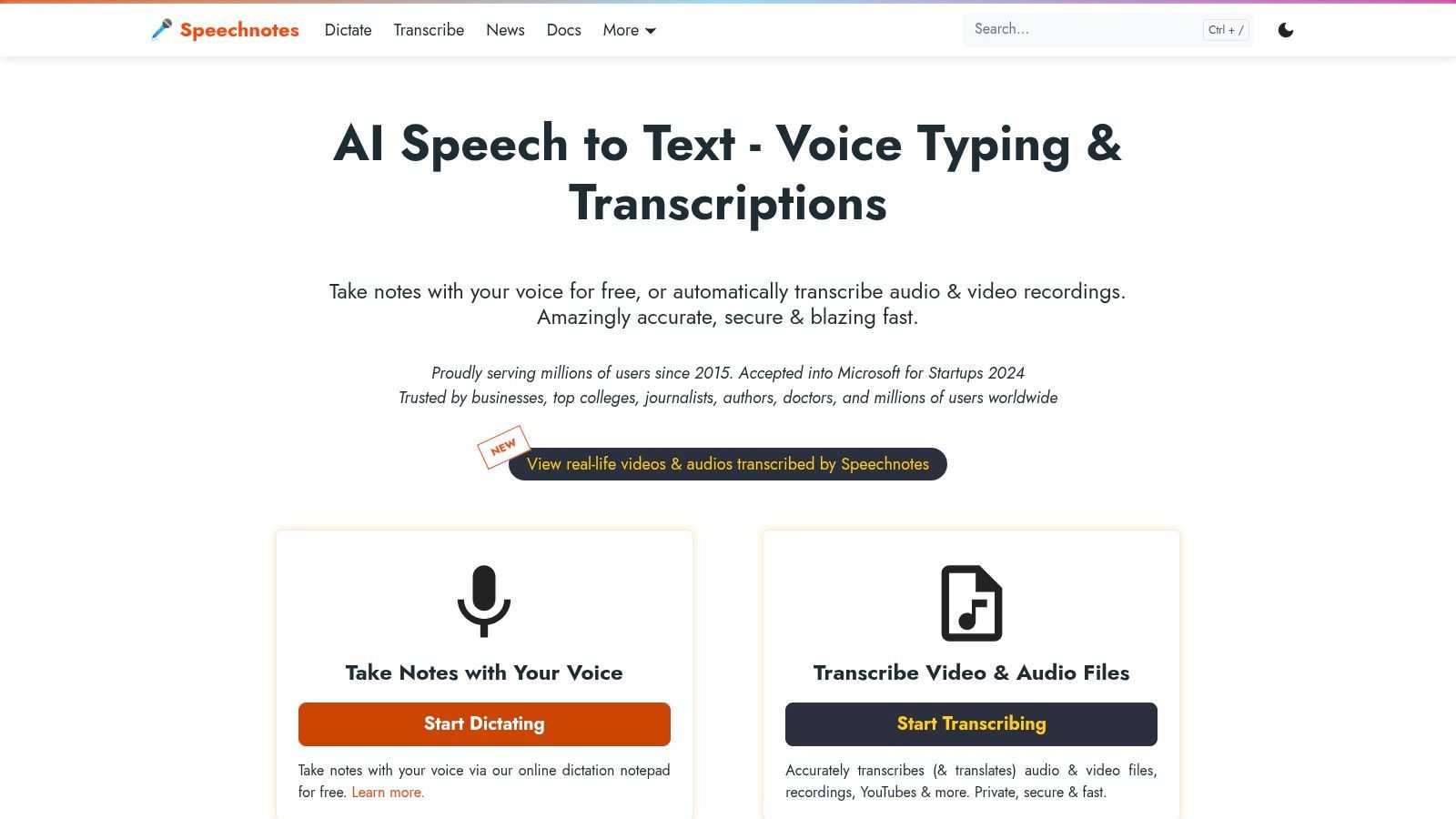
Speechnotes operates mainly as a web-based dictation tool, turning your browser into a powerful voice-activated notepad. While many tools focus on transcribing existing audio files, Speechnotes excels at capturing your spoken thoughts in real-time, directly into a clean, editable text area. This makes it some of the best free transcription software for users who prioritize live dictation over processing files. Its core dictation feature is completely free and unlimited, offering a frictionless way to convert speech to text on the fly.
Key Features and User Experience
The user experience is dead simple: open the website, click the microphone icon, and start talking. The text appears instantly. The platform uses Google's speech recognition engine, ensuring high accuracy for many languages. While live dictation is its main free feature, Speechnotes also offers a paid service for transcribing uploaded audio and video files with competitive per-minute pricing. For a productivity boost, it offers a Chrome extension for easy access from any tab.
Setup and Requirements
- Access: The live dictation notepad is free to use directly on the official Speechnotes website. File transcription is a paid, optional service.
- Technical Skill: None required. It's one of the most user-friendly tools you can find.
- Hardware: A computer with a modern web browser (Chrome is recommended) and a working microphone.
- Pros:
- Completely free and unlimited for live dictation.
- Extremely simple and intuitive interface, no signup needed to get started.
- Convenient for quick notes, drafting, and hands-free typing.
- Cons:
- Transcription of existing audio/video files is a paid feature, not free.
- Requires a constant internet connection to work.
- Lacks advanced features like speaker identification in its free version.
10. oTranscribe
Best for: Students, journalists, academics, and anyone who needs to manually transcribe audio or clean up an AI-generated transcript. It excels at making the painful process of typing out audio as efficient and private as possible.
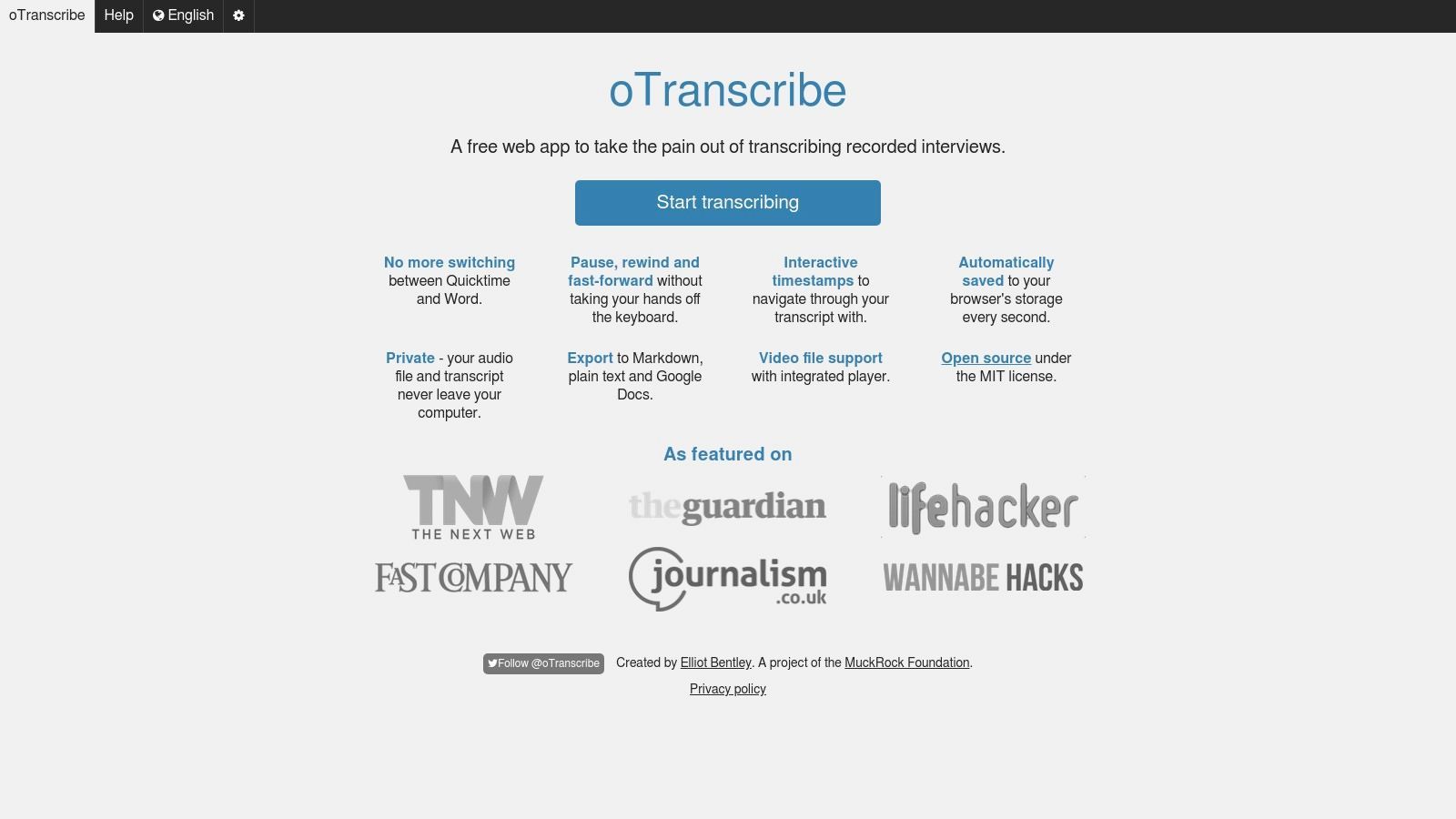
oTranscribe isn't an automatic transcription tool; it's a brilliant free web app designed to make manual transcription easier. It ingeniously combines a text editor and an audio/video player into a single browser window, so you don't have to constantly switch between apps. This makes it some of the best free transcription software for tasks that need human precision, like editing machine-generated drafts or transcribing sensitive interviews where privacy is key. Since your files are processed locally in your browser and never uploaded to a server, you keep complete control over your data.
Key Features and User Experience
The user experience is all about efficiency. Interactive keyboard shortcuts let you play, pause, rewind, and fast-forward the audio without ever taking your hands off the keyboard. You can also insert timestamps with a simple command, making it easy to reference specific points in the audio later. The app auto-saves your work to your browser's storage, preventing you from losing work if you accidentally close the tab. It handles local audio/video files and can even load content directly from a YouTube URL, offering great flexibility.
Setup and Requirements
- Access: Completely free and open-source, accessible directly at otranscribe.com.
- Technical Skill: None required. The interface is intuitive and ready to use immediately.
- Hardware: Any computer with a modern web browser will do.
- Pros:
- 100% free with no ads or limitations.
- Excellent for proofreading and detailed manual transcription.
- Extremely privacy-friendly since files stay on your local device.
- Simple, clean interface with powerful keyboard shortcuts.
- Cons:
- No automatic speech-to-text functionality.
- Not suitable for generating transcripts from scratch quickly or for bulk processing.
11. YouTube Automatic Captions (Show transcript)
Best for: Students, researchers, and casual users who need a quick, no-cost transcript from public videos like lectures, interviews, and news reports already on the platform.
While not a dedicated transcription service, YouTube has a built-in feature that makes it a surprisingly effective tool for getting quick text from videos. For many uploaded videos, YouTube automatically generates captions using its own speech recognition tech. Viewers can access this text through the "Show transcript" option, which presents a full, time-stamped script that is easy to search, read, and copy. This makes it one of the most accessible and best free transcription software options for content already hosted on the platform, requiring zero setup or software.
Key Features and User Experience
The user experience is incredibly straightforward. If a transcript is available, you can open it with a few clicks right on the video page. The transcript appears alongside the video, with clickable timestamps that jump you to that exact point in the playback. This interactivity is perfect for finding key moments in a long video. You can easily highlight and copy the entire text to use in another document, though formatting and speaker labels will be missing. Content creators can find more tips in this content creator transcription guide.
Setup and Requirements
- Access: Completely free. Just go to any video on and look for the "Show transcript" option in the video's description menu.
- Technical Skill: None needed. It's a built-in feature for viewers.
- Requirements: A web browser or the YouTube mobile app. Transcript availability depends on the creator's settings and YouTube's processing.
- Pros:
- Entirely free and instantly accessible with no software needed.
- Excellent for quickly transcribing public lectures, talks, and podcasts.
- Interactive, time-stamped text makes navigation easy.
- Cons:
- Accuracy can be highly variable depending on the audio quality.
- Creators can disable the feature for their videos.
- Only works for videos already uploaded to YouTube.
12. Tactiq – Free YouTube Transcript Generator
Best for: Content creators, students, and researchers who need to quickly grab and save the closed captions from a YouTube video without signing up or downloading any software.
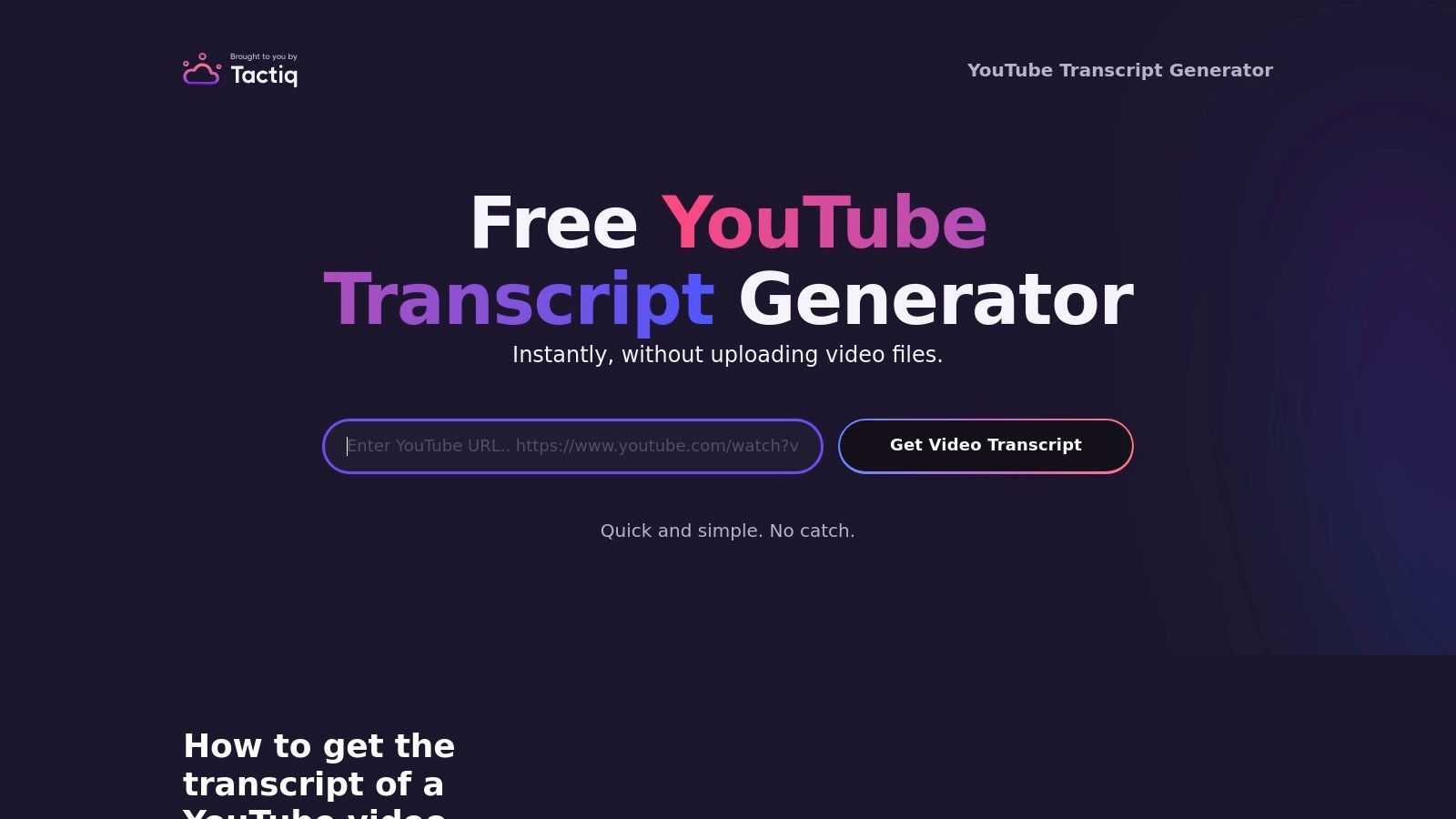
Tactiq offers one of the simplest and most direct solutions for a very specific job: grabbing a transcript from a YouTube video. It’s not a traditional audio-to-text converter; instead, it's a web-based tool that extracts the existing closed captions generated by YouTube. This makes it an incredibly fast and efficient way to get a written record of a video, perfect for pulling quotes, creating notes from lectures, or repurposing video content into blog posts. While its focus is narrow, its performance as a YouTube transcript extractor makes it a noteworthy piece of best free transcription software for this specific use case.
Key Features and User Experience
The user experience is all about simplicity. You just paste a YouTube URL into a single field on the webpage and click a button. The tool immediately fetches and displays the full transcript, complete with timestamps. There are no uploads, no processing queues, and no accounts required for this basic function. From there, you can easily copy the text to your clipboard or download it as a .txt file. While the core tool is web-based, Tactiq also offers a Chrome extension for transcribing live meetings in Google Meet and Zoom, which shows their broader focus on productivity.
Setup and Requirements
- Access: Completely free for the YouTube tool via the official Tactiq website. No account is needed.
- Technical Skill: None. It's as simple as copy-and-paste.
- Hardware: Any device with a web browser.
- Pros:
- Instantaneous results with no waiting.
- Extremely easy to use, no signup required.
- Perfect for quickly getting text from YouTube content that already has captions.
- Cons:
- Only works with YouTube videos that have captions enabled.
- Cannot transcribe local audio or video files.
- Transcript accuracy depends entirely on YouTube's auto-captioning quality.
Top 12 Free Transcription Tools Comparison
| Solution | Core features | Quality ★ | Price/Value 💰 | Target audience 👥 | Unique strengths ✨ |
|---|---|---|---|---|---|
| OpenAI Whisper (GitHub) | Open-source ASR, multi-model sizes, translation, local batch use | ★★★★★ | 💰 Free (MIT) — no per-minute fees | 👥 Developers, researchers, privacy-first teams | ✨ High multilingual accuracy; flexible speed/accuracy trade-offs |
| whisper.cpp (ggml-org) | C/C++ port, quantized models, real-time mic, hardware optimizations | ★★★★ | 💰 Free | 👥 Edge developers, laptop/Apple Silicon users | ✨ Extremely fast CPU inference; low-RAM quantized models |
| Vosk Speech Recognition | Offline streaming API, small models, many language bindings | ★★★ | 💰 Free | 👥 Embedded/mobile/IoT developers | ✨ Lightweight multilingual models; broad language SDKs |
| Audacity + OpenVINO plugin | On-device Whisper transcription inside audio editor; export labels/SRT | ★★★★ | 💰 Free | 👥 Podcasters, audio editors, privacy-focused creators | ✨ Edit + transcribe + AI audio effects in one local workflow |
| Subtitle Edit | Pro subtitle editor, waveform/spectrogram, integrated Whisper/Vosk STT | ★★★★ | 💰 Free | 👥 Captioners, video editors, localization teams | ✨ 250+ formats, timing/QA tools, batch processing |
| Google Docs Voice Typing | Browser live voice typing + commands, Drive integration | ★★★ | 💰 Free | 👥 Writers, note-takers, Workspace users | ✨ Seamless real-time dictation inside Google Docs |
| Live Transcribe (Android) | Real-time on-device captions in 70+ languages, privacy-minded | ★★★★ | 💰 Free | 👥 Accessibility users, conversational note-takers | ✨ Instant live captions optimized for conversations |
| Recorder by Google (Pixel) | On-device live transcription, web sync, export/search, summaries | ★★★★ | 💰 Free (Pixel-only) | 👥 Pixel users, journalists, students | ✨ Offline transcription + searchable synced transcripts |
| Speechnotes | Web dictation notepad, Chrome extension, optional paid uploads/API | ★★★ | 💰 💰 Free live; low-cost uploads | 👥 Note-takers, journalists, automation users | ✨ Unlimited live dictation + Zapier/API integrations |
| oTranscribe | Browser media player + editor with hotkeys, auto-save, local files | ★★ (manual) | 💰 Free | 👥 Manual transcribers, researchers, privacy-focused users | ✨ Keyboard-driven local workflow — no uploads required |
| YouTube Automatic Captions | Auto-generated captions + "Show transcript" with timestamps | ★★ | 💰 Free | 👥 Viewers, content researchers, creators | ✨ Instant transcript extraction for public videos |
| Tactiq – YouTube Transcript Generator | Paste YouTube URL → instant transcript view/download, Chrome ext. | ★★ | 💰 Free (basic) | 👥 Content researchers, quick-extract users | ✨ One-step transcript extraction when YouTube UI is hidden |
Beyond Free: When to Upgrade to a Professional Tool like WhisperAI
The world of transcription has been completely reshaped by powerful, free tools. As we've seen, options ranging from the technical muscle of OpenAI's Whisper on GitHub to the user-friendly interfaces of Google Docs have made accurate transcription more accessible than ever. For many jobs, like transcribing personal notes, generating simple subtitles with Subtitle Edit, or capturing the gist of a short meeting, these solutions are more than enough.
However, the "free" in "best free transcription software" often comes with hidden costs. These costs aren't in dollars but in your time, your computer's processing power, and sometimes, frustrating limitations. The journey from a casual user to a professional who relies on transcription often reveals the ceiling of these free options.
The Tipping Point: Recognizing the Limits of Free
You'll know it's time to consider a paid, professional service when you consistently run into the same roadblocks. These are the tell-tale signs that your needs have outgrown what free tools can efficiently provide.
- Time and Processing Power: Are you spending hours troubleshooting installations of local models like Whisper or Vosk? Do you find your computer's fans screaming at maximum speed for ages while it processes a single audio file? Professional services offload this heavy lifting to dedicated, optimized cloud servers, returning transcripts in minutes, not hours.
- Accuracy and Nuance: While the accuracy of models like Whisper is phenomenal, getting top-tier results requires careful audio prep and tweaking settings. Furthermore, critical features like speaker diarization (figuring out who is speaking) and precise timestamps are often missing or basic in free tools. For legal depositions, interviews with multiple people, or clinical documentation, these features are non-negotiable.
- Scale and Volume: Free tools often have strict limits on file size or duration. If your workflow involves transcribing hours of audio daily—like a podcast backlog, university lectures, or corporate archives—hitting these limits becomes a major bottleneck. Paid platforms are built for high-volume work and offer robust APIs for automation.
- Collaboration and Workflow Integration: A transcript is rarely the final product; it's a piece of a larger puzzle. Professional services offer collaborative workspaces, secure sharing, and integrations with other platforms (like video editors or data analysis tools). This creates a seamless workflow that free, standalone tools just can't match. For those ready to invest in a full suite of AI capabilities, exploring other best AI tools for content creation can further streamline your workflow.
- Security and Compliance: For industries like healthcare (HIPAA), legal, and finance, data security and privacy are paramount. Handling sensitive information on free, consumer-grade platforms or locally managed systems can pose huge compliance risks. Enterprise-grade services provide the security protocols, data processing agreements (DPAs), and support needed to operate securely.
Making the Strategic Upgrade
Choosing the right tool is about matching its capabilities with your goals. A podcaster's needs are vastly different from a legal paralegal's, just as a researcher's requirements are distinct from a business executive's. Start by using the free tools we've outlined here to understand your own workflow. Pinpoint where you lose the most time and which features you wish you had.
This hands-on experience will give you the knowledge to make an informed decision when you're ready to invest. The goal isn't just to get a transcript; it's to unlock the value within your audio data efficiently, accurately, and securely. Upgrading isn't an expense—it's a strategic investment in productivity and precision.
Ready to move beyond the limitations of free tools and experience enterprise-grade transcription? WhisperAI leverages the power of OpenAI's Whisper model in a secure, scalable, and user-friendly platform, offering advanced features like speaker diarization and unmatched accuracy. Start transcribing with professional precision today at WhisperAI.